2015 Commemoration of the 1848 Hungarian Revolution and War of Liberation: The American Hungarian Federation – Founded 1906
3/17/2017 – The American Hungarian Federation’s annual commemoration of Hungarian National Day and the anniversary of its historic 1848 democratic revolution led by Louis Kossuth for 2017 was held at the Hungarian Embassy in Washington, DC. In keeping with tradition, the Hungarian Scouts of Washington led the audience in patriotic performance and song. The keynote addresses were provided by Deputy State Secretary Dr. Péter Szilágyi and AHF Chairman Frank Koszorus, Jr.
Today, there are many reminders of Kossuth’s impact on America and the
world. In North America, there is a Kossuth County in the state of Iowa,
a town with his name in Indiana, Ohio and Mississippi,
a settlement with a Kossuth Post Office is in Pennsylvania. In addition,
there are Kossuth statues and plaques in New York, Cleveland, Akron, New
Orleans, Washington, and Ontario, Canada. The Hungarian
Reformed Federation‘s building on Dupont Circle, in Washington, DC
is called Kossuth House with a memorial plaque commemorating his speech
on democracy. See the picture gallery and memorials on Louis
Kossuth in North America.
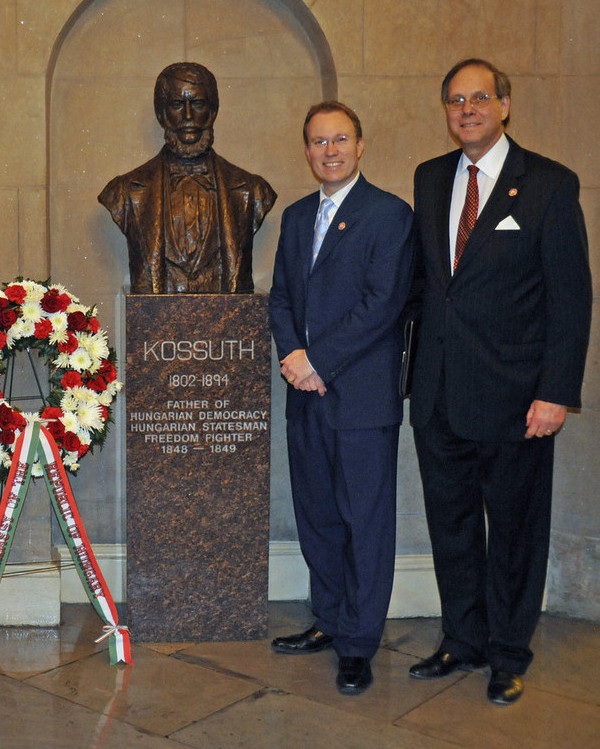
AHF presents a gift to to the American People: The Kossuth Bust in the US Capitol [read more]
Mr. Koszorus remarks are below and available for [download]:
Is Commemorating Kossuth Relevant At All? On the occasion of the American Hungarian Federation’s and co-sponsoring organization’s commemoration of March 15, 1848 hosted by the Embassy of Hungary
Washington, D.C. March 11, 2017
Your Excellency, Mr. Deputy State Secretary, Distinguished Guests, Dear Friends:
We come to the part of the program when we switch to English so that those who are not completely fluent in Hungarian can participate in our commemoration of Hungary’s democratic revolution and war independence of 1848 – 1849.
I would like to thank Ambassador Szemerkenyi for hosting this wonderful and timely event. I also thank you my fellow Hungarian Americans for joining us this afternoon as this community and the American Hungarian Federation have done so for decades to commemorate this singularly important period of Hungary’s history. By participating you are continuing a tradition that extends back to Lajos Kossuth’s highly acclaimed trip to the United States from December 4, 1851 until July 14, 1852.
Kossuth was only the second non-American to address the United States Senate and the House of Representatives, the first being the Marquis de Lafayette.
From the moment he set foot on American soil, Kossuth was enthusiastically received. His reception in New York was only equaled by the reception that had earlier greeted George Washington and Lafayette.
During his extended tour of the United States, Kossuth delivered more than 300 public addresses and lectures, including his famous speech in which he stated, “All for the people and all by the people. Nothing about the people without the people. That is Democracy, and that is the ruling tendency of the spirit of our age.” These words were uttered by Kossuth over a decade before President Abraham Lincoln’s famed “for the people, by the people” speech given at Gettysburg in 1863.
Lincoln, who met with Kossuth, eloquently referred to Kossuth, as the “most worthy and distinguished representative of the cause of civil and religious liberty on the continent of Europe.”
The other day someone tried to convince me that commemorating the Ides of March had somehow lost its luster and relevance as Hungary is now a free and independent country. Are Kossuth and Hungary’s noble quest for freedom really less relevant today?
I respectfully and vigorously have to say “no” for three reasons. First, Kossuth and Hungary’s cause stood for the universal principles of freedom and democracy. These principles are as relevant to us as they were for the generations living in the 19th century; we must jealously guard them.
Second, Kossuth inextricably ties Hungary and the United States together – his trip to the United States is part of the history of both countries and served to strengthen the emotional and historical ties of the two nations. As Hungarian Americans it is incumbent upon us to know this history and pass it on to our children so that these ties are never weakened.
Finally, Kossuth is a remarkable example for us to follow. Remember Lincoln’s words, “most worthy and distinguished representative of the cause of civil and religious liberty.”
We still have unresolved issues to address, as democracy has not yet grown strong roots everywhere in Central and Eastern Europe. Indeed, intolerance toward religious and national minorities shamefully and surprisingly still flourishes in some places.
And this is where Kossuth’s championing liberty and democracy comes into play. We can, we must follow his example; we can, we must educate the public in our communities about these critically important matters. We can, we must educate to dispel faulty information about Hungary and Hungarian history; we can, we must vigorously support policies that will promote democracy and minority rights.
The legacy of Kossuth and Hungary of 1848-49 is indeed relevant today!
Now this is where I would normally end my presentation. But there is another theme I would like to mention in view of the diaspora meeting for which we are grateful to Amb. Szemerkenyi.
Considering our dwindling community and the seemingly insurmountable obstacle we often face, we can only hope to live up to the legacy of Kossuth and the freedom fighters if with a sense of humility and selfless service we strive for far greater unity when confronting mutual challenges. And we should not lose sight of the fact that the recognition of the benefits of greater unity coupled with the commitment to take affirmative acts to achieve unity must come from within us.
Unfortunately, there are times we don’t always act in a unified manner and this, whether we admit it or not, harms our otherwise good works and what we are trying to accomplish. Some, for example, carry around real or imagined grievances that prevent them from working with others and weaken much-needed initiatives.
Let me now close with two quotations on the value of unity – one a profound quotation and another a humorously incisive one:
“Behold they are one people, and they all have the same language. And this is what they began to do, and now nothing which they propose to do will be impossible for them.” Genesis 11:6
“The Destiny of Man is to unite, not to divide. If you keep on dividing you end up as a collection of monkeys throwing nuts at each other out of separate trees.” T.H. White
Do we choose to do the impossible or do we throw nuts? The answer is quite obvious even if we only want to honor the legacy of Kossuth and the freedom fighters with deeds and not just words.
The following excerpt is courtesy the Hungary Initiatives Foundation:
The Embassy of Hungary and the Consulate General of Hungary hosted Regional Diaspora Meetings in Washington, DC and New York City over the weekend of March 11-12.
[The American Hungarian Federation and] over 40 Hungarian-American organizations participated in the day-long discussions on the future of the Hungarian diaspora in the U.S. The program included presentations by Dr. Péter Szilágyi, Deputy State Secretary for Hungarian Communities Abroad, H.E. Réka Szemerkényi, ambassador of Hungary, H.E. Ferenc Kumin, consul general of Hungary, Mr. László Hámos, US representative to the Diaspora Council, and Mrs. Anna Smith Lacey, executive director of the Hungary Initiatives Foundation.
The open forum, which aimed at better understanding the needs of the Hungarian America community and to review the general dynamic of the diaspora’s growth, was the first of its kind organized in Washington by Ambassador Szemerkényi and the third such event hosted by the Hungarian Consulate General in New York. Representatives came from all across the United States to share their ongoing projects and future plans.
Dr. Peter Szilágyi presented the Hungarian government’s various outreach programs, including the Mikes Kelemen Program, the Kőrösi Csoma Sándor Program, the Julianus Program, the annual Diaspora Council and the grant opportunities offered by the Bethlen Gábor Fund all aimed at supporting the preservation of Hungarian cultural heritage abroad and fostering stronger relations between Hungary and the Hungarian American community, the largest Hungarian community outside of the United States.
Ambassador Szemerkényi underscored the importance of a pro-active, two-way engagement between the Hungarian American organizations and Hungary’s official representations in Washington and New York.
HIF Executive Director Anna Smith Lacey discussed the wide-ranging grant and funding opportunities that HIF offered in the past and will continue to do in the future, including sponsoring flagship Hungarian cultural programs, supporting grassroots educational programs in the Hungarian American community, fellowship and scholarship opportunities for young Hungarians and capacity-building events for diaspora representatives. She also emphasized that HIF will continue to prioritize projects that foster cooperation between various organizations, that are focused on youth outreach and education, that target non-Hungarian audiences, and that involve larger non-Hungarian educational and cultural institutions and organizations as project partners and those that have a long term vision and growth potential.


 Hear Louis Kossuth Speak! Audio Recording and text of 1890 Louis Kossuth
speech