

2/17/2012 – AHF briefs top professional staff advisor to Chairman of the House Subcommittee on Europe and Eurasia on the eve of congressional delegation (CODEL) trip to Hungary and Slovakia. The Federation submitted a letter to the Chairman and Ranking Member along with significant background materials on Hungary and Slovakia and called their attention to recent harsh and often politically motivated and unfair criticism of Hungary and the anti-Hungarian attitudes, policies and practices in Slovakia.
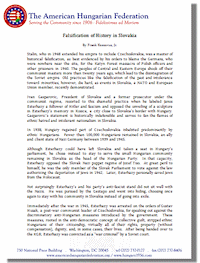
[download] AHF’s Letter to the House Subcommittee on Europe and Eurasia
On Thursday, February 16, Frank Koszorus, Jr., the president of the American Hungarian Federation (“Federation”), and Paul Kamenar, policy advisor and member of the Federation’s International Relations Committee, met with and briefed Brian Wanko, Professional Staff Member of the Subcommittee on Europe and Eurasia of the House Committee on Foreign Affairs in advance of next week’s Congressional Delegation (CODEL) trip to Brussels, Hungary and Slovakia. The CODEL is headed by Congressman Dan Burton (R-IN), Chairman of the Subcommittee, and Ranking Member Gregory W. Meeks (D-NY) and will be accompanied by Mr. Wanko.

The Federation submitted a letter to the Chairman and Ranking Member along with significant background materials on Hungary and Slovakia. The Federation’s submissions and presentation at the meeting reflected on the recent harsh and often politically motivated and unfair criticism of Hungary and suggested that discussions relating to democratic institution building should be “based on facts, and [done] in a fair, unbiased and even-handed manner bereft of partisanship and undertaken solely to promote Western values and in a manner that advances U.S. interests by strengthening relations with a valuable American ally.”
The Federation also raised the anti-Hungarian attitudes, policies and practices in Slovakia, citing the punitive citizenship law; the refusal to exonerate Janos Esterhazy; the discriminatory language law; and the continuing effects of the Benes Decrees. Building a “tolerant society would promote genuine democracy, defuse tensions caused by discrimination and intolerance, and promote U.S. interests in a Europe that is whole, free, stable and secure,” concluded the Federation.
The letter to the delegation is available for [download] or in [full text] below. The accompanying background is also available for [download] or [full-text below].
February 16, 2012
The Honorable Dan Burton
Chairman, Subcommittee on Europe and Eurasia
House Committee on Foreign Affairs
The Honorable Gregory W. Meeks
Ranking Member,
United States House of Representatives
Washington, DC 20515
Re: Upcoming Trip to Central Europe
Dear Mr. Chairman and Ranking Member Meeks:
The American Hungarian Federation (“AHF”), founded in 1906 as an umbrella organization, represents a broad cross-section of the Hungarian American community. From its founding, it has supported constitutional democracy, human and minority rights, and the rule of law in Central and Eastern Europe. AHF also supports good American/Hungarian relations and U.S. engagement in the region to advance security through promotion of democracy. AHF has submitted testimony before your Committee on these issues. Your upcoming trip to Hungary and Slovakia presents a timely opportunity to advance these goals and U.S. interests in this region. We are respectfully submitting two memoranda relating to current issues involving both countries for consideration by your delegation.

[Download] the AHF Statement: “Hungary Under the Microscope, Genuine Concern or Politics.”
Hungary. Although Hungary is a democracy, a member of NATO and an important U.S. ally, it recently has been harshly and often unfairly criticized by some in the United States and international community. AHF writes not because it believes that no steps could be taken to strengthen democracy or that no mistakes have been made. Rather it believes that much of the criticism is either politically motivated (inspired by the opposition) or not evenhanded or based on facts but on generalizations and speculation, i.e., what might happen as a result of the new laws as opposed to what has happened.
The perception of unfairness can be illustrated by Hungary’s recently enacted law on religions which has been criticized for being too restrictive. The Constitutional Court annulled parts of that law in December. And it appears that additional religions will also be recognized imminently. While further amendments may be in order, it is noteworthy that the latest State Department Report on Religious Freedom refers to similar restrictions in other European countries. The Report, for instance, notes that Austria only has 14 officially recognized religious societies. No one is averring, however, that democracy has been put at risk there or in other European countries.
While democracy and democratic institution building should be encouraged and discussed, they should be done based on facts, and in a fair, unbiased and even-handed manner bereft of partisanship and undertaken solely to promote Western values and in a manner that advances U.S. interests by strengthening relations with a valuable American ally.
[download] AHF’s accompanying Statement: “Minority Rights ought to be Respected by Slovakia.”
Slovakia. An indispensable element of sustainable security in the region involves the respect for minority rights. Several of Slovakia’s laws, policies and practices discriminate against members of the Hungarian minority. These include: (1) a punitive citizenship law that deprives ethnic Hungarians of their Slovak citizenship if they become dual citizens; (2) refusal to exonerate Janos Esterhazy who was the only member of Slovakia’s parliament to vote against the deportation of Jews in 1942. He died in a communist Czechoslovak prison in 1957. On November 3, 2011, the Anti-Defamation League presented the Jan Karski Courage to Care Award posthumously to Esterhazy for saving persecuted Jews; (3) an oppressive language law that discriminates against Hungarians; and (4) the continuing effects of the Benes Decrees originally issued in 1945 that stripped ethnic Hungarians of their citizenship, virtually all of their rights – all on the unjustified basis of collective guilt.
A tolerant society that respects the human and minority rights of its minorities would promote genuine democracy, defuse tensions caused by discrimination and intolerance, and advance U.S. interests in a Europe that is whole, free, stable and secure.
Sincerely,
Frank Koszorus, Jr.
President
AHF Statement to the House Subcommittee on Europe and Eurasia: Minority Rights ought to be Respected by Slovakia [download]
The American Hungarian Federation (the “Federation”), founded in 1906 as an umbrella organization, is an independent, non-partisan entity representing a broad cross-section of the Hungarian American community. From its founding, the Federation has supported constitutional democracy, human and minority rights and the rule of law in Central and Eastern Europe (CEE). The Federation supports continued American engagement in the region to help strengthen democratic institutions and the stability that derives from democracy. It also supports good trans-Atlantic relations.
This statement focuses on two issues: (1) minority rights as the prerequisite to democracy; and (2) intolerance and discrimination against members of the Hungarian minority living in Slovakia.
MINORITY RIGHTS: AN INDISPENSABLE ELEMENT OF REAL DEMOCRACY AND SUSTAINABLE SECURITY
An indispensable element of democracy and sustainable security in the region involves the respect for minority rights, the rule of law, and constitutional democracy, as opposed to illiberal democracy. This important question does not always receive the attention it should. As the tragic events in the nineties demonstrated, a primary cause of tensions and violence in the region is discrimination against and intolerance toward national, ethnic and religious minorities by the majority. A persistent problem in many parts of CEE is the mistreatment of Roma, conspicuous anti-Semitism and discrimination against Hungarians.
A government that fails or refuses to respect minority rights can hardly be deemed to be genuinely democratic, even if it has come to power through the ballot. Moreover, granting legitimate minority rights to historical groups would defuse tensions and promote political stability and greater cooperation in the Carpathian Basin.
The issue of minority rights has nothing to do with borders or irredentism as some erroneously or falsely assert in order to ignore their international legal obligations. It has everything to do with meaningful and enduring stability in CEE. The Hungarian minorities who live in countries neighboring Hungary (due to the 1920 Treaty of Trianon which transferred over three million ethnic Hungarians and over 70% of the Hungary’s territory to foreign rule) seek redress for their grievances strictly through peaceful and democratic means and contribute substantially to sustainable stability in the region. The stability flowing from collective rights is not only of interest to Hungarians, but should also be of great interest to the U.S. and NATO.
SLOVAKIA: ANTI-HUNGARIAN MEASURES AND ATTITUDES
More than two decades after the collapse of Communism, Slovakia has yet to fulfill its promises to its ethnic Hungarians. Although Slovakia was accepted into NATO and the EU based, in part, on these promises, the irrefutable record demonstrates that its laws and practices fail to conform to European and Western standards relating to human and minority rights. The members of the Hungarian minority in Slovakia often face intolerant or discriminatory laws, practices or attitudes. A few examples of Slovakia’s less than exemplary record will suffice.
Punitive Citizenship Law. Hungary’s citizenship law facilitates the acquisition of Hungarian citizenship by ethnic Hungarians living outside of Hungary, not just in countries neighboring Hungary. Nevertheless, Slovakia passed a punitive citizenship law specifically in response to Hungary’s citizenship law. While on its face Slovakia’s law deprives dual citizens of Slovak citizenship, the timing of the new law clearly demonstrates that it targets Hungarians. Slovakia’s law is not only contrary to European and American practices, it violates Paragraph 2 of Article 5 of the Slovak constitution, which provides that “no one must be deprived of the citizenship of the Slovak Republic against his will.”
NOTE: The Case of Aladarne Tamas (in Slovak: Helena Tamasova). Among the most recent anti-Hungarian incident involves Slovakia stripping Tamas of her Slovak citizenship after she received Hungarian citizenship. Her case is particularly disconcerting. She was born in 1912 in Rimaszombat (Solvakian name: Rimavska Sobota). Rimaszombat was then the seat of Gomor County and part of Hungary. Thus, Mrs. Tamas was born a Hungarian citizen. She never relocated, but as a result of the Treaty of Trianon, she became first a citizen of Czechoslovakia and then, with the recent breakup of Czechoslovakia, a citizen of Slovakia. As a 99-year-old ethnic Hungarian, she wanted to become a Hungarian citizen again, while retaining her Slovak citizenship. Yet, seven months after she notified the authorities about having received her Hungarian citizenship, and her intent of retaining her Slovak citizenship, the Slovak authorities informed her that she lost her Slovak citizenship. With this, Tamas became a “person without registered address.”
NOTE: The Case of Oliver Boldoghy. Another case involves Slovakia revoking Oliver Boldoghy’s Slovak citizenship after becoming a dual citizen. These decisions must be reversed and the citizenship law substantially modified or repealed.
Janos Esterhazy Still Awaits Exoneration. Slovakia should at long last exonerate Janos Esterhazy who as the leader of the Hungarian Party in Tiso’s Fascist Slovakia was the only Member of Parliament to vote against the deportation of Jews in 1942 and the anti-Semitic laws, which he criticized as not being in accordance with humanitarian principles. Esterhazy also personally helped Jews flee Slovakia.
Immediately after the war in 1945, Esterhazy was arrested on the orders of Gustav Husak, a post-war communist leader of Czechoslovakia, for speaking out against the discriminatory anti-Hungarian measures introduced by the government. After being handed over to the KGB, Esterhazy was convicted as a “war criminal” by a Soviet court.
In 1947, while Esterhazy was imprisoned in the Soviet Union, the National Court in Slovakia in a perfunctory proceeding, and without any evidence, sentenced him to death in absentia on the trumped up charges of being a fascist and having contributed to the dissolution of Czechoslovakia. It is a cruel irony that Esterhazy was wrongly accused of doing exactly what Slovakia would do on its own forty-six years later in the “Velvet Divorce” of 1993 — dissolving Czechoslovakia. Upon his return from Russia, Esterhazy’s sentence was commuted to life in prison. He died in a Czechoslovak prison in 1957 and was buried in an undisclosed mass grave. While Russia exonerated him on January 21, 1993, acknowledging that he had been “arrested without cause,” more than twenty years after the fall of Communism, Slovakia astonishingly refuses to exonerate Esterhazy, an unsung hero of anti-Nazi resistance.
NOTE: ADL Honors Esterhazy for Saving Persecuted Jews. On November 3, 2011, the Anti-Defamation League presented the Jan Karski Courage to Care Award posthumously to Esterhazy.
NOTE: Slovak Media Council reportedly sanctions television program for broadcasting a documentary on Esterhazy. Following a complaint by a television viewer, the Slovak Media Council reprimanded Hungarian Magazine (Magyar Magazin), a program of Slovak public television, in connection with a documentary about Esterhazy. The stated reasons for the reprimand were that the documentary was allegedly “biased” and failed to include alternate views. The documentary was filmed in the Olmouc region of the Czech Republic, showed the infamous prison where Esterhazy died and featured an interview with a fellow inmate.
Discriminatory Language Law. An example of overt discrimination is the language law that took effect on September 1, 2009 in Slovakia and discriminates against ethnic Hungarians who comprise only 11% of the population and live in contiguous areas of southern Slovakia – the geographic location where they and their ancestors have lived for over a millenium.
The language law threatened the Hungarian minority’s culture and infringed on fundamental freedoms. The mere existence of the law, as drafted, caused considerable uncertainty, fear and anxiety among ethnic Hungarians. The result was to chill the use of their mother tongue, precisely why this law was so odious and anti-democratic. There is no place for such a law in 21st century Europe.
The language law was among the latest manifestation of the previous Slovak government’s intolerance toward its Hungarian minority. Not surprisingly, the Slovak National Party (“SNS”) was a member of the ruling coalition. Its chairman Jan Slota is known for his xenophobic outbursts: “Hungarians are the cancer of the Slovak nation, without delay we need to remove them from the body of the nation.” The Stephen Roth Institute has called the SNS “an extremist nationalist party.”
Such extremist attitudes contributed to the adoption of the law, even though Slovakia promised to respect the rights of its minorities before being accepted into NATO and the EU. Not only did the law cause considerable internal unease in Slovakia, it threatened much needed unity within NATO by increasing tensions between Slovakia and Hungary – both NATO allies.
International objections to the law included the conclusions by the European Commission for Democracy Through Law (the “Venice Commission”), which criticized provisions of this law as being incompatible with international standards and reminded Slovakia that it was not absolved “of the obligation to comply with the provisions of the international conventions for the protection of national minorities.” While this odious law has been modified, it is still on the books and does not reflect a tolerant attitude toward the Hungarians.
Lingering Effects of the Benes Decrees. The Slovak Parliament on September 20, 2007 adopted a resolution proposed by extremist Jan Slota ratifying and confirming the Benes Decrees originally issued between May 14 and October 27, 1945. Among the most controversial decrees were the ones which stripped ethnic Hungarians of their citizenship, virtually all of their rights, property (without compensation), dignity, and, in some cases, their lives – all on the unjustifiable basis of collective guilt. Hungarian schools were closed and the Hungarian language forbidden even in their churches. Czechoslovakia also pursued a policy of ethnic cleansing in southern Slovakia and sent thousands of Hungarians to camps. The debilitations continue to affect many of the victims of the crimes committed in post-World War II Czechoslovakia.
The concept of collective guilt is abhorrent to Americans and to anyone committed to the rule of law, human rights and democracy. Indeed, the United States did not endorse the principle of collective guilt of Hungarians in Slovakia. Nevertheless, as a result of pressure from the victorious powers, including the Soviet Union which favored Czechoslovakia, Hungary was forced to agree to a “population exchange.”
The Benes Decrees are still on the books and their discriminatory impact remains in effect. Compensation has yet to be paid to those whose properties were summarily and unjustly confiscated and legal redress for the inequities suffered by Hungarians solely because of their nationality are not in sight. Slovakia should provide legal redress to remedy the continuing and discriminatory effects of the Benes Decrees and thereby adopt the values shared by the trans-Atlantic community of nations.
CONCLUSION
Slovakia should be encouraged to build a tolerant society by respecting the human and minority rights of its Hungarian and other minorities and the rule of law. Concrete steps it should be urged to take include: restoration of Aladarne Tamas’ and Oliver Boldoghy’s Slovak citizenship; repeal of the citizenship law that strips Slovak citizenship of persons seeking dual citizenship; exoneration of Janos Esterhazy; repeal of the discriminatory language law; and repeal of the multiple Benes Decrees that affected ethnic Hungarians based on collective guilt. These actions would defuse tensions caused by discrimination and intolerance, improve Hungarian/Slovak relations, promote United States interests in a Europe that is whole, free stable and secure, and serve the cause of justice, genuine democracy and the rule of law.
[<< back to News from Slovakia]
Related
3/5/2012 – UPDATE: AHF has Follow-Up Capitol Hill Meeting on Recent Congressional Trip to Hungary and Slovakia. “At a time when there is considerable misinformation being disseminated about Hungary and so little known about the discrimination against the Hungarian minority in Slovakia, we believe such fact-finding missions are most useful, welcome and greatly appreciated,” said Mr. Koszorus. “Objective analysis based on facts is imperative to advance U.S. interests in Hungary and the region,” he added. [read more]

Join the Discussion!
American Hungarian Federation defends Hungary against criticism – By MTI
Hungary has recently been harshly and often unfairly criticised, the president of the American Hungarian Federation (AHF) said on Monday, in a letter briefing the US House Committee on Foreign Affairs ahead of its delegation’s visit to Hungary this week. [read more]

“Amerikai Magyar Szövetség: durva, méltánytalan bírálatok érték Magyarországot.” Noha Magyarország demokrácia, a NATO tagja és az Egyesült Államok fontos szövetségese, az utóbbi időben durva és gyakran méltánytalan bírálatok érték mind az Egyesült Államokban, mind máshol külföldön – hangoztatta az Amerikai Magyar Szövetség (AMSZ) a héten Magyarországra és Szlovákiába látogató amerikai kongresszusi küldöttség tagjaihoz intézett levelében. [tovább]
- AHF reacts to what it sees as politically motivated, unmerited, biased criticism of Hungary
- Slovakia stripping citizenship of ethnic Hungarian minorities
- Slovak President shamefully calls Janos Esterhazy, a hero of the Holocaust, a follower of Hitler. AHF continues call for rehabilitation of Janos Esterhazy, reacts to Slovak falsification of history
- The Anti-Defamation League presented the Jan Karski Courage to Care Award to Count Janos Esterhazy
- In a letter to Knut Vollebaek, OSCE High Commissioner on National Minorities, the Federation again raises anti-Hungarian measures in Slovakia and Serbia
- AHF submits statement to Congressional Committee on Foreign Affairs, Subcommittee on Europe and Eurasia
- AHF and the Central and East European Coalition participate in a reception and Capitol Hill Policy Seminar entitled, “20 years: Three Perspectives on the Evolution of U.S. Strategic Engagement with Central and Eastern Europe.”
- AHF urges Secretary of State Hillary Clinton to “publicly and unambiguously express [her] concern relative to the Slovak language law
- AHF calls upon Vice President Biden to discuss Slovakia’s language law with Hungarian Prime Minister Bajnai
- AHF Submits Letter Regarding Intolerance in Slovakia
- AHF Reacts to Senator Benjamin L. Cardin (D-MD), Co-Chairman of the U.S. Helsinki Commission, who questioned democracy in Hungary and criticized expressions of concern for Hungarian minorities
- Use of Hungarian ILLEGAL in Slovakia – Hungarian FM expresses regret
- Slovaks Confirm Benes Decrees: Called “Cancer of the Slovak Nation.” AHF issues statement.
- The Benes Decrees – a shameful act of ethnic cleansing
- AHF Expresses Concern About Romania Ignoring Minority Rights… Romania considers “redistricting.”
- The American Hungarian Federation’s call for greater cooperation among Hungarian American organizations in raising the ill-advised and discriminatory Slovak language law published in Heti Valasz
- “Halál a magyarokra!” / “Hunok a gázkamrába! Magyarok a Dunába!“
- 168 Óra Online írása: A ‘Halál a magyarokra’ Amerikában is kiverte a biztosítékot
- Amerikai magyar szervezet küldött levelet Kubišnak
- The Treaty of Trianon – A Nation Dismembered
- Vojvodina – More ethnic cleansing in historic Vajdasag
- News from Rumania – Home to the largest Hungarian “minority”
- Hungarian National Flags fly again in Hungarian churches in today’s Slovakia
- AHF Supporting Dual Citizenship
Why So Many Hungarians Across the Border?
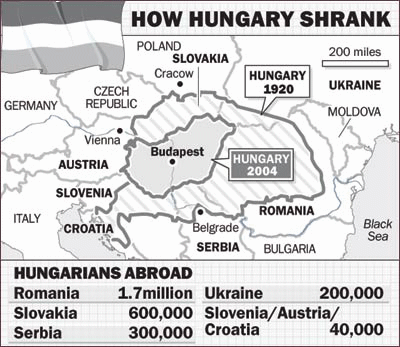
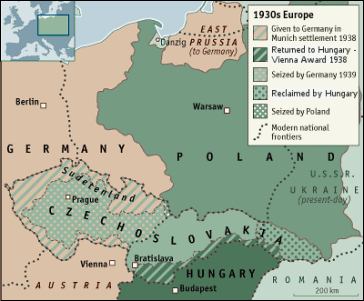
The Treaty of Trianon in 1920… in the aftermath of WWI, was extremely harsh on Hungary and unjustifiably one-sided. The resulting “treaty” lost Hungary an unprecedented 2/3 of her territory, and 1/2 of her total population or 1/3 of her Hungarian-speaking population. Add to this the loss of up to 90% of vast natural resources, industry, railways, and other infrastructure.
They are home in the sense that they, as communities, haven’t moved anywhere. They just woke up one morning to be told: “You are now a Czechoslovak, you are a Romanian, you are a Yugoslav.” This first happened in 1918-20, when Hungary was partitioned by the infamous Trianon Treaty, which was not a treaty at all, but a diktat enforced by occupying Entente Armies. In the late 1930’s, Hungary got some portions of its territories back, but after losing yet another war, the borders were tightened even more in 1947.