

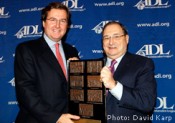
11/8/2011 – On November 3, 2011, the Anti-Defamation League presented the Jan Karski Courage to Care Award posthumously to Count Janos Esterhazy: “Those who defended and aided Jews and other victims of the Nazi slaughter merit our recognition and our eternal thanks. They were individuals who followed the call to conscience, which is surely no simple matter… Count János Esterházy was such a person of conscience, one who had more than enough reason to remain silent. Esterházy was born in 1901 into the Hungarian aristocratic house of Esterhazy.” Giovanni Malfatti, Esterhazy’s grandson, was in New York to accept the award on behalf of the family.
Esterhazy was the only member of the Slovak Parliament in 1942 who voted against expelling the Jews, setting an example which few dared to follow in the parts of Europe controlled by Adolf Hitler’s Germany. He was detained by the Nazis and died in a communist prison. He is still classified as a war criminal in Slovakia.
In a statement on ADL’s Website, Abraham H. Foxman, ADL National Director, reflects: “I know first-hand how essential it is to have the help of just one person, who at the moment of moral collapse, did not forget the essential principle of leading a moral life: Do unto others, as you would have others do unto you,” said Foxman, a Holocaust survivor who was saved by his Polish nanny. “To help another human being when to do so will earn you scorn, contempt and even threaten your life and that of your family, that is to take a moral stand of incalculable value. János Esterházy did and he deserves our recognition and our eternal thanks.”
AHF thanks the ADL for recognizing Count Esterhazy and his personal sacrifice in the fight for justice. The full statement appears below and on [ADL’s Official Website] Special thanks to ADL for hte courtesy to re-publish.
Courage to Care Award Presentation to Janos Esterhazy
Remarks by Abraham H. Foxman
National Director, Anti-Defamation League
Presentation of ADL Jan Karski Courage to Care AwardPosthumously To Count János Esterházy
New York, NY, November 3, 2011
Since 1987, we have been presenting the ADL Courage to Care Award to honor rescuers of Jews during the Holocaust. As you can see from your program, our recipients have included individuals from all walks of life—diplomats and dignitaries, businessmen and farmers, housewives and shopkeepers.
The recipients have been of varying faiths and come from many different countries—from Eastern Europe, where the Shoah was primarily carried out, to the continents of Africa and Asia, and America.
This year we are renaming our award in honor of one its first recipients—Jan Karski, the Polish Christian, who covertly ventured twice into the Warsaw Ghetto and Belzec concentration camps in order to provide one of the first eyewitness accounts of Hitler’s Final Solution to the Polish government-in-exile.
Karski subsequently spoke directly to Winston Churchill and Franklin Roosevelt and urged the allies to stop the mass murder.
Such is the esteem we feel for Jan Karski, whom I had the privilege of knowing during his years of teaching at Georgetown University, that we decided to rename the award in his memory.
Each time we present the Courage to Care Award to the family of someone who risked his or her life to save Jews, we will also remember Karski’s urgent message to the western nations that governments and people have the power and the obligation to step forward and stop the murder of innocent men, women and children. That the Holocaust is not just a history lesson, but a message for today and for all time.
We dedicate this award in his memory so that each time we present it, we will remember his heroism.
As Jews, we give praise to individuals who do good deeds, which we call, a mitzvah. But the greatest mitzvah of all is that one that is the hardest. To maintain one’s decency in the face of moral evil.
To help another human being when to do so will earn you scorn, contempt and even threaten your life and that of your family, is to take a moral stand of incalculable value.
Those who defended and aided Jews and other victims of the Nazi slaughter merit our recognition and our eternal thanks. They were individuals who followed the call to conscience, which is surely no simple matter.
What motived this relatively small group of people is sometimes difficult for us to understand in the world as we now know it. Difficult because it seems these individuals possessed a moral courage to which most of us can only aspire. Difficult to comprehend because they risked everything, including the lives of their families, to help people who, for the most part, they did not know at all.
Apart from their willingness to help others, they do not seem to have much in common. They crossed gender, ethnic, religious, and socio-economic lines. They were Catholic, Orthodox Christian, Evangelical, Baptist, Lutheran and also Muslim. They were farmers, doctors, diplomats, peasants and kings. They were simple people of faith.
Count János Esterházy was such a person of conscience, one who had more than enough reason to remain silent. Esterházy was born in 1901 into the Hungarian aristocratic house of Esterhazy.
After attending school in Budapest, Esterházy returned to his estate to find that Hungary was forced to cede most of his estate to Czechoslovakia as part of the treaty that ended World War I. He married a countess and had two children, Alice and Janos.
In the 1930’s, Esterházy actively participated in the political arena. He was elected President of the Hungarian National Union League and ultimately elected President of the National Christian Socialist Party in Czechoslovakia. He was an opposition politician who was a stringent defender of the cause of self-determination.
In 1935, he was elected to the Parliament of Prague and he gave numerous speeches in which he defended linguistic, cultural and economic rights of minorities. He pleaded for fair treatment of Slovakians then under Hungarian rule and later refused to become a member of the Parliament in Budapest.
In 1939, he became the only Hungarian member of the Slovak Parliament. He was an ardent Catholic, and made clear his rejection of Nazism and its Hungarian version symbolized by an arrow. He said that “we shall not replace the cross with the arrow, we shall stay loyal to the cause…while the arrow should continue its mission as a noble tool of traffic control.”
Also in 1939, he actively participated in assisting the settlement of Polish refugees in Hungary, many of whom were Jews. In 1942, out of 63 members of the Slovak Parliament, he was the only one to vote against the deportation of Slovakia’s Jews.
Following the vote he and some close friends helped Jews flee to Hungary. For these heroic actions, Slovakia’s Nazi-allied government listed Esterházy amongst its public enemies. He was charged with defaming Slovakia, his parliamentary immunity was cancelled and he was convicted of treason and imprisoned.
In 1944, he was in direct contact with participants in the Slovak national uprisings. He was arrested again in 1945, but soon set free. He was captured by the Soviets and taken to Moscow where he was accused on false grounds and condemned to 10 years of forced labor.
Czechoslovakian authorities condemned him, in absentia, to death and all of his property was confiscated. He was passed from Soviet to Czechoslovakian authorities and condemned to life imprisonment.
János Esterházy died in prison in 1957 of lung disease. In 2010 Yad Vashem acknowledged his efforts in saving persecuted Jews.
I stand before you today because of someone like Count János Esterházy. I had the good fortune to be sheltered from the Nazis by a brave and decent woman who was my Polish nanny, Bronislawa Kurpi. She baptized me and raised me as a Catholic. But for her, I would not be alive today to bear witness.
I know firsthand how essential it was to have the help of just one person, who at a moment of moral collapse, did not forget the essential principle of leading a moral life: do unto others, as you would have others do unto you.
My nanny and János Esterházy stood up to say no. Others did too, but too few. And we know that whenever and wherever good people stood up to say no, Jews lived, Catholics lived, and others lived. Imagine what would have happened if there were more people like Chiune Sugihara, Raoul Wallenberg, Oskar Schindler and Bronislawa Kurpi.
Those from that time whom we in the Jewish community call the “righteous” provide our morally compromised world the example of their call to conscience. Often, their bravery went unnoticed, yet through their actions, they proved that it is possible to choose to do a most demanding mitzvah against overwhelming odds and without hope of commendation or advantage.
I want to take this opportunity to thank Eileen Ludwig-Greenland for her generosity through the years in sponsoring the Courage to Care Award.
It is now my honor to present ADL’s prestigious Jan Karski Courage to Care Award to Giovanni Malfatti, the son of Alice Esterházy Malfatti and the grandson of Count János Esterházy, who will accept the award on behalf of his family.
The award is a plaque with miniature bas-reliefs depicting the backdrop for the rescuers’ exceptional deeds during the Shoah. It is a replica of the Holocaust memorial wall created by noted sculptor Arbit Blatas.
AHF REMEMBERS THE HEROES OF THE HUNGARIAN HOLOCAUST
The Federation takes this opportunity to remember Carl Lutz, Raoul Wallenberg and other foreign diplomats as well as the Hungarian heroes who at great personal peril saved many Jewish lives. The Hungarians include but, of course, are not limited to the following individuals:
- Janos Esterhazy opposed the Slovak Nazi puppet regime of Jozef Tiso. At great peril to himself, he was the only member of the Slovak Parliament to vote against the law authorizing the deportation of Jews in 1942. Later, Esterhazy personally saved Jews from the Holocaust. He was detained by the Nazis and died in a communist prison. He is still classified as a war criminal in Slovakia and shamefully called a follower of Hitler in 2011 by the Slovak President.
- General Vilmos Nagybaczoni-Nagy who upon being appointed minister of defense by the Kallay government took measures to end the gross abuse threatening the lives of Jews and others in the auxiliary labor force;
- Tibor Baranszky who, as secretary to Monsignor Angelo Rotta, the Vatican’s ambassador to Budapest, saved many lives by distributing protective letters to Jews on forced marches and elsewhere;
- Roman Catholic Priest Ferenc Kallo who gave Jews life‐saving certificates of baptism and who was killed by the Arrow Cross on October 29, 1944;
- Jozsef Antall Senior, who as a member of the ministry of internal affairs for civilian refugees
gave refuge to and thereby saved Jews and Poles and who enjoyed the support and confidence of Minister of Interior Ferenc Keresztes‐Fischer and Prime Ministers Pal Teleki and after his death Miklos Kallay. - Istvan Bethlen who communicated protests to Regent Horthy in 1944 against deportations following Nazi Germany’s occupation of Hungary; and
- Col. Ferenc Koszorus, posthumously promoted to the rank of General by Prime Minister Antall after the fall of Communism, who volunteered his services and mobilized the 1st Armored Division under his command to militarily intervene on July 5, 1944 to stop Laszlo Baky, a secretary of state in the Ministry of Interior for “Jewish Affairs,” from deporting the approximately 200,000 plus Jews from Budapest.
A Few Related Articles
6/30/2009 – Use of Hungarian ILLEGAL in Slovakia… Hungary’s Foreign Ministry expressed regret and concern over the amendment to Slovakia’s act on its official language approved in parliament on Tuesday. Under the amended act the use of the minority language in official communication would be punishable in towns and villages where the ethnic community makes up less than 20 percent of the total population. [read more]
9/13/2011 – Slovak President shamefully calls Janos Esterhazy, a hero of the Holocaust, a follower of Hitler. AHF continues call for rehabilitation of Janos Esterhazy, reacts to Slovak falsification of history… Esterhazy was the only member of the Slovak Parliament in 1942 who voted against expelling the Jews, setting an example which few dared to follow in the parts of Europe controlled by Adolf Hitler’s Germany. He was detained by the Nazis and died in a communist prison. He is still classified as a war criminal in Slovakia. [read more]
12/02/2011 – Slovakia strips citizenship of ethnic Hungarian minorties. AHF submits a statement to the US Congress Helsinki Commission: “Intolerance and discrimination targeting any group based on ethnicity, nationality or religion is not acceptable… The most recent anti-Hungarian incident involves Slovakia stripping Oliver Boldoghy of his Slovak citizenship after becoming a dual citizen. This decision is not only contrary to American and European practices, it violates the Slovak constitution, which provides that “no one must be deprived of the citizenship of the Slovak Republic against his will.” [read more]
3/23/2011 – AHF honors Col. Ferenc Koszorus, Sr., reflects on Holocaust Memorial Month. AHF honors the millions of lives lost and the untold suffering caused by Nazism and Communism. But even during the horrors of WWII, stories of resistance to Nazi atrocities emerged. Hungary, heavily influenced by her desire to regain lost territories and reunite Hungarians in the Carpathian Basin, had found support in Italy and Germany and joined the Axis, a tragic mistake. [read more]
10/20/2007 – Slovaks confirm Benes Decrees: “Hungarians are the cancer of the Slovak nation, without delay we need to remove them from the body of the nation” – Jan Slota. AHF releases statement on the Benes Decrees and recent extremist developments in Slovakia. “Having taken a step that has fueled ethnic hatred and assaulted good relations with Hungary, the Slovak Parliament on September 20, 2007 adopted a resolution proposed by extremist Jan Slota ratifying and confirming the Benes decrees. Those decrees shamefully imposed collective guilt on the Hungarian (and German) population of Czechoslovakia in 1945 and stripped them of their citizenship, rights and property without compensation. Czechoslovakia also pursued a policy of ethnic cleansing in southern Slovakia. The debilitations continue to affect many of the victims of the crimes committed in post-World War II Czechoslovakia.
The concept of collective guilt is abhorrent to Americans and to anyone committed to the rule of law, human rights and democracy. Rather than affirm the inviolability of the Benes decrees, Slovakia should reject them, provide legal redress to remedy their continuing and discriminatory effect and thereby adopt the values shared by the trans-Atlantic community of nations. [read more]
[<< back to News from Slovakia]
Related
“The Slovak government has strayed onto a dangerous path when it submitted the bill about expelling the Jewish, because by that it acknowledged that simply ousting a minority by the majority is lawful… As a representative of the Hungarians here, I state it, and please acknowledge this, that I don’t vote in favour of the proposal because as a Hungarian, a Christian and a Catholic I believe that this is against God and humanity.” – Count János Esterházy
Briefly about Janos Esterhazy
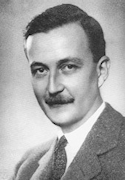
A Proud Aristocratic Tradition
Count János Esterházy (Nyitraújlak, Austria-Hungary, March 14, 1901 – Czechoslovakia, March 8, 1957) a member of the House of Esterházy was the most prominent ethnic Hungarian politician in former Czechoslovakia. He was four when his father died. He went to secondary school in Budapest and after studying commerce he returned to his estate in an area which Hungary was forced to cede to Czechoslovakia in the Treaty of Trianon which closed World War I. In 1935, He was elected to parliament in Kassa (Košice). In his first speech in parliament he said: “As we have been attached to Czechoslovakia against our will, we demand that the Czechoslovak government fully respect our minority, language, cultural and economic rights.” He also supported the claims of ethnic Hungarians for autonomy within Slovakia. This made him a target for Czechoslovak authorities.
The Courage of Conviction
He was the only member of the Slovak Parliament in 1942 who voted against expelling the Jews, setting an example which few dared to follow in the parts of Europe controlled by Adolf Hitler’s Germany. He was detained by the Nazis and died in a communist prison. Officially he is still classified as a war criminal in Slovakia, as courts have rejected requests for his rehabilitation.
On May 15, 1942, the Slovak parliament approved constitutional law 68/1942 ordering the expulsion of Jews from Slovakia. Esterházy was the only MP who voted against the bill and he immediately became the target of fierce attacks in the Slovak press. To defend his views, he said:
“The Slovak government has strayed onto a dangerous path when it submitted the bill about expelling the Jewish, because by that it acknowledged that simply ousting a minority by the majority is lawful… As a representative of the Hungarians here, I state it, and please acknowledge this, that I don’t vote in favour of the proposal because as a Hungarian, a Christian and a Catholic I believe that this is against God and humanity.”
He also declared:
“It is shameful that a government, whose president and prime minister claim to be good Catholics, deports its Jewish citizens to Hitler’s concentration camps”
János Esterházy helped hundreds of Jewish, Czechs, Slovaks and Poles escape prosecution. He was interned for a short period and the German Gestapo declared him wanted. Here is a quote from Irén Rujder, widow of Ödön Rujder’s a Jew who was rescued by Esterházy:
“We all, who lived in Slovakia in that time, know the truth. They (the Czechoslovaks) handed him (Esterházy) to the Soviets, because if they had brought him to justice in Bratislava, all of the Jews would have testified his innocence. The misinterpretation of truth like this is painful, Esterházy really deserves the true tree of Israel.”
A Tragic Life and DeathAfter the Soviet army ousted German troops from Pozsony (Bratislava), they interned Esterházy, but released him after 12 days. He later negotiated with Gustáv Husák who represented the interim Slovak government, and complained about the persecution of ethnic Hungarians. On the order of Husák he was arrested and handed over to the Soviet secret service KGB. He was kept for one year in the feared Lubyanka prison in Moscow, and then, on the basis of fabricated allegations, he was sentenced to ten years work in Siberia. The Slovak National Court in Bratislava on September 16, 1947 sentenced him in his absence to death for alleged collaboration with fascism. In 1949 the Soviet Union extradited him to Czechoslovakia. He was not executed as a presidential pardon commuted his sentence to life imprisonment. Over the next years he was transferred from prison to prison in Czechoslovakia. He died in Mírov prison in 1957.
Rehabilitation Denied
On January 21, 1993 the Russians rehabilitated János Esterházy. Under the seal of the Office of the Attorney General and the IG of the Armed Forces and signed by N. Sz. Vlaszenko, (document #Sz.: Zuv-9563-54) the order states in part that:
“It is hereby certified that János Esterházy, citizen of Czechoslovakia, born in Újlak in 1901, was arrested without cause on June 27, 1945…..and sentenced to ten years in a labor camp…. János Esterházy was rehabilitated according to the Russian Federation’s “Political Terror Victim’s Rehabilitation Act” of October 18, 1991, paragraphs 3 and 5….”
Slovakia still refuses to rehabilitate Esterhazy. But it enacted it’s Slovak Language Law and confirmed the outrageous Benes Decrees. Renowned Nazi-hunter, Simon Wiesenthal wrote a letter to Dr. Peter Samko, chief judge of the City of Pozsony (Bratislava), (published in the newspaper of Új Szó, 1993) in which he strongly defends Esterházy and offers witnesses on his behalf. Janos Eesterhazy was one of many Hungarians who spoke out against the Nazi threat.
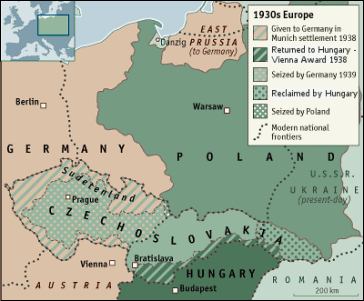
Why So Many Hungarians Across the Border?
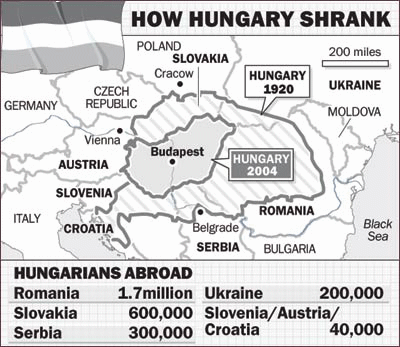
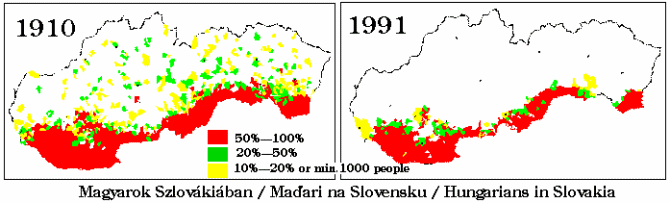
The Treaty of Trianon in 1920… in the aftermath of WWI, was extremely harsh on Hungary and unjustifiably one-sided. The resulting “treaty” lost Hungary an unprecedented 2/3 of her territory, and 1/2 of her total population or 1/3 of her Hungarian-speaking population. Add to this the loss of up to 90% of vast natural resources, industry, railways, and other infrastructure.
Additional Links
- AHF urges Secretary of State Hillary Clinton to “publicly and unambiguously express [her] concern relative to the Slovak language law
- AHF calls upon Vice President Biden to discuss Slovakia’s language law with Hungarian Prime Minister Bajnai
- AHF Submits Letter Regarding Intolerance in Slovakia
- Use of Hungarian ILLEGAL in Slovakia – Hungarian FM expresses regret
- Slovaks Confirm Benes Decrees: Called “Cancer of the Slovak Nation.” AHF issues statement.
- The Benes Decrees – a shameful act of ethnic cleansing
- The American Hungarian Federation’s call for greater cooperation among Hungarian American organizations in raising the ill-advised and discriminatory Slovak language law published in Heti Valasz
- “Halál a magyarokra!” / “Hunok a gázkamrába! Magyarok a Dunába!“
- 168 Óra Online írása: A ‘Halál a magyarokra’ Amerikában is kiverte a biztosítékot
- Amerikai magyar szervezet küldött levelet Kubišnak
- The Treaty of Trianon – A Nation Dismembered
- Vojvodina – More ethnic cleansing in historic Vajdasag
- News from Rumania – Home to the largest Hungarian “minority”
- Hungarian National Flags fly again in Hungarian churches in today’s Slovakia
- AHF Supporting Dual Citizenship
They are home in the sense that they, as communities, haven’t moved anywhere. They just woke up one morning to be told: “You are now a Czechoslovak, you are a Romanian, you are a Yugoslav.” This first happened in 1918-20, when Hungary was partitioned by the infamous Trianon Treaty, which was not a treaty at all, but a diktat enforced by occupying Entente Armies. In the late 1930’s, Hungary got some portions of its territories back, but after losing yet another war, the borders were tightened even more in 1947.