
7/25/2007 – AHF Calls for protection on minorities in Kosovo and Vojvodina. With independence of Kosovo inevitable, and the potential for violence, the Federation who calls international attention to the other large minority in the former Yugoslavia: The Hungarians of Vojvodina who lost autonomy by Serbian totalitarian regime of Milosevic.
In a Letter to the Editor to the Washington Post regarding Kosovo Independence, AHF’s Frank Koszorus, Jr., writes:
John Podesta [“Standing With Kosovo Again,” July 23] makes a strong case in favor of independence for Kosovo. Two caveats warrant attention.
If Kosovo becomes independent, the international community, including the United
States, must ensure that the rights of the non-Albanian population are respected. Because
intolerance toward minorities characterizes the region, minority rights guarantees – a
prerequisite to democracy and stability — must not be entrusted exclusively to the local
political elites. Similar previous commitments have failed. For example, prior to
annexing Transylvania after the First World War, Romanians promised to grant the
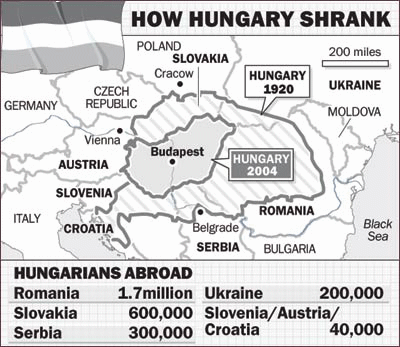
province’s 1.7 million Hungarians full rights and autonomy. Eighty-seven years later that
promise has yet to be fulfilled.
Podesta acknowledges the need to protect the rights of all citizens of Kosovo. His statement of a country “not of Kosovar Albanians or Kosovar Serbs, but a nation for all Kosovars,” confuses citizenship and nationality as understood in the region, however. That statement thereby unwittingly undermines minority rights.” [download the letter]
[< Back to News from the Former Yugoslavia]
Why so many Hungarians across the border?

Vojvodina was part of Hungary since 896 AD and was awarded to the newly formed Yugoslavia by the French in the “Treaty” of Trianon in 1920 when Hungary lost 2/3 of her territory and 1/3 of her Hungarian population. Large scale evictions, fear of self-reporting, and other Serb progroms, have left only about 300-350,000 ethnic Hungarians in the province. Some, however, estimate this number to be double that since many fear self-reporting as Hungarian exposes them to risk
The American-Hungarian community is increasingly concerned by the recent outbreak of violence in Vojvodina.
“Ethnic Cleansing” in action
How did this region become part of Yugoslavia? Read “The Conflict in the Former Yugoslavia and Autonomous Region of Vojvodina, and the Need for a More Coherent U.S. Foreign Policy” on The Hungary Page and refer to the following demographic maps comparing Vojvodina in 1910 and 1991. Note the decline seen here in Hungarian population does NOT take into consideration the Balkan conflicts and the significant escalation of atrocities against Hungarians over the last decade:
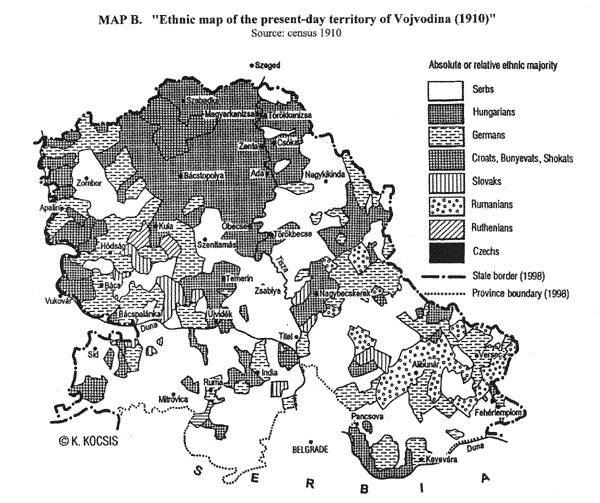

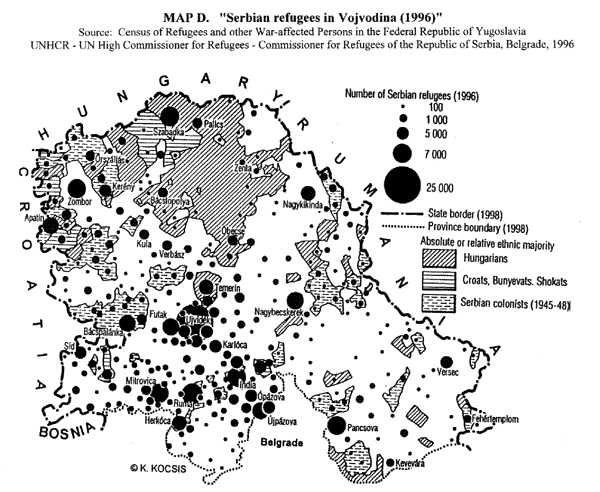
Click images for larger version
External Links
- Purchase the book, “The Hungarian Kosovo” by Sam Vankin, UPI Senior Business Correspondent
- Institute for War and Peace Reporting
- United Press International (UPI)
- “The
Conflict in the Former Yugoslavia
and Autonomous Region of Vojvodina,
and the Need for a More Coherent
U.S. Foreign Policy” on The Hungary Page - NATO EXPANSION FLASHPOINT NO. 2: The Border between Hungary and Serbia, by Ted Galen Carpenter and Pavel Kislitsyn. A Cato Foreign Policy Briefing No. 45 November 24, 1997
AHF Related Links
- News from Rumania
- News from Vojvodina [I], [II], [III]
- Slovakia and the Benes Decrees
- Hungarian Flags Flying Again in Slovakia
- Rumania’s Basescu in the US
- AHF on Dual Citizenship for Hungarians
- The Csango Hungarians of Moldavia
- The Tragedy of the Treaty of Trianon
Read additional Stories in HUNGARIAN
- 10/14/2005 – Koszorús Ferencet idézi az újvidéki Magyar Szó: „NEMZETKÖZIESÍTSÜNK”-E VAGY SEM: Tojástánc [tovább]
- 6/10/2005 – A MAGYAROK CSAK TÁNCOLJANAK: Egybehangolt lejáratási kampány a VMSZ ellen [tovább]


These are .PDF files.
If you do not have the free
Adobe Reader, get it by clicking the icon
- “Magyarellenes
Falfirkák Szabadkán,”
MAGYAR SZÓ, Novi Sad/Újvidék (in Hungarian) 4/3/2004 - “Temetőgyalázás,”
MAGYAR SZÓ, Novi Sad/Újvidék (in Hungarian)
3/29/2004 - See the International Crisis Group Report on Serbia from July 1994: Serbia’s Changing Political Landscape, a Briefing. An excerpt regarding Serb violence: “Some Serbs in Vojvodina are demonstrating behaviour reminiscent of that which they so frequently and vociferouslt condemn the Kosovo Albanians.“


Monica
Seles – (b. in the Vajdaság (Vojvodina), the Hungarian region
that was given to Serbia/Yugoslavia.)
Tennis Superstar – She has won 9 Grand Slam
singles titles and bronze in Sydney 2000!
Seles (pronounced sell-esh and spelled Szeles Monika) won the European junior championship at the age of ten. Born to a Hungarian family in the former Hungarian province of Vojvodina, she moved to the United States in 1986, and in 1989 turned professional. In 1990 she won her first French Open, and in each of the following two years she won the Australian, United States, and French opens. Seles won the Australian Open in early 1993, but later that year, while resting between sets during a tournament in Hamburg, Germany, she was stabbed by a spectator. The incident caused Seles to withdraw from competition in 1993 and 1994. Seles returned to competition in 1995 and won the initial tournament of her comeback, the Canadian Open. In 1996 she again won the Australian Open.
Monica is a fierce competitor and is still going strong into the new millennium including winning the Bronze medal at the 2000 Sydney Olympics!
See: http://www.angelfire.com/tx/MONICASELES/index2.html or a small bio: http://www.bartleby.com/65/se/SelesMoni.html
- See The Hungary Page for more famous Hungarians!
Contribute or join online!

DISCLAIMER: The American Hungarian Federation does not necessarily
endorse the content or opinions expressed by its individual members
and member organizations. © American Hungarian Federation®,
All Rights Reserved