Related
<< Back to all News from Slovakia
<< The use of Hungarian in official communication is now punishable: Read about the Slovak Language Law
<< Slovakia stripping citizenship of ethnic Hungarians: Read about the anti-Hungarian Citizenship Act
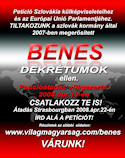
3/1/2008 – AHF joins international petition effort to call attention to the Benes Decrees. On September 20, 2007, the Slovak Parliament adopted a resolution proposed by extremist Jan Slota ratifying and confirming the Benes decrees. This is unacceptable. Make your feelings known. [Sign the petition] and read more about the cruel [Benes Decrees] which unjustly expelled thousands of Hungarian families from their ancestral homelands. See where the [demonstrations] will be held and get involved!
Help us help the community! Join us online.
10/20/2007 – Slovaks confirm Benes Decrees: “Hungarians are the cancer of the Slovak nation, without delay we need to remove them from the body of the nation” – Jan Slota. AHF releases statement on the Benes Decrees and recent extremist developments in Slovakia. “Having taken a step that has fueled ethnic hatred and assaulted good relations with Hungary, the Slovak Parliament on September 20, 2007 adopted a resolution proposed by extremist Jan Slota ratifying and confirming the Benes decrees. Those decrees shamefully imposed collective guilt on the Hungarian (and German) population of Czechoslovakia in 1945 and stripped them of their citizenship, rights and property without compensation. Czechoslovakia also pursued a policy of ethnic cleansing in southern Slovakia. The debilitations continue to affect many of the victims of the crimes committed in post-World War II Czechoslovakia.
The concept of collective guilt is abhorrent to Americans and to anyone committed to the rule of law, human rights and democracy. Rather than affirm the inviolability of the Benes decrees, Slovakia should reject them, provide legal redress to remedy their continuing and discriminatory effect and thereby adopt the values shared by the trans-Atlantic community of nations. [download the statement]
7/5/2005 – The Benes Decrees and Post Communist-era Developments – Bryan Dawson, AHF Information Office, Washington, D.C.
The 1945 Benes Decrees claimed collective World War II responsibility of Germans and Hungarians living in Czechoslovakia, and deprived them of their rights, their property and expelled many of them from the country. The Decrees, formally, are still in force. Austria, Germany, and Hungary are have called for the repeal of the laws.
According to the Decrees, 2.5 million ethnic Germans (Sudetendeutsch) and approximately 40,000 Hungarians were lost their Czechoslovakian citizenship, their land was expropriated and they were exiled. This transition was carried out over 1945-46, and was in many cases badly administered and brutal. Many people lost their lives. Ethnic Czechs were moved in to fill the empty towns.
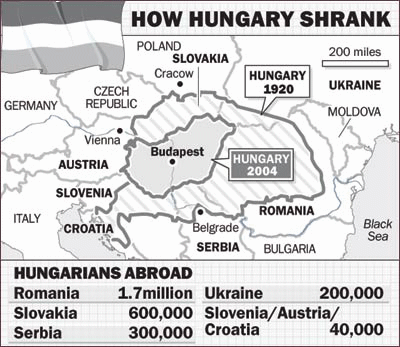
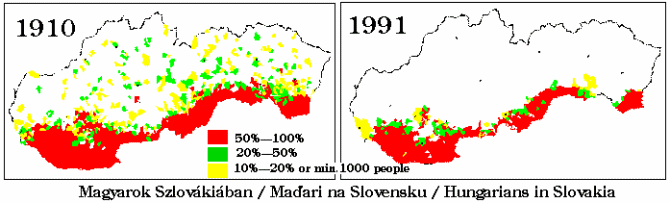
There are presently about 578,000 ethnic Hungarians, or Magyars, living in scattered settlements along the southern border areas of the Slovakia and constitute the largest ethnic minority in the country. This is 10.8% of the Slovak Republic’s population of 5,353,000 as estimated from a 1991 census and country population review from the UN. These numbers are easily argued as many ethnic Hungarians do not self-identify to avoid discrimination. In either case, these Magyars are what remains of the Hungarians in what was “Upper Hungary” for about 1000 years until 1919, when Czechoslovakia was created.
As written on “Hungarians in the Slovak Republic” from Slovakia.org, “Since the 1989 “velvet revolution,” Slovaks have had greater control over their region and nationalist sentiment has been growing. This has resulted in a series of Slovak laws restricting the use of the Hungarian language and what is perceived by the Hungarians as a campaign advocating racial discrimination against them by many Slovak politicians and the Slovak media. This anti-Hungarian sentiment has been made worse by the elimination of the moderating influence of the Czechs on Slovakia’s relationship with its Hungarian minority. The elimination of Czech influence became complete on January 1 1993 when Czechoslovakia formally divided into Slovakia and the Czech Republic. The anti-Hungarian sentiment is made worse by perceptions that Hungary is using Slovakia’s ethnic Hungarians as part of an expansionist policy, Whether or not this is actually the case, it is clear that Hungary does take an active interest in the well being of ethnic Hungarians living outside its borders, especially the large populations in Slovakia and Romania.”
Chronology of Events
Despite EU pressures and hopes that EU accession by Slovakia, anti-Hungarian nationalism remains a threat to regional stability. Some recent highlights from Slovakia.org:
October 26, 1991: The Slovak regional parliament votes to make Slovak the only official language in the region. The rights of minorities to use their own languages will continue to be respected. Hungarians can still use their native language in all official venues in communities where they constitute at least 20% of the population. Deputies of the Slovak National Party (SNP) walk out in protest, demanding that the law bar ethnic Hungarians and other minorities from conducting any kind of business in their mother tongues. This is followed by formal protests and hunger strikes by SNP supporters which continue well into November.
June 18, 1992: Reuters reports that in southern Slovakia some bilingual signs have been defaced and that slogans such as “Slovakia for the Slovaks” adorn the walls of houses.
June 30, 1992: The Financial Times reports that Hungary has called for autonomy for ethnic Hungarians in Slovakia.
July, 1992: The European Community expresses concern about the status of Slovakia’s national minorities and the Council of Europe Secretary-General Catherine Lalumiere visits Bratslava to discuss the matter with Slovak Prime Minister Meciar.
August 10, 1992: The New York Times reports that Slovak Prime Minister Meciar announced in parliament, when referring to Hungarians, that any ethnic politicians who roil national tensions will be treated as “political criminals.”
September, 1992: Ethnic Hungarians accuse Slovak police of brutally beating soccer fans from Budapest at a soccer match while Slovak fans cheer. Police claim they were merely subduing rowdy fans who had started fights.
September, 1992: Signs showing the names of ethnically mixed towns in Hungarian are ordered removed and state-run television bans those names from Hungarian-language television programs.
September, 1992: Prime Minister Meciar rejects any accord with Hungary on the minority issue calling the matter an internal affair.
September 1, 1992: The Slovakian parliament passes a draft constitution. Hungarian deputies walk out after parliament rejects their demands for cultural, educational, and territorial autonomy. The new constitution recognizes Hungarian as an official language only in regions where ethnic Hungarians constitute at least 20% of the population.
October 19, 1992: Reuters reports that permission has been refused for the creation of a Hungarian school system in Slovakia and that a proposal by Hungarian deputies to create a Hungarian university had been rejected.
January 2, 1993: Reuters reports that under a law passed last year, all official documents including birth certificates must be in Slovak as must all public ceremonies. This means that ethnic Hungarians must give their children Slovak names.
April 27, 1993: Slovak President Michal Kovac says that Slovakia will never grant autonomy to its Hungarian minority. His statement follows renewed calls by Coexistence for Hungarians to be given autonomy in districts in southern Slovakia.
May 13, 1993: Prime Minister Vladimir Meciar says that his government is ready to lift restrictions on the rights of ethnic Hungarians in Slovakia in accordance with the Council of Europe’s demands. This includes lifting the ban on the use of Hungarian first names and the mandatory use of a Slovak ending on all female last names. Slovakia wants to join the Council but has been prevented from doing so because of its perceived discrimination against minorities. Note: Meciar’s HZDS party never keeps its promise and those reforms that do occur are enacted by another government after the HZDS party is ousted.
June 8, 1993: The Irish Times reports that in order to join the Council of Europe, Slovakia plans to change local government boundaries in Hungarian populated areas. The borders currently run from north to south, slicing up the Hungarian population. Note: This promise is, to date, not kept. In fact, the government later proposes a redistricting plan which would make Hungarians a minority in all districts. This law passes in 1996.
June 30, 1993: Slovakia becomes a member of the Council of Europe despite Hungary’s reservations about Slovakia’s treatment of its ethnic Hungarian minority.
July, 1993: Prime Minister Meciar refuses to sign into law a bill that would have legalized the official use of Hungarian first and family names.
July 2, 1993: The St. Petersburg Times reports that the present demands of Hungarians in Slovakia include: the right to education in Hungarian beyond the elementary school level, the right to Hungarian street signs and the right to give Hungarian first names to their children.
August 12-16, 1993: Ethnic Hungarians block traffic through their village in protest against a government decision to remove a road sign written in Hungarian. The village later erects signs with question marks to replace the Hungarian-language signs. In June, the government allowed Hungarian signs to be put up alongside Slovak ones but the permission was rescinded on July 14 and communities were given until the end of July to remove the signs.
August 27, 1993: For the first time ever, Slovakia’s ethnic Hungarians hold a mass demonstration in the town of Komarno to defend their rights and demand the government’s compliance with the Council of Europe’s recommendations on minority rights.
September 24, 1993: Slovakia and Romania agree to coordinate their policies on the question of national minorities. Both countries have sizable ethnic Hungarian populations.
January 2, 1994: 500 ethnic Slovaks demonstrate in the southern Slovakian town of Surany against self-rule for ethnic Hungarians.
January 8, 1994: About 3,500 ethnic Hungarians, mostly local elected officials and parliament members, meet in the southern Slovakian town of Komarno to demand greater autonomy.
February 2, 1994: Slovak Foreign Minister Jozef Maravcik accuses Hungary of feeding “irredentist tendencies” within Slovakia’s ethnic Hungarian population. Note: Slovakian politicians repeatedly accuse Hungary of fueling Slovakia’s ethnic Hungarian population’s demands for cultural rights and separatism throughout the period covered by this chronology.
March 11, 1994: Slovakia’s government is ousted by a vote of no confidence.
March 14, 1994: Jozef Maravick is formally recognized as Prime Minister at the head of a 5-party coalition which will act as a caretaker government until elections next September.
May 27, 1994: Parliament passes a law allowing the country’s ethnic Hungarians to officially use Hungarian names. Deputies from the SNP and the HZDS storm out of the chamber in protest claiming that the law does not comply with the rules of Slovak grammar.
June 3, 1994: Parliament narrowly rejects a law which would allow signs in both Slovak and Hungarian in towns with at least a 20% Hungarian population. Hungarian deputies vote against the law because villages named after Slovak heros are to be excluded from the law’s provisions.
July 7, 1994: Parliament passes a law allowing some 590 Slovak towns and villages with at least a 20% ethnic Hungarian population to use bilingual signs.
March 19, 1995: Hungary and Slovakia sign a treaty agreeing on borders and the protection of ethnic minorities. Slovakia agrees to a clause calling for “appropriate laws or autonomous authorities” in areas where the country’s ethnic Hungarians constitute a majority. In return, Hungary recognizes the inviolability of Slovakia’s borders.
March 21, 1995: The World Coalition of Hungarians, which claims to represent 2.5 million Hungarians living outside of Hungary, states that the Hungary-Slovakia treaty constitutes nothing but empty promises.
March 27, 1995: Max Duraj, chairman of Coexistence, announces that despite the Hungary-Slovakia friendship treaty, Slovakia’s ethic Hungarians still want self-rule. Many Slovak nationalists think that the treaty went too far.
July 27, 1995: The Prime Ministers of Slovakia and Romania agree to boost bilateral ties and take a common stand on the sensitive issue of treatment of their large ethnic Hungarian minorities.
4 August 1995: Laszlo Nagy and two other ethnic Hungarian minority parties’ chairmen were being prosecuted for their statements allegedly defaming the republic, according to complaints lodged by the government Slovak National Party.
25 October 1995: Slovak Culture Minister Ivan Hudec said a new version of the state language law would restore the rights of Slovaks and correct for ethnic Hungarians having had too many rights. He also accused ethnic Hungarian politicians of reacting unreasonably to the new version of the bill.
12 June 1996: Slovak President Michal Kovak, visiting Hungary, urged his own government to pass legislation to protect the language rights of Slovakia’s Hungarian minority.
1 August 1996: Far-right members of Slovakia’s ruling coalition said it would propose the country withdraw from a basic treaty with neighboring Hungary over the issue of ethnic Hungarian abroad.
7 September 1996: The Slovak cultural and educational organization Matica Slovenska has warned the Council of Europe of “Hungarian irredentism in Slovakia.” On 25 August, their supporters protested against a demand for autonomy for the half-million strong Hungarian minority in south Slovakia and alleged violation of the rights of Slovaks in that area.
10 October 1996: Slovakia, appealing to be included in the first wave of new NATO members, said it was doing more for ethnic rights than some NATO states. Foreign Minister Pavol Hamzik said a proposed law protecting minority languages was all that was needed to improve human rights. The U.S. State Department said on 3 October that Washington was concerned about indications that the Slovak government’s commitment to democracy had been weakening.
23 October 1996: The traditional division of the country into four regions has been discarded in favor of a system with eight regions centered around the country’s eight largest cities. In addition, these eight regions are further divided into 79 district levels governments. With the new district organization, ethnic Hungarians would not be the majority of any district. At present the Hungarian minority is well-represented in Parliament and local governments, but not in the central government.
These continued actions on the part of Slovakia add fuel to an already explosive situation. Oppressive “Language laws,” preventing education, and forcing parents to choose certain nameshas no place in a new Europe of the 21st century. AHF will continue to monitor the situation and assist the Hungarian community in support of its right to free-association, basic human rights, dignity, and national self-determination. – special thanks to slovakia.org for the partial chronolgy and other material above.
2/4/2005 – Hungarians have until September 2005 to formally request return of confiscated properties in Slovakia under the Benes Decrees. The “Szabad Ujsag” weekly has published a list of those lands, which were taken away during the Benes programs. The original owners or their descendants may recover these expropriated lands and properties if they can prove their ownership and relationships to the original owner. The validated documents have to be shown to the proper athorities. One catch is that it has to be proven before September 1 of 2005. [Check the Database – in Hungarian and Slovak from Szabad Ujsag and the Hungarian Human Rights Foundation]