Hungarian Olympic Triumph!by Bryan Dawson
Did you know…as of 2016, Hungary ranks 8th in the world in medals at the Summer Olympic Games despite its being torn apart after WWI and losing half her population and 2/3 of her territory. This does not include an additional 6 medals won in the Winter Olympics nor the Hungarians that won medals as nationals of other countries after borders were redrawn or after large-scale emigration.
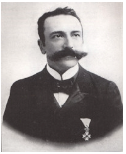
Ferenc
Kemeny,
founding
member of the International Olympic Committee.
The beginnings of the Olympic movement in Hungary go back further than the Games in Athens. Ferenc Kemeny, a great pacifist and member of the International Peace Bureau, was one of Pierre de Coubertin’s first kindred spirits, with whom he struck up a friendship in the 1880’s.
Kemeny took an active part in the Congress for the re-establishment of the Games held in Paris in 1894 and was one of the founding members of the International Olympic Committee (IOC). Coubertin supported Kemeny’s suggestion to hold the first Olympics in Budapest in 1896 in honor of Hungary’s 1000 years of statehood. While the dream of hosting an Olympics is not yet realized, Hungary has won more Olympic medals than any other nation that has never hosted the Games.
Hungary in the Olympics – Select a Year:
Sections:
- Master Name Index
- Sports
- Science, Mathematics, & Technology
- Film, the Arts, & Media
- Business & Politics
- Military
- Hungarian Nobel Prize Winners
- Hungarian Olympic Triumph
COPYRIGHT:
Please ask for permission and CITE this source, attributing Bryan Dawson, before using this information.
- [Start page]
- [Ferenc Kemeny and the Origins of the Olympic Movement]
- [1896, Athens]
- [1900, Paris]
[1904, St. Louis]
[1906, Athens]
- [1908, London]
- [1912, Stockholm]
- [1920, Antwerp]
- [1924, Paris]
- [1928, Amsterdam]
[1932, Los Angeles]
[1936, Berlin]
- [1948, London]
- [1952, Helsinki]
- [1956, Melbourne]
- [1960, Rome]
- [1964, Tokyo]
[1968, Mexico City]
[1972, Munich]
- [1976, Montreal]
- [1980, Moscow]
- [1984, Los Angeles]
- [1988, Seoul]
- [1992, Barcelona]
[1996, Atlanta]
[2000, Sydney]
- [2004, Athens]
- [2008, Beijing]
- [2012, London]
- [2014, Sochi]
- [2016, Rio de Janeiro]
1896 Athens Highlights
- Hajos Alfred Wins First Two Olympic Swimming Gold Medals, starting the Hungarian Swimming Olympic Medal tradition
- Speedwalkers take Silver and Bronze
Medal
Name
Event

Hajos Alfred
100m freestyle swimming /gyorsuszas
Hajos Alfred
1200m freestyle swimming /gyorsuszas

Dáni Nándor
800m Track Speedwalking

Szokoly Alajos
100m track Speedwalking (named Alojz Szokol as claimed as a “Slovak” champion)
Tapavicza Momcsilló
(Tapavica Momsilo)
Tennis
Kellner Gyula
Marathon
- See all 1896 medalists (magyarul / in Hungarian)
- Wikipedia (English)
Featured 1896 Olympians
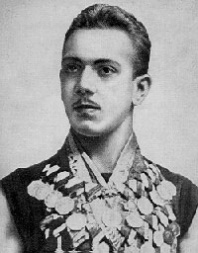
Alfred Hajos:
(b. 2/1/1878, Budapest d. 11/12/1955) Dubbed the
“Hungarian Dolphin” by the admiring Greeks.. Hajos
was the first-ever Olympic swimming champion, andthe first Hungarian
Olympic gold medalist. He won his medals in the 100-meter freestyle
(1:22.2), and the 1200-meter freestyle (18:22.2).

Alfred Hajos was 13 years old when he felt compelled to become a good swimmer after his father drowned in the Danube River. At the 1896 Games, the swimming events were held in the Mediterranean Sea battling the elements. The 18-year old Hajos won his two gold medals in extremely cold weather (the water temperature was about 50 degrees) with 12-foot waves crashing down on him. Before the 1200-meter race, he smeared his body with a half-inch thick layer of grease, but it proved to be of little protection. He confessed after winning the race that, “my will to live completely overcame my desire to win.” While at a dinner honoring Olympic winners, the King of Greece asked Alfred where he had learned to swim so well. Hajos replied: “In the water.”
- Won silver in 1924 for Architecture (controversy surrounded his second place showing as many felt he did not receive the Gold medal because the French did not want to award it to a non-Frenchman.)
- European swimming champion
- Hungarian track and discus champion
In 1930, Hajos created the Margaret Island National Sports Hall in Budapest
See more photos at International Olympic Committee Heroes