“Make the strangers welcome in this land, let them keep
their languages and customs, for weak and fragile is the realm which is based on a single
language or on a single set of customs.” “(Unius linguae uniusque moris regnum imbecille et fragile est)”St. Stephen in a letter to his son St. Emeric, 1036 A.D..
St. Stephen
of Hungary
St. Emeric
of Hungary
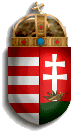
Above, you see the Coat of Arms of the Republic of Hungary with crown of
Vajk (pronounced similar to Vike) who made Hungary a Christian power and is now known as
St. Stephen (Szt. István), Hungary’s first Christian King, receiving his crown from the
Pope in 1000 A.D. The stripes on the heraldic right side represent the 7 Hungarian
(Magyar) tribes who established Hungary in the Carpathian basin in the 9th century.
The Apostolic white cross on its left, part of the coronation jewels presented to St.
Stephen, sits on the mountains that protected the borders of historic Hungary – the Tatra,
Matra, and Fatra. St. Stephen’s crown sits atop the arms with its crooked cross,
which according to legend, broke after the death of the great renaissance King, Matthias
Corvinus – Mátyás Király. It is said, “truth and justice died with
him.” This was soon to be prophecy, as Hungary’s tragic history began to
unfold. The crown jewels were taken to the US after the Romanian occupation force
attempted to remove them. The jewels were returned to Hungary by President Jimmy Carter.
St. Stephen was a member of the original Árpád Dynasty which established Hungary in the
Carpathian Basin in the year 896. His son, also canonized, is St. Emeric, the namesake of
Amerigo Vespucci, discoverer of North America. The images on the right have more
detailed and larger representations – click to view.
There is a lot here for those of you interested in Hungary
and Central and Eastern European politics, history, and culture.
Hungary has made phenomenal contributions to the world. I want visitors to my site to
learn something about this land so filled with tragedy and triumph, a proud past and
hopeful future. Though there is too much on these pages to describe in a few short
paragraphs, the following text offers a few shortcuts. Click on the blue links to skip
down to that area. I recommend, however, that you keep reading, take your time, and browse
through the page!
Among other things, below is an interesting briefing
I presented on the conflict in the former Yugoslavia that covers issues largely
undiscussed by our media, an English translation of the Székely
Himnusz (Székely National Anthem of Transylvania), and great maps
and images. The ever popular list of Hungarian Nobel Prize
Winners and Famous Hungarians now has photos and expanded biographical information. I
have also added information on the Treaty of Trianon and a page
dedicated to our Hungarian Olympians, their triumph in Atlanta,
and past gold medal winners since 1896!
You will also find links to resources that
will allow you to explore Hungary, Transylvania, and other Hungarian regions and related
topics. For example, you can contact Hungarian political organizations in Hungary and
Transylvania or visit the Hollosi Information Exchange. HIX is
a great site that provides databases, news, and the ability to automatically download
daily to your mailbox magazines and news articles from Hungarian and Western European news
agencies in both Hungarian and English. Add your name to its directory.
If you like food, you’ll love my links to
delicious Hungarian recipes – Paprika Power! And, authentic Mexican recipes that go beyond
tacos and burritos – Viva México!. Did you know there was an Austro-Hungarian
Emperor of Mexico? Maximilian. He was eventually executed along with his Hungarian
Huszárs. Poor guy…