minority, treaty, trianon, WWI, World War, autria, hungary,
romania, serbia, yugoslavia, croatia
The Treaty of Trianon
and
the Dismemberment of Hungary
“We must not forget that the territories on question
are in the vicinity of Russia, the most critical part of Europe today,
and so lie in the path of that advance of Bolshevism which must sooner
or later ensue…”
Accurate prophecy from a pamphlet entitled, “Justice for Hungary!”,
1932
The
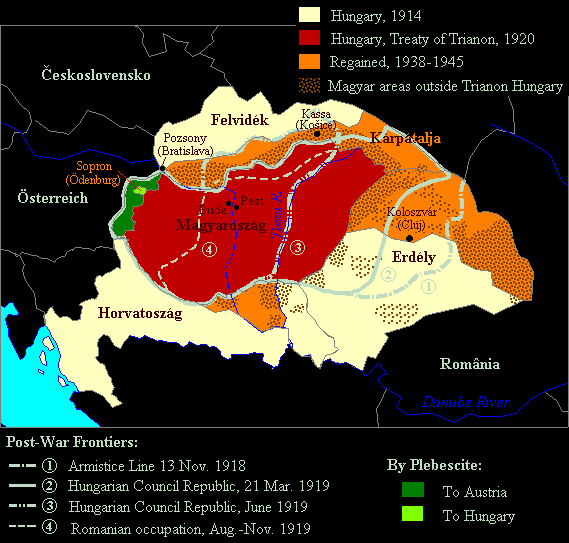
Treaty of Trianon (1920)…
in the aftermath of WWI, was extremely harsh on Hungary and
unjustifiably one-sided. The resulting “treaty” lost Hungary
an unprecedented 2/3 of her territory, and 1/2 of her total population
or 1/3 of her Hungarian-speaking population. Add to this the loss of up
to 90% of vast natural resources, industry, railways, and other infrastructure.
This was done to a nation whose borders were established
over a thousand years earlier (896 A.D.) and one who lost countless
lives defending the rest of Europe from numerous invasions from the likes
of the Mongolian Tatars and the Ottoman Turks.
Hungary experienced phenomenal economic growth during the latter part
of the 19th century and into the 20th. It’s alignment with another economic
powerhouse Germany, alarmed France and Russia. Each needed a way to stave
off German-Hungarian economic competition. With the advent of WWI, France
had her chance and began fostering anti-Hungarian sentiment among non-Magyar
speaking Hungarian nationals. It is important to note that for over a
thousand years, Hungary never experienced ethnic civil war. France, eager
to weaken Hungary, offered to reward those nations and groups that assisted
them in the war with large pieces of territory. The “Little Entente”
of Rumania (who switched sides in the last minute), Czechoslovakia, and
Serbia took that opportunity and got very lucky.
One thousand years of nation building successfully delineated groups
based on culture, religion and other attributes to create the countries
with which we are so familiar. While some Western European nations would
continue power struggles and princely battles and civil wars, Hungary
was a peaceful multi-ethnic state for those 1000 years and her borders
were unchanged. The West, in its infinite wisdom, created out of Hungary
and the Austrian Empire the unlikely “nations” of Czechoslovakia
and Yugoslavia. In Yugoslavia, groups that never wanted to live together
were thrust into nationhood. Catholic and Protestant Christian Slovenians,
Croatians and Hungarians were joined to Greek Orthodox and Serbian Orthodox.
All these people were in turn combined with Macedonian church followers,
and then Muslims. The developed Western regions of Slovenia and Croatia
(who was in peaceful confederation with Hungary for 600 years) were “Balkanized”
and now open to Serbian desires to dominate their economic and cultural
landscape. The treaty also doubled the size of a new country called Rumania
which was created only some 60 years earlier. Czechoslovakia and Yugoslavia,
the signatories of the treaty, have now ceased to exist, yet the borders
remain unchanged. Civil war, atrocities, rape and killing of children,
and continued
oppression are the result of French and allied meddling in Central
Europe. Perhaps they should turn their focus on Switzerland, another stable
multi-ethnic state!
The dictators in these successor states began to foster nationalism and
teach a less-than-accurate history to help bring legitimacy to their regimes.
These claims are based on some seriously unfortunate state propaganda-cum-history
about an ancient Roman
province called Dacia. In Rumania, this revised history, accelerated
by Ceaucescu, has become the accepted state historical doctrine even today,
making the process of reconciliation much more difficult. In the newly
formed Czechslovakia, Eduard Benes and his infamous “Benes
Decrees” forcibly expelled thousands and confiscated personal
and church properties. Today, the Slovaks, in what was Northern Hungary,
with their “Language Law” which sounds like something out of
Nazi Germany, forbid the use of Hungarian in official places. Perhaps
more unbelievably, the original bill, which was later amended, also forbade
Hungarian (or any other language) in church. In one of the most recent
attacks on human rights, the Slovaks have made the Hungarian National
Anthem illegal unless an official delegation has been invited by the government.
Still more recently in June ’97, a Hungarian teacher was fired because
he handed out bi-lingual grade reports to his students who were mostly
Hungarian. Efforts to guarantee anew the rights of the Hungarian “minorities”
in Slovakia continue. See the additional
steps the Slovak Government has taken against the Hungarian minority.
Though the United States recommended a more liberal approach in regards
to Hungary, it did not prevail. The
“self-determination of the nationalities” posited by President
Woodrow Wilson resulted in only one plebiscite in Sopron, in Western Hungary.
The vote was overwhelmingly pro-Hungarian and Sopron remained within the
new borders. Oddly enough, although Austria was also a loser in the war,
she also received a part of Hungary, and Sopron became a border city.
The Hungarians tried to resist, but the French moved troops into Upper
Hungary (now Slovakia) in defiance of the armistice agreement. The Hungarian
delegation at Trianon signed the “treaty” in protest. The dismemberment
and instability brought economic collapse and governmental crisis. A mini-communist
takeover, a republican government, finally gave way to Admiral Miklos
Horthy who took over as “Regent” of of Hungary and brought stability
back to the country. The new government got to work on trying to revise
the unjst treaty. Sadly, the US with its growing isolationist stance,
pulled out of the League of Nations and Western Europe wanted no part
in re-opening the case. France was focused on making sure Germany was
punished and paid its “reparations” even though it was France
who declared war on Germany! The Hungarians got a sympathetic ear from
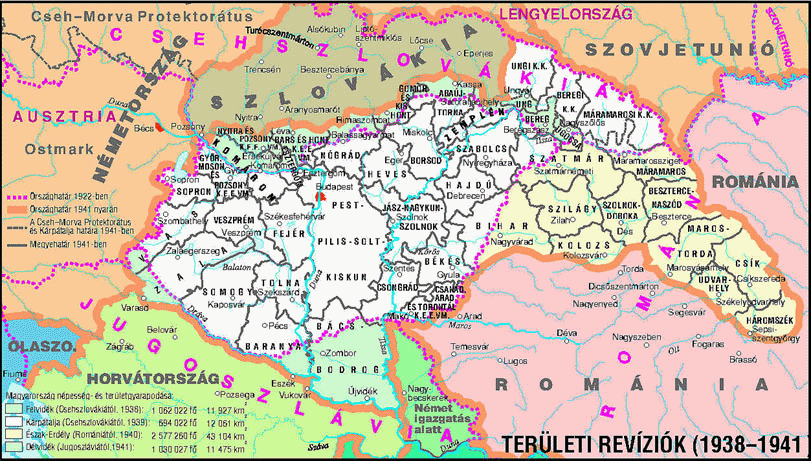
only Italy and Germany. This tragic alliance initially gained Hungary
part of her northern territory from Czechoslovakia and Northern Transylvania
from Rumania (see Territorial revisions map). But this alliance would
only to plunge her into another disaster and occupations by first Nazis
and later Soviet communists. Her land was again taken. One part of northern
Hungary was then transferred from Czechoslovakia and became part of the
Soviet Union and is today part of the Ukraine.
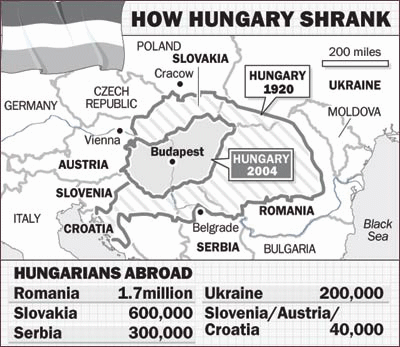
The
maps here not only show graphically the extent to which the Treaty of
Trianon dismembered Hungary, it shows how much Hungarian-majority areas
were arbitrarily “reassigned.”. But the Slovaks, Serbs, and
Rumanians, however, wanted much more. The Rumanians, also in defiance
of the armistice agreement with their new-found French allies, took advantage
of the turmoil in Hungary and moved troops into the defenseless nation
and occupied Budapest and beyond. To this day, the Greater Rumania Party
and other in Rumania still claim territory that includes the river Tisza
and even Budapest. Hungarians today are the one of the largest minorities
in Europe and face oppression and violence. Numbering in the millions,
Hungarian minorities are second only to the Russians who became “minorities”
with the dissolution of the Soviet Union. Hungarians live under harsh
persecution in the new states created by the treaty. The Helsinki Watch
Committee called Romanian efforts to “purify” Transylvania as
“Cultural Genocide.”
It is important to remember that the regions transferred were not part
of the Austrian “Empire” and “deserving” of liquidation,
but rather integral parts of Hungary who was herself part of the Austrian
Empire and fought two bloody revolutions to free herself. PLUS, THERE
WAS NO VOTE, except in a town called Sopron who voted to remain part of
Hungary despite the turmoil facing the nation in 1920. Today, these “minorities”
in their own lands are calling for autonomy and restitution of properties
illegally seized. As expected, their actions are called radical and revisionist,
and these governments do what they can to prevent justice. Despite the
thousands of legal cases in Rumania, for example, demanding church and
synagogue restitutions as provided under Rumanian laws, only a scant 1%
of these have been adjudicated. When will this all end?
The Corvinus Library has other resources on Rumanian-Hungarian
Affairs from the Origins of the Rumanians to the roots of conflict.
There is also an examination of the Daco-Rumanian
thesis posited by Rumanian nationalists.
HUNGARY:
A Short History, by C. A. Macartney, Fellow of All Souls College,
Oxford; Director of the Hungarian Section of the Foreign Office Research
Department; and Professor of International Relations, University of
Edinburgh, is another excellent resource on Hungarian History and Trianon