10/30/2004 – AHF Releases Statement on Vojvodina Violence. Reacts to Anti-Hungarian Grafitti: “Drop dead Hungarians”… In the last six months, non-Serbs, including members of Vojvodina’s 300,000-strong Hungarian minority, have been harassed and assaulted and their cemeteries and churches have been desecrated in a wave of physical violence, vandalism and anti-Semitism. [download the statement] or [Read it below].
Background
The Minority
communities in Serbia’s former Hungarian northern province of Vojvodina
(Vajdaság) are feeling the heat after stunning gains by Serbian
ultra-nationalists raised fears of a return to the ethnic violence of
the 1990s.
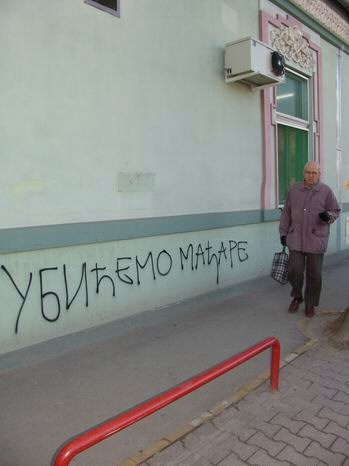
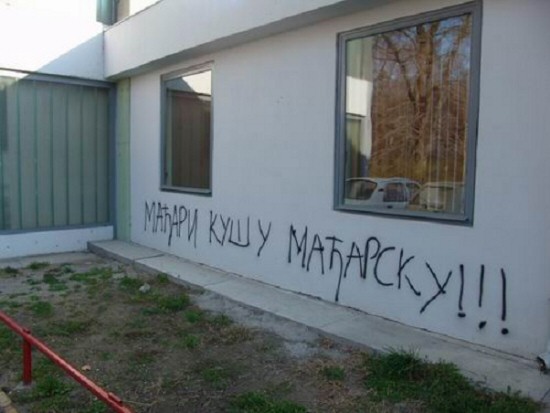
Residents in the province’s capital, Novi Sad (Ujvidek), were woken by drunken mobs over Serbian New Year on January 13-14 shouting, “Hey Serbs let’s butcher the Croats! Hey Serbs, let’s butcher the Hungarians!” In recent developments, Serbs riot and set historic landmarks on fire and spray graffiti saying “We Will Kill Hungarians.”
During the recent bloodshed in Kosovo, violence also broke out in the northern Serb province of Vojvodina. According to Tanjug News Agency in Belgrade, there were several dozen protests throughout the province. The region’s large ethnic Hungarian minority was the target of the attacks especially in the provincial capital of Novi Sad.

Duna TV on March 19 reported a group of demonstrators had “vandalized and smashed up things and set fire to them.” The mob also attacked the Magyar Szinhaz (Hungarian Theater), a symbol of Hungarian culture in Vojvodina. The report states that following a performance, a shouting crowd marched in front of the theater and broke the doors and windows as well as ripped off the posters and pictures promoting the show. The Tanjug News Agency on March 22 reported several injuries during the protest.
According to Radio B92 in Belgrade, nationalist graffiti was found on a cathedral saying “Death to Hungarians” in the northern city of Novi Sad (Ujvidek). There have been many cases of anti-Hungarian graffiti in the city.

On Duna TV (March 19), the Alliance of Vojvodina Hungarians (SVM) condemned the violence and called for the ethnic Hungarians to stay calm. Peace and stability has returned after the few days of protests. On Kossuth Radio (March 20), Jozsef Kasza, leader of SVM, “demanded that the Serbian government prevent the settling of ethnic scores and that it punish the perpetrators of the law and order offences that had taken place at the Theater.” Tanjug News Agency stated that criminal charges have been filed against numerous individuals who participated in the violent acts in Vojvodina.
March 2004 brought more sadness and fear when 85 crosses were pulled out and broken in Subotica (Szabadka). Another 100 had been destroyed in a previous attack in a different cemetery in January. The police always come up with some useless “results” This time they say it was two 7-year-olds who did it.
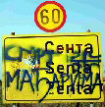
Violence and anti-Hungarian graffiti spread to smaller towns as well: Zenta (35,000, 70% Hungarian) and the neighboring Ada (20,000, 75% Hungarian). See on the left, Zenta’s city sign was vandalized with the words “Death to Hungarians” on April 4, 2004.
AHF STATEMENT – “Drop dead Hungarians”
In the last six months, non-Serbs, including members of Vojvodina’s 300,000-strong Hungarian minority, have been harassed and assaulted and their cemeteries and churches have been desecrated in a wave of physical violence, vandalism and anti-Semitism.
“When the Setets family set off this morning to take their 13-year-old daughter to school, they got a shock. As they left their small, two-room house on the outskirts of Subotica, in northern Serbia, they found a 15-inch kitchen knife embedded in their front door. Alongside it, someone had sprayed the Serbian word for ‘death’ in red. Further to the right was ‘Drop dead Hungarians.’” The New York Times, September 16, 2004.
On July 9, 2004, thirteen Members of Congress, including members of the Congressional Human Rights Caucus and the Hungarian American Caucus, wrote to the Prime Minister of Serbia and Montenegro, Vojislav Kostunica, to express their “concern regarding the rise of anti-Hungarian violence in the province of Vojvodina.”
Throughout this wave of violence and intolerance, the Serbian authorities have turned a blind eye to these hate crimes. This moved Congressman Tom Lantos, Ranking Member of the House International Relations Committee and a co-chair of the Hungarian American Caucus, on July 9, 2004 to urge Prime Minister Kostunica to “take immediate action to curb those Serbian elements in Vojvodina which are targeting Hungarian and other minorities as scapegoats. It is important that the Government of Serbia vigorously investigate and prosecute the criminal elements responsible for these hate crimes. Government leaders, under your direction, should undertake a high profile campaign to condemn anti-minority hostilities and restore the centuries-old spirit of inter-ethnic harmony.”
Unfortunately, neither has there been a high profile campaign nor have the perpetrators been brought to justice.
Vojvodina is one of two provinces in the Republic of Serbia which along with Montenegro forms Serbia and Montenegro. Vojvodina occupies the northern one-fifth (8,348 sq. miles) of the country’s territory, bordering Hungary in the north, Croatia in the west, Bosnia-Herzegovina in the southwest, Serbia proper in the south, and Romania in the east. The province has 2.2 million inhabitants of which 57 percent are Serbs, 17 percent Hungarians, 5 percent Croats, 3 percent Slovaks, 2 percent Montenegrins, 2 percent Romanians, 1 percent Ruthenians, and 13 percent others. These numbers are based on the 1991 census and have likely changed during the Balkan wars in the 1990’s.
Prior to World War I Vojvodina was part of Hungary for approximately 1,100 years, with the exception of 200 years of Turkish occupation (1526-1699/1718). That occupation resulted in the depopulation of the area. Thereafter, the Habsburgs began to repopulate the area with German and Serb settlers and the Hungarians also began to resettle in the region. In 1910 the 1,320,000 inhabitants included 30.2 percent Hungarians, 25 percent Serbs, 23 percent Swabian Germans, 10 percent other South Slavs (including Croats, Bunjevci, Sokci), and 10 percent others (Romanians, Slovaks, Ruthenians). It is unlikely that this region would have become part of Yugoslavia had Woodrow Wilson’s principle of self-determination been respected. It was not and the Paris peace treaties awarded Vojvodina to the newly created Kingdom of Serbs, Croats and Slovenes (renamed Yugoslavia in 1929).
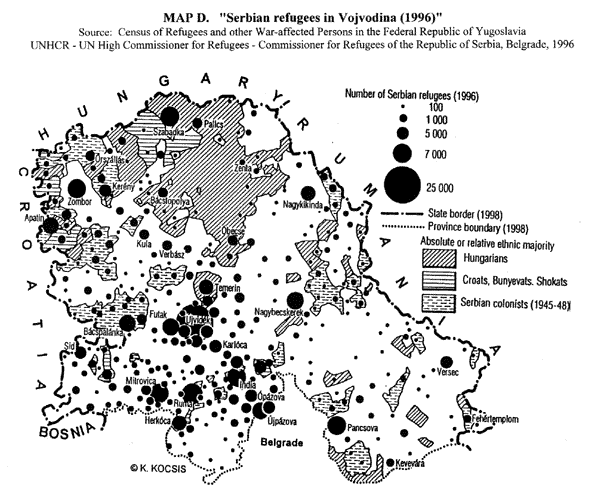
The Serbs began an aggressive Serbianization process that, among other things, radically altered Vojvodina’s ethnic composition in the 20th century. As soon as Vojvodina was transferred to Yugoslavia, they moved tens of thousands of Serb families into Vojvodina, dispossessing the original residents. This was repeated after World War II when twenty to thirty-five thousand Hungarian men and boys were massacred between October and December 1944. An additional 40-50,000 Hungarians fled this terror.
A third wave of “ethnic cleansing” took place under Milosevic: tens of thousands of Serb families poured in from Kosovo, Croatia, and Bosnia, while some hundred thousand Hungarians and Croats fled the forced mobilization and intimidation. The ethnic structure of Vojvodina has thus been significantly altered — international treaties notwithstanding — through forced or state-sponsored relocation, in favor of the Serbs, as noted above.
In 1988 Milosevic’s Serbian parliament, supported by populists rallies financed by Serb nationalists, destroyed the province’s autonomy when it illegitimately overturned the 1974 Yugoslav Constitution, which guaranteed legislative, executive, and judicial powers to both Vojvodina and Kosovo. As noted by the March 15, 2001 RFE/RL Newsline, “[d]estroying the two provinces’ autonomy was an important step in the consolidation of Milosevic’s power.” For Vojvodina this has resulted in domination by Belgrade and loss of the right to local self-government.
Despite years of intimidation, Vojvodinians consistently and peacefully voted against Milosevic, demonstrating their deep commitment to democracy. Milosevic is gone and on trial for war crimes. The decimated minorities and those Serbs whose historical roots are in Vojvodina are still waiting for the restoration of autonomy, both territorial for the province (indeed, legislative, executive, and judicial) and “personal” autonomy (in education, the media, publishing, and cultural institutions) for members of the ethnic minorities. They are still waiting for the intolerance to stop, the xenophobia to vanish, and the criminals to be brought to justice. – Frank Koszorus, Jr. (Professor Andrew Ludanyi and Tibor Purger contributed to the background on Vojvodina).
Related
- << Back to AHF news on Vojvodina
- AHF Statements on Trianon
- AHF Articles
- External links on Vojvodina
- Congressional Resolutions and Records
Vojvodina (Vajdsaság in Hungarian), an integral part of Hungary for over 1000 years, was awarded to the newly formed Yugoslavia by the French at the “Treaty” of Trianon in 1920 when Hungary lost 2/3 of her territory and 1/3 of her Hungarian population. Intimidation, large scale evictions and ethnic cleansing, emigration, and fear of self-reporting have official estimates of only 300-350,000 ethnic Hungarians remaining in the province. Some, however, estimate this number to be double that since many fear self-reporting as Hungarian exposes them to risk.The American-Hungarian community is increasingly concerned by ethnic violence in Vojvodina.
“Ethnic Cleansing” in action
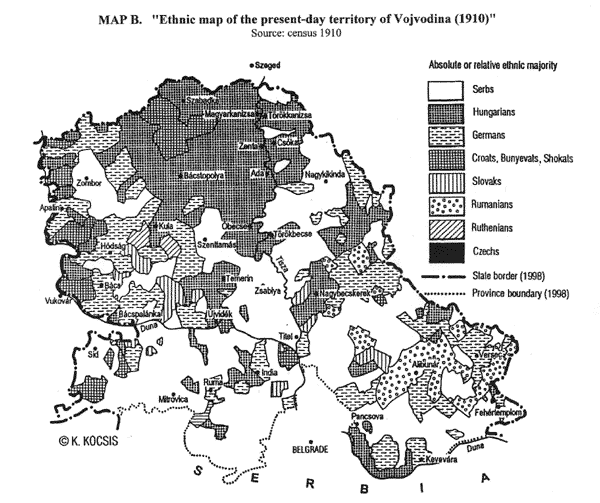
How did this region become part of Yugoslavia? Read “The Conflict in the Former Yugoslavia and Autonomous Region of Vojvodina, and the Need for a More Coherent U.S. Foreign Policy” by Bryan Dawson and refer to the following demographic maps comparing Vojvodina in 1910 and 1991. Note the decline seen here in Hungarian population does NOT take into consideration the Balkan conflicts and the significant escalation of atrocities against Hungarians over the last decade:

One thousand years of nation building successfully delineated groups based on culture, religion, geography, and other attributes to create the countries with which we are so familiar. While some WesternEuropean nations would continue power struggles and princely battles and civil wars, Hungary, founded in 896, was a peaceful multi-ethnic state for a 1000 years and her borders were virtually unchanged. Until 1920…
The Treaty of Trianon in 1920… in the aftermath of WWI, was extremely harsh on Hungary and unjustifiably one-sided. The resulting “treaty” lost Hungary an unprecedented 2/3 of her territory, and 1/2 of her total population or 1/3 of her Hungarian-speaking population. Add to this the loss of up to 90% of vast natural resources, industry, railways, and other infrastructure. The clear winner of the land grab, was Rumania, who, established only 60 years earlier, more than doubled in size overnight.
AHF Related Links
- News from Rumania
- News from Vojvodina [I], [II], [III]
- Slovakia and the Benes Decrees
- Hungarian Flags Flying Again in Slovakia
- Rumania’s Basescu in the US
- AHF on Dual Citizenship for Hungarians
- The Csango Hungarians of Moldavia
- The Tragedy of the Treaty of Trianon
External Links
- Purchase the book, “The Hungarian Kosovo” by Sam Vankin, UPI Senior Business Correspondent
- Institute for War and Peace Reporting
- United Press International (UPI)
- “The
Conflict in the Former Yugoslavia
and Autonomous Region of Vojvodina,
and the Need for a More Coherent
U.S. Foreign Policy” on The Hungary Page - NATO EXPANSION FLASHPOINT NO. 2: The Border between Hungary and Serbia, by Ted Galen Carpenter and Pavel Kislitsyn. A Cato Foreign Policy Briefing No. 45 November 24, 1997
Read additional Stories in HUNGARIAN
- 10/14/2005 – Koszorús Ferencet idézi az újvidéki Magyar Szó: „NEMZETKÖZIESÍTSÜNK”-E VAGY SEM: Tojástánc [tovább]
6/10/2005 – A MAGYAROK CSAK TÁNCOLJANAK: Egybehangolt lejáratási kampány a VMSZ ellen [tovább]
“Magyarellenes Falfirkák Szabadkán,”
MAGYAR SZÓ, Novi Sad/Újvidék (in Hungarian) 4/3/2004- “Temetőgyalázás,”
MAGYAR SZÓ, Novi Sad/Újvidék (in Hungarian)
3/29/2004 - See the International Crisis Group Report on Serbia from July 1994: Serbia’s Changing Political Landscape, a Briefing. An excerpt regarding Serb violence: “Some Serbs in Vojvodina are demonstrating behaviour reminiscent of that which they so frequently and vociferouslt condemn the Kosovo Albanians.“


Monica
Seles – (b. in the Vajdaság (Vojvodina), the Hungarian region
that was given to Serbia/Yugoslavia.)
Tennis Superstar – She has won 9 Grand Slam
singles titles and bronze in Sydney 2000!
Seles (pronounced sell-esh and spelled Szeles Monika) won the European junior championship at the age of ten. Born to a Hungarian family in the former Hungarian province of Vojvodina, she moved to the United States in 1986, and in 1989 turned professional. In 1990 she won her first French Open, and in each of the following two years she won the Australian, United States, and French opens. Seles won the Australian Open in early 1993, but later that year, while resting between sets during a tournament in Hamburg, Germany, she was stabbed by a spectator. The incident caused Seles to withdraw from competition in 1993 and 1994. Seles returned to competition in 1995 and won the initial tournament of her comeback, the Canadian Open. In 1996 she again won the Australian Open.
Monica is a fierce competitor and is still going strong into the new millennium including winning the Bronze medal at the 2000 Sydney Olmpics!
See: http://www.angelfire.com/tx/MONICASELES/index2.html or a small bio: http://www.bartleby.com/65/se/SelesMoni.html