9/13/2017 – Ukraine Language Law: AHF submits letter to US Secretary of State Tillerson regarding the inexplicable decision by Ukraine prohibiting Hungarian children of western Ukraine to study in their mother tongue (as well as in Ukrainian) beyond the 4th grade. That discriminatory law threatens the Hungarian minority’s culture and infringes on fundamental freedoms insofar as the survival of any national minority is to a large extent dependent on its ability to preserve and cultivate its culture, especially its language.
The law not only violates commitments made by Ukraine, it has unnecessarily resulted in tensions between Hungary and Ukraine. The letter appears in full below and available for [download]


The AHF Letter to Secretary Tillerson is available for download:
English
September 13, 2017
The Honorable Rex W. Tillerson
Secretary of State
United States Department of State
Washington, D.C. 20502
Dear Mr. Secretary:
We write to express our deep concern regarding a discriminatory law passed by Ukraine’s parliament stripping the ability of Hungarian children of western Ukraine* to study in their mother tongue (as well as in Ukrainian) beyond the 4th grade. That discriminatory law threatens the Hungarian minority’s culture and infringes on fundamental freedoms insofar as the survival of any national minority is to a large extent dependent on its ability to preserve and cultivate its culture, especially its language. The law not only violates commitments made by Ukraine, it has unnecessarily resulted in tensions between Hungary and Ukraine.
The American Hungarian Federation (“AHF”), founded in 1906, represents a broad cross-section of Americans who trace their heritage to Central Europe. Throughout its 110 year old existence, AHF has supported democracy, minority rights in Central and Eastern Europe, a strong NATO and an open door policy toward NATO enlargement to include countries which seek and qualify for membership.
AHF believes a cornerstone of U.S. security interests in a region that has not always been tolerant of its Hungarian (and other) minorities is the protection of minority rights in accordance with Western standards and bilateral agreements.
As a member of the Central East European Coalition (“CEEC”) representing 18 national, membership-based organizations, AHF has supported and supports measures against Russia for its occupation of Ukraine. AHF also believes, however, that a democratic and tolerant Ukraine would build on the most effective measures devised by the West to strengthen the country. A weak, corrupt and intolerant Ukraine, on the other hand, would enable Russia to continue to fish in muddy waters and continue its aggressive policies.
With these considerations in mind, we are writing to respectfully urge you to publicly and unambiguously express your concern relative to Ukraine’s discriminatory education law.
Most respectfully,
Frank Koszorus, Jr.
Bryan Dawson
Chairman, Board of Directors
Vice-President
____________________________________
*The Hungarians in Ukraine number 150,000 and largely inhabit the Zakarpattia Oblast region which was part of Hungary until the post WW I Treaty of Trianon dismembered that country.
Hungary was the first country to recognize Ukraine’s independence in 1991. The two countries entered into an agreement that, among other things, provided for the preservation of the ethnic, cultural, linguistic, and religious identities of the members of the Hungarian minority in Ukraine and guaranteed that they could be educated at all levels in their mother tongue.
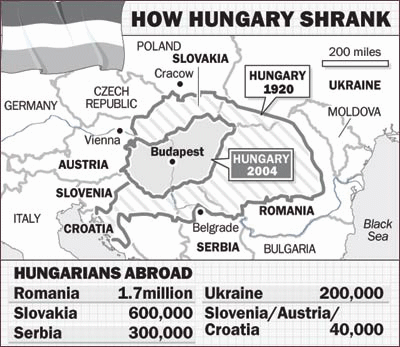
Why so many Hungarians Across the Border?
A thousand years of nation building successfully delineated groups based on culture, religion, geography, and other attributes to create the countries with which we are so familiar. While some Western European nations would continue power struggles and princely battles and civil wars, Hungary, founded in 896, was a peaceful multi-ethnic state for over a 1000 years and her borders were virtually unchanged…. Until 1920.
“The greatest catastrophe to have befallen Hungary since the battle of Mohacs in 1526,” the Treaty of Trianon in 1920, was extremely harsh on Hungary and unjustifiably one-sided. The resulting “treaty” lost Hungary an unprecedented 2/3 of her territory, and 1/2 of her total population or 1/3 of her ethnic-Hungarian population. Add to this the loss of all her seaports, up to 90% of her vast natural resources, industry, railways, and other infrastructure. Millions of Hungarians saw borders arbitrarily redrawn around them, without plebiscites, ignoring President Wilson’s lofty goal of national self-determination. The affects of this dictat are felt strongly today throughout the region. Two of the three newly created countries carved out of Hungarian territory no longer exist. “Slovakia” (Upper Hungary) split with the Czech Republic while “Yugoslavia” suffered from civil war and the ravages of ethnic cleansing. This should never have happened. Hungarian populations continue to decline significantly after forced removals such as the Benes Decrees and other pograms, and continued pressure and discriminative policies such as the 2009 Slovak Language Law, the Slovak Citizenship Act which is being used to strip Hungarians of their citizenship and status, and gerrymandering and other practices in Romania and Serbia.
The United States never ratified this treaty. At the time President Wilson said: “The proposal to dismember Hungary is absurd” and later Sir Winston Churchill said: “Ancient poets and theologians could not imagine such suffering, which Trianon brought to the innocent.” We are sad to report that they were right.
[read more] about the Treaty of Trianon
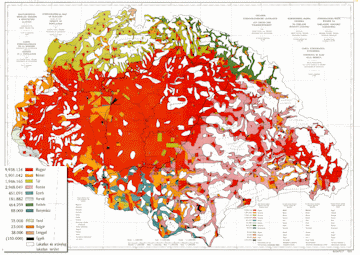
Ethnic Distribution in the Kingdom of Hungary in 1910 (Hungarians shown in red)
[download extra large image 4962×3509]
[download large image 1000×707]
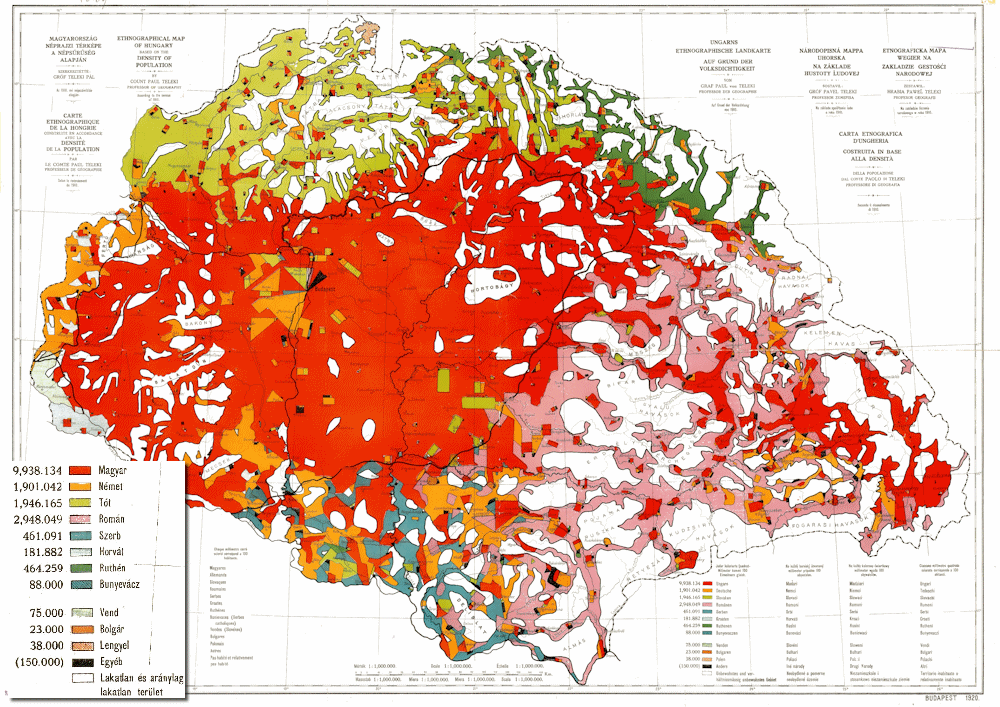
Hungarian populations declined significantly after forced removals such as the Benes Decrees and other pograms, the effects of WWI, and Trianon in 1920. With continued pressure and discriminative policies such as the 2009 Slovak Language Law, the Slovak Citizenship Law, discriminatory practices in Rumania and Serbia, this trend has continued over the past 90 years.
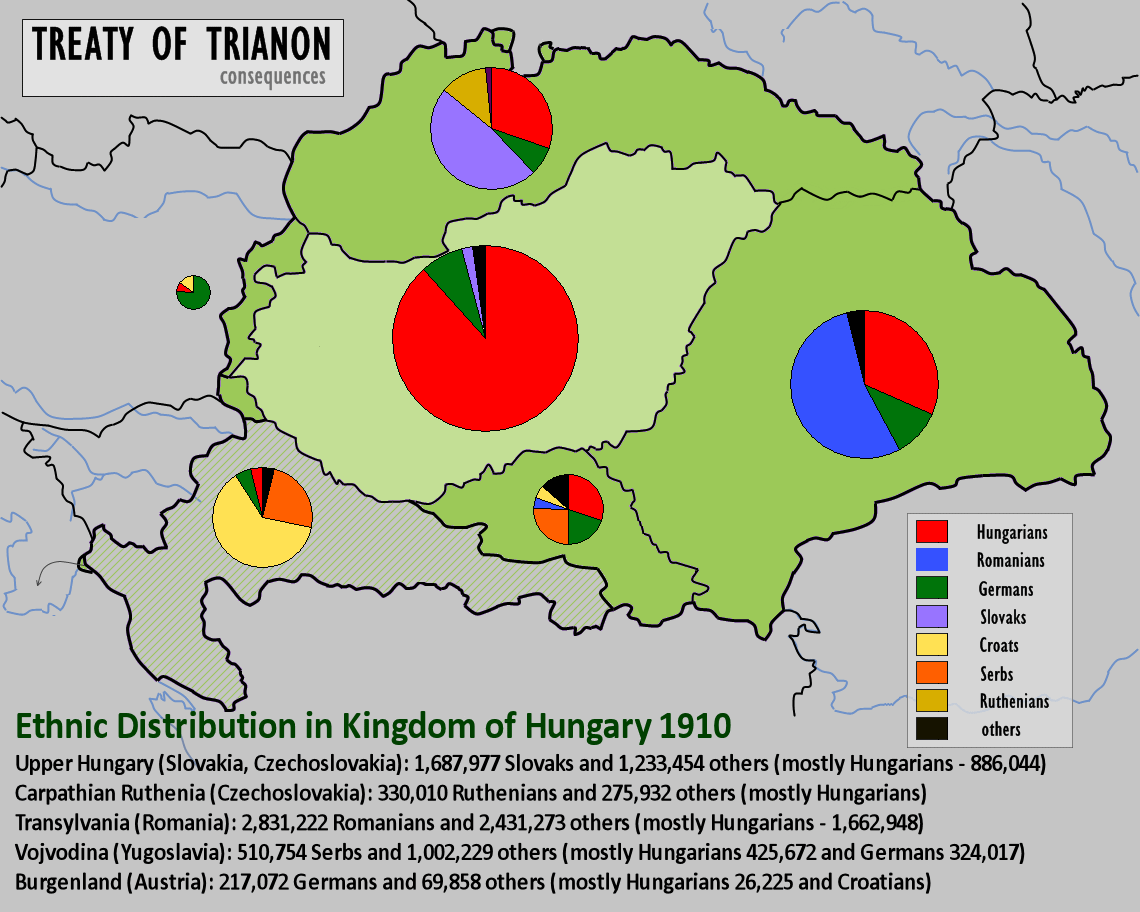
- In Upper Hungary (awarded to Czechoslovakia, now Slovakia): 1,687,977 Slovaks and 1,233,454 others (mostly Hungarians – 886,044, Germans, Ruthenians and Roma) [according to the 1921 census, however, there were 1,941,942 Slovaks and 1,058,928 others]
- In Carpathian Ruthenia (awarded to Czechoslovakia after WWI and then annexed by Stalin to the Soviet Union (Ukraine) after WWII): 330,010 Ruthenians and 275,932 others (mostly Hungarians, Germans, Romanians, and Slovaks)
- In Transylvania (awarded to Romania): 2,831,222 Romanians (53.8%) and 2,431,273 others (mostly Hungarians – 1,662,948 (31.6%) and Germans – 563,087 (10.7%)). The 1919 and 1920 Transylvanian censuses indicate a greater percentage of Romanians (57.1%/57.3%) and a smaller Hungarian minority (26.5%/25.5%)
- In Vojvodina 510,754 Serbs and 1,002,229 others (mostly Hungarians 425,672 and Germans 324,017)
- In Vojvodina and Croatia-Slavonia combined (awarded to Yugoslavia): 2,756,000 Croats and Serbs and 1,366,000 others (mostly Hungarians and Germans)
- In Burgenland (awarded to Austria): 217,072 Germans and 69,858 others (mainly Croatian and Hungarian)
[read more] about the Treaty of Trianon
Join and Support Us Online!

Related

Amerikában is tiltakoznak az ukrán oktatási törvény ellen. Amerikai Magyar Szövetség levelet intézett az Egyesült Államok külügyminiszteréhez, Rex Tillersonhoz, amiben aggodalmát fejezte ki amiatt, hogy az ukrán parlament megszavazta a nyelvtörvényt, amely sokak szerint az ukrajnai kisebbségi magyarokat megfosztja attól a lehetőségtől, hogy 4. osztály után anyanyelvükön tanuljanak. A diszkriminatív törvény a magyar kisebbség kultúráját fenyegeti és alapvető szabadságát sérti. A nemzeti kisebbség túlélése ugyanis nagymértékben függ kultúrája megőrzésétől, aminek alapvető eszköze a nyelvhasználat. [tovább]
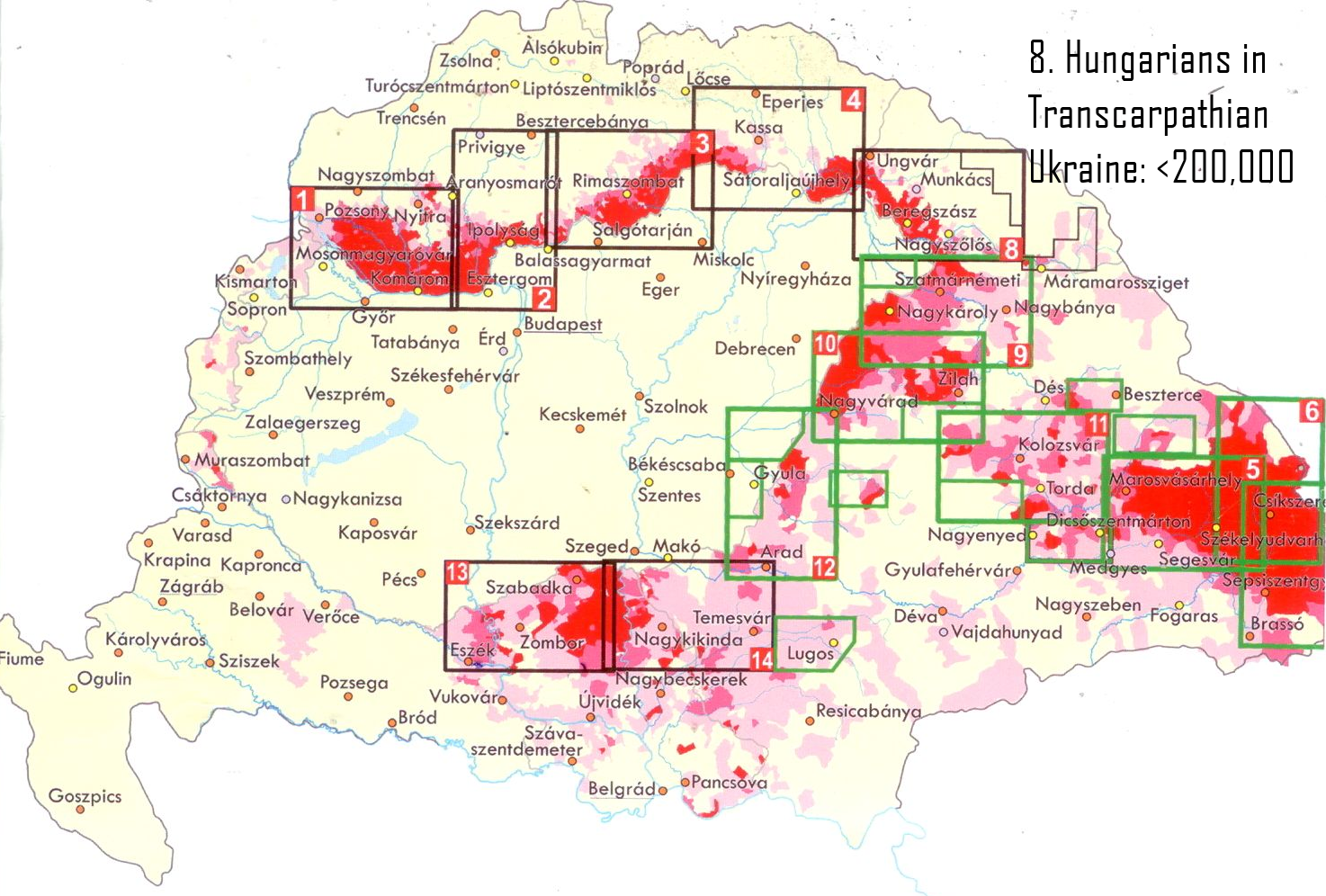
3/10/2014 – Ukraine: AHF Releases another Statement on the Plight of the Hungarian Minority in Transcarpathia. “Minority rights is a dimension to the complexity of Ukraine and the region that perhaps is laden with less immediate strategic significance but one that calls out for immediate attention to dispel the fear of perpetual conflict and to promote a democratic Ukraine. What is too often overlooked relates to the treatment of national minorities generally and specifically to Ukraine’s close to 200,000 ethnic Hungarians who live in western Sub-Carpathia, an area which was part of Hungary.” [read more]
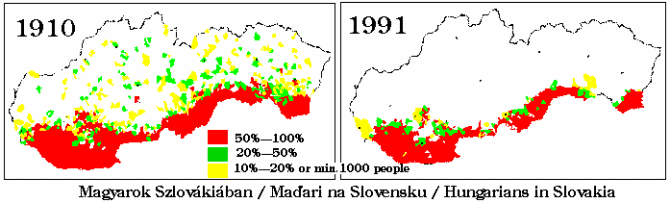
In 2005 and amended in 2009, Slovakia Criminalized the use of Hungarian: Under the act, the use of the minority language in official communication would be punishable in towns and villages where the ethnic community makes up less than 20 percent of the total population. [read more]
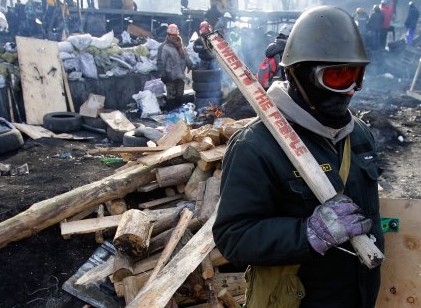
2/28/2014 – AHF Releases Statement in Connection with Recent Events in Ukraine calling attention to the plight of the Hungarian minority in Transcarpathia Ukraine. AHF urges the transitional government in Ukraine to fulfill the spirit of democracy as government for the people, by the people, and respect pluralism, the rule of law, and the rights of the Hungarian minority, including their democratically asserted right to autonomy. [read more]
3/28/2014 – Ukrán válság – üzent az Amerikai Magyar Szövetség: A legnagyobb amerikai magyar szervezet, az Amerikai Magyar Szövetség közleményben hívja fel az Egyesült Államok és az Európai Unió figyelmét a kisebbségi jogok problémájára az ukrán válság kapcsán. Az írás Barack Obama ma kezdődő európai útja előtt jelent meg. [tovább]
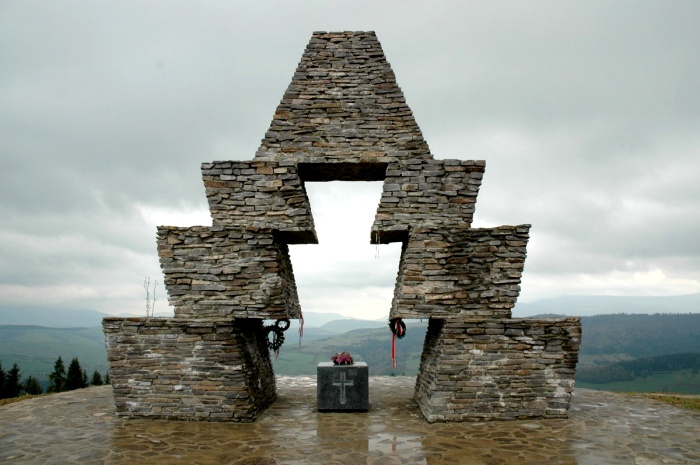
3/27/2014 – “Strengthen Ukraine by Strengthening Minority Rights:” As Russia completes the annexation of Crimea, creating a fait accompli probably impossible to reverse, the situation in Ukraine proper remains fraught with uncertainty. For the Hungarian minority in Ukraine the situation is especially precarious, particularly in light of a proposed ban on minority languages currently being pushed by nationalists in the Ukrainian parliament. While the legislation is currently stalled, it is essential that the United States and the European Union remind those Ukrainians hostile towards ethnic minorities that, as noted by World Jewish Congress President Ronald S. Lauder, “one of the basic tenets of liberal democracy is that minority rights are protected.” This is especially important because the backlash to the loss of Crimea could fuel ultra-nationalism and intolerance. [read more]

Ukraine’s Hungarian Minority Nervous as Crisis Rages [more]
March 2014 – Vandalism of Hungarian monument in Ukraine “appalling”, says govt official [more]
April, 2011 – Hungarian memorial vandalized in Western Ukraine [more]
2011 – Hungarian Minority Communities Targets of Intimidation, Incitement and Vandalism throughout Central Europe – Hungarian Human Rights Foundation [more]