Video Coverage
HirTV: Felavatták Gróf Esterházy János szobrát Budapesten – 2013.05.15 [YouTube]
HIRADO: Felavatták Esterházy János első budapesti szobrát
[MTV Videotar]
Kassa, az Esterházy-szobor avatása – kommentár nélkül (Slovak nationalists chant “fascist, fascist” and disrupt solemn event) [youtube]
Kassa, az Esterházy-szobor avatása (teljes) [YouTube]
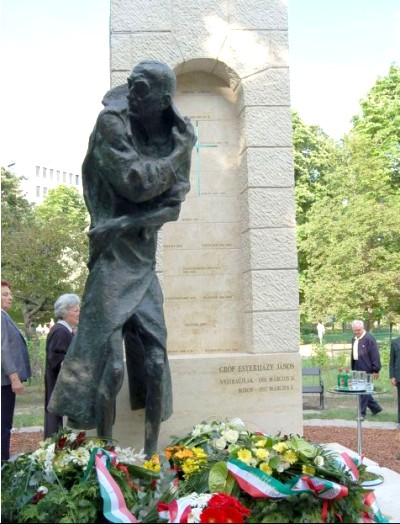
5/20/2013 – AHF welcomes the unveiling of statues of Count Janos Esterhazy, hero of the Holocaust, in Budapest and Kassa (now Kosice after annexation). AHF has long called for Esterhazy’s exoneration, despite strong opposition from Slovak nationalists, and recently published key documents from Simon Wiesenthal, Yad Veshem, and historians Dr. Magda Ádám and Dr. István Deák that attest to his principled stand and actions to save Jews during World War II and protect the Hungarian minority in Slovakia. Hungary’s Heti Valasz published the article below. Videos are also shown here of the ceremony held in Slovakia and the disruptions there.

Az amerikai magyarok üdvözlik Esterházy János budapesti szobrának felállítását. A legnagyobb amerikai magyar szervezet, az Amerikai Magyar Szövetség közleményben üdvözli Esterházy János budapesti szobrának felállítását. A XII. kerületi Gesztenyéskertben május 15-én leplezték le a felvidéki magyar politikus első budapesti szobrát, Nagy János alkotását. [tovább]
A Szövetség már régóta küzd Esterházy János gróf szlovákiai rehabilitálásáért. Esterházy János a szlovák parlament egyetlen tagja volt, aki 1942-ben a zsidótörvény ellen szavazott. Egyszerre küzdött a zsidók és a magyar kisebbségek jogaiért.
„Sajnálatos, hogy a totalitárius ideológia vezette mai politika megkísérli, hogy megváltoztasson, semmibe vegyen, kitöröljön történelmi tényeket. Szégyentelen történelemhamisítás folyik Esterházy János esetében, aki elkötelezett antifasisztaként zsidó életeket mentett és a magyar kisebbség jogaiért harcolt Szlovákiában. Esterházy, akit a Szovjetunió és akkori szövetségese, Csehszlovákia koholt vádak alapján tartóztatott le, kommunista börtönben halt meg. (Oroszország már 1993-ban rehabilitálta.) Figyelmen kívül hagyva alapvető tényeket, néhány idegengyűlölő azon fáradozik, hogy Esterházy antifasiszta tevékenységét kicsinyítse. Hamis érvelésben becsmérlői azt állítják, hogy nem lehet rehabilitálni, mert háborús bűnösként ítélték el” – írja az Amerikai Magyar Szövetség.
Honlapjukon a Wiesenthal Intézet levelei, Ádám Magda történész, Jeszenszky Géza történész, jelenlegi oslói magyar nagykövet és Koszorús Ferenc, az Amerikai Magyar Szövetség elnökének írásai olvashatók Esterházy Jánosról.
AHF REMEMBERS THE HEROES OF THE HUNGARIAN HOLOCAUST
The Federation takes this opportunity to remember Carl Lutz, Raoul Wallenberg and other foreign diplomats as well as the Hungarian heroes who at great personal peril saved many Jewish lives. The Hungarians include but, of course, are not limited to the following individuals:
- Janos Esterhazy opposed the Slovak Nazi puppet regime of Jozef Tiso. At great peril to himself, he was the only member of the Slovak Parliament to vote against the law authorizing the deportation of Jews in 1942. Later, Esterhazy personally saved Jews from the Holocaust. He was detained by the Nazis and died in a communist prison. He is still classified as a war criminal in Slovakia and shamefully called a follower of Hitler in 2011 by the Slovak President
- General Vilmos Nagybaczoni-Nagy who upon being appointed minister of defense by the Kallay government took measures to end the gross abuse threatening the lives of Jews and others in the auxiliary labor force;
- Tibor Baranszky who, as secretary to Monsignor Angelo Rotta, the Vatican’s ambassador to Budapest, saved many lives by distributing protective letters to Jews on forced marches and elsewhere;
- Roman Catholic Priest Ferenc Kallo who gave Jews life‐saving certificates of baptism and who was killed by the Arrow Cross on October 29, 1944;
- Jozsef Antall Senior, who as a member of the ministry of internal affairs for civilian refugees
gave refuge to and thereby saved Jews and Poles and who enjoyed the support and confidence of Minister of Interior Ferenc Keresztes‐Fischer and Prime Ministers Pal Teleki and after his death Miklos Kallay. - Istvan Bethlen who communicated protests to Regent Horthy in 1944 against deportations following Nazi Germany’s occupation of Hungary; and
- Col. Ferenc Koszorus, posthumously promoted to the rank of General by Prime Minister Antall after the fall of Communism, who volunteered his services and mobilized the 1st Armored Division under his command to militarily intervene on July 5, 1944 to stop Laszlo Baky, a secretary of state in the Ministry of Interior for “Jewish Affairs,” from deporting the approximately 200,000 plus Jews from Budapest.
Related
“The Slovak government has strayed onto a dangerous path when it submitted the bill about expelling the Jewish, because by that it acknowledged that simply ousting a minority by the majority is lawful… As a representative of the Hungarians here, I state it, and please acknowledge this, that I don’t vote in favour of the proposal because as a Hungarian, a Christian and a Catholic I believe that this is against God and humanity.” – Count János Esterházy
Az amerikai magyarok üdvözlik Esterházy János budapesti szobrának felállítását. A legnagyobb amerikai magyar szervezet, az Amerikai Magyar Szövetség közleményben üdvözli Esterházy János budapesti szobrának felállítását. A XII. kerületi Gesztenyéskertben május 15-én leplezték le a felvidéki magyar politikus első budapesti szobrát, Nagy János alkotását. [tovább]
Briefly about Janos Esterhazy
The Courage of Conviction
He was the only member of the Slovak Parliament in 1942 who voted against expelling the Jews, setting an example which few dared to follow in the parts of Europe controlled by Adolf Hitler’s Germany. He was detained by the Nazis and died in a communist prison. Officially he is still classified as a war criminal in Slovakia, as courts have rejected requests for his rehabilitation.
On May 15, 1942, the Slovak parliament approved constitutional law 68/1942 ordering the expulsion of Jews from Slovakia. Esterházy was the only MP who voted against the bill and he immediately became the target of fierce attacks in the Slovak press. To defend his views, he said:
“The Slovak government has strayed onto a dangerous path when it submitted the bill about expelling the Jewish, because by that it acknowledged that simply ousting a minority by the majority is lawful… As a representative of the Hungarians here, I state it, and please acknowledge this, that I don’t vote in favour of the proposal because as a Hungarian, a Christian and a Catholic I believe that this is against God and humanity.”
He also declared:
“It is shameful that a government, whose president and prime minister claim to be good Catholics, deports its Jewish citizens to Hitler’s concentration camps”
János Esterházy helped hundreds of Jewish, Czechs, Slovaks and Poles escape prosecution. He was interned for a short period and the German Gestapo declared him wanted. Here is a quote from Irén Rujder, widow of Ödön Rujder’s a Jew who was rescued by Esterházy:
“We all, who lived in Slovakia in that time, know the truth. They (the Czechoslovaks) handed him (Esterházy) to the Soviets, because if they had brought him to justice in Bratislava, all of the Jews would have testified his innocence. The misinterpretation of truth like this is painful, Esterházy really deserves the true tree of Israel.”
A Tragic Life and DeathAfter the Soviet army ousted German troops from Pozsony (Bratislava), they interned Esterházy, but released him after 12 days. He later negotiated with Gustáv Husák who represented the interim Slovak government, and complained about the persecution of ethnic Hungarians. On the order of Husák he was arrested and handed over to the Soviet secret service KGB. He was kept for one year in the feared Lubyanka prison in Moscow, and then, on the basis of fabricated allegations, he was sentenced to ten years work in Siberia. The Slovak National Court in Bratislava on September 16, 1947 sentenced him in his absence to death for alleged collaboration with fascism. In 1949 the Soviet Union extradited him to Czechoslovakia. He was not executed as a presidential pardon commuted his sentence to life imprisonment. Over the next years he was transferred from prison to prison in Czechoslovakia. He died in Mírov prison in 1957.
Rehabilitation Denied
On January 21, 1993 the Russians rehabilitated János Esterházy. Under the seal of the Office of the Attorney General and the IG of the Armed Forces and signed by N. Sz. Vlaszenko, (document #Sz.: Zuv-9563-54) the order states in part that:
“It is hereby certified that János Esterházy, citizen of Czechoslovakia, born in Újlak in 1901, was arrested without cause on June 27, 1945…..and sentenced to ten years in a labor camp…. János Esterházy was rehabilitated according to the Russian Federation’s “Political Terror Victim’s Rehabilitation Act” of October 18, 1991, paragraphs 3 and 5….”
Slovakia still refuses to rehabilitate Esterhazy. But it enacted it’s Slovak Language Law and confirmed the outrageous Benes Decrees. Renowned Nazi-hunter, Simon Wiesenthal wrote a letter to Dr. Peter Samko, chief judge of the City of Pozsony (Bratislava), (published in the newspaper of Új Szó, 1993) in which he strongly defends Esterházy and offers witnesses on his behalf. Janos Eesterhazy was one of many Hungarians who spoke out against the Nazi threat.
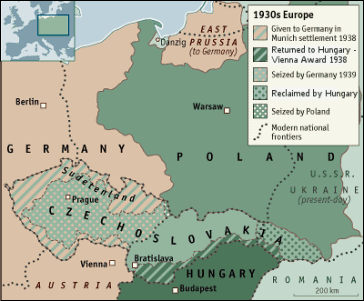
Why So Many Hungarians Across the Border?
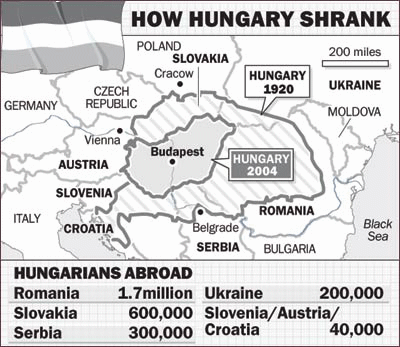
The Treaty of Trianon in 1920… in the aftermath of WWI, was extremely harsh on Hungary and unjustifiably one-sided. The resulting “treaty” lost Hungary an unprecedented 2/3 of her territory, and 1/2 of her total population or 1/3 of her Hungarian-speaking population. Add to this the loss of up to 90% of vast natural resources, industry, railways, and other infrastructure.
Additional Links
- AHF urges Secretary of State Hillary Clinton to “publicly and unambiguously express [her] concern relative to the Slovak language law
- AHF calls upon Vice President Biden to discuss Slovakia’s language law with Hungarian Prime Minister Bajnai
- AHF Submits Letter Regarding Intolerance in Slovakia
- Use of Hungarian ILLEGAL in Slovakia – Hungarian FM expresses regret
- Slovaks Confirm Benes Decrees: Called “Cancer of the Slovak Nation.” AHF issues statement.
- The Benes Decrees – a shameful act of ethnic cleansing
- The American Hungarian Federation’s call for greater cooperation among Hungarian American organizations in raising the ill-advised and discriminatory Slovak language law published in Heti Valasz
- “Halál a magyarokra!” / “Hunok a gázkamrába! Magyarok a Dunába!“
- 168 Óra Online írása: A ‘Halál a magyarokra’ Amerikában is kiverte a biztosítékot
- Amerikai magyar szervezet küldött levelet Kubišnak
- The Treaty of Trianon – A Nation Dismembered
- Vojvodina – More ethnic cleansing in historic Vajdasag
- News from Rumania – Home to the largest Hungarian “minority”
- Hungarian National Flags fly again in Hungarian churches in today’s Slovakia
- AHF Supporting Dual Citizenship
They are home in the sense that they, as communities, haven’t moved anywhere. They just woke up one morning to be told: “You are now a Czechoslovak, you are a Romanian, you are a Yugoslav.” This first happened in 1918-20, when Hungary was partitioned by the infamous Trianon Treaty, which was not a treaty at all, but a diktat enforced by occupying Entente Armies. In the late 1930’s, Hungary got some portions of its territories back, but after losing yet another war, the borders were tightened even more in 1947.