
10/24/2013 – AHF Executive Chairman delivers multimedia presentation entitled “Reflections on the 1956 Hungarian Revolution” for the Shepherd Center World Affairs Series coordinated by A. Ross Johnson, Wilson Center Senior Scholar, Hoover Institution Research Fellow, and former Director of Radio Free Europe. Bryan Dawson, whose mother was wounded in the Freedom Fight, discussed the roots of the conflict and Polish-Hungarian sympathies, Hungary’s history and national character that contributed to the uprising, and the Revolution’s impacts internationally.

Mr. Dawson opened the discussion with a collection of video footage from 1956 as they were aired to Western audiences during these fateful events. The presentation and access to the video is below:
INTRODUCTION
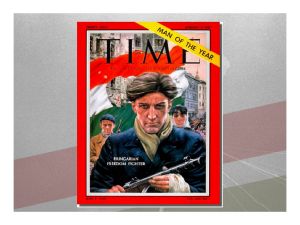
Fifty-seven years ago yesterday, Hungarians from all walks of life rose up against insurmountable odds to fight the brutal Soviet-installed Communist government. Thousands died fighting, tens of thousands were wounded and imprisoned, others – men, women, and children – tortured and executed, while 200,000 fled their homeland.
Their enormous sacrifice may have seemed futile then, but today it is universally recognized as having contributed to the ultimate demise of Soviet domination of Central and Eastern Europe and the restoration of constitutional democracy and independence in Hungary and the region.
We must never forget the heroes of 1956 – the students, the intellectuals, the workers, the farmers, left and right, indeed the cross-section of the entire Hungarian nation — who were prepared to realize their dreams at great personal sacrifice. They fought and died for freedom, a multi-party democracy and independence from the barbarism of the Soviet Union.
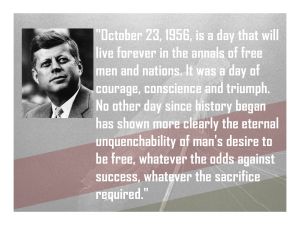
John F. Kennedy, on the first anniversary of the Hungarian Revolution remarked: “October 23, 1956, is a day that will live forever in the annals of free men and nations. It was a day of courage, conscience and triumph. No other day since history began has shown more clearly the eternal unquenchability of man’s desire to be free, whatever the odds against success, whatever the sacrifice required.”
What is striking about the words of President Kennedy and all presidents since, is what they do NOT address – the US failure to actively respond to Hungarian pleas for help.
Today, I’d like to examine not just the political events leading up the 1956 Revolution, but what led up to the fateful events of October. To add perspective, I will also examine what makes a people rise up against impossible odds, sacrificing everything in the name of freedom.
I will then leave you with a few personal thoughts as a child of 1956. Now, let’s set the stage through the lens of 1956 Western newsreels.

Video presentation: “1956 in the Newsreels.” Watch it (and more) on AHF’s YouTube Channel!
Why Hungary?
In thinking about the state-sponsored brutality in the 1950’s Eastern Bloc and the revolt against it, this question has always intrigued me.
If one can characterize a nation, there can be no doubt that Hungarians not only give lip service to the vaunted principles of democracy and national independence, but also, as their history so eloquently and repeatedly demonstrates, sacrifice life and treasure to achieve them.
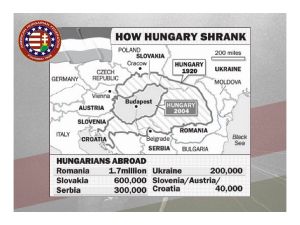
After losing 2/3 of her thousand-year-old territory, 1/3 of her Hungarian speaking population, 90% of her natural resources and railroads after WWI, Hungary was now a tiny, weak nation surrounded by enemies on three sides in the heart of Central Europe. Why Hungary? Why not much larger and powerful nations in the Eastern Bloc? What was it in the Hungarian character that would give Freedom Fighters the courage to take up arms and defy one of the most brutal superpowers in world history? The answer lies in its history.
Hungarians are a fiercely independent, philosophical, honor-driven, but now pessimistic people. Democracy and desire for freedom and independence… and the willingness to fight for it, is not a new phenomenon in Hungary. But their pessimism is borne of their 20th century history as they are tied to their more than 1000-year old past. Hungarians often attribute a phrase to Napoleon’s prime minister and advisor on foreign policy who said: “Hungarians are a proud people, take away their past, and you do to them whatever you wish to do.” This describes communist policy in Hungary well.
1222…The Arany Bulla (Golden Bull) of 1222 is Hungary’s Magna Carta and Hungary’s first written Hungarian constitution. It determined the principle of equality between nobles, election of the King, and occupied a central place in the thought of the Hungarian aristocracy for centuries. It contained a “clause of resistance,” hereby if the king failed to keep his word, the nobles were invested with the right to resist and oppose him without charge of disloyalty.

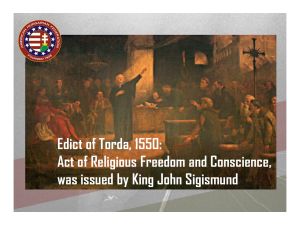
1550… The Edict of Torda (Patent of Toleration), declared in Transylvania, Hungary, for the first time granted freedom of worship with the words: “Every man may hold to his God-given faith, and under no circumstances shall one religion interfere with another.”
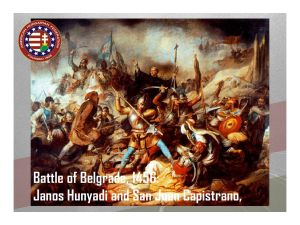
1456 – 1687… The Hungarians would fight the Ottoman Turks for over 200 years, losing millions of men in the fight. Church bells ring at noon around the world marking the first victory against the Ottomans at Nándorfehérvár (today’s Belgrade) by Janos Hunyadi and San Juan Capistrano in 1456. The “Saviors of Christianity,” a moniker given them by the Pope, finally drove out the Ottomans, but soon elect the House of Hapsburg to the throne.
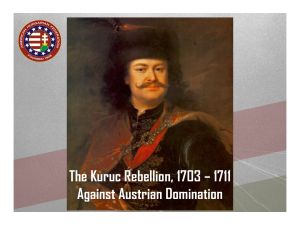
1703… The Kuruc Rebellion. With the Hapsburgs embroiled in Spain, Ferenc Rákóczi II, Prince of Transylvania, led an unsuccessful revolt against the Austrians and was forced into exile. The brave Kuruc troops laid down their arms in 1711. But the discontent under Hapsburg rule would continue.
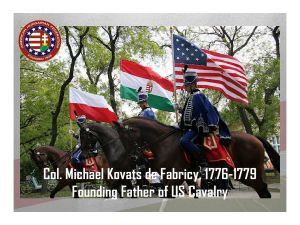
1779… Hussar Col. Michael Kovats offered his sword to Benjamin Franklin and US Congress saying “Golden Freedom cannot be purchased with yellow Gold.” He was asked by his friend Col. Tadeusz Kościuszko, to recruit, train, organize, and lead into battle the first ever American cavalry. Kovats died a hero’s death at the battle for Charleston, S.C. in 1779. He is immortalized at the Citadel and is known as a founding father of the US Cavalry. He is the first known Hungarian to give his life for American freedom and independence, but not the last. “The Col. Commandant Michael Kovats Medal of Freedom” is AHF’s highest award. “The best cavalry the Rebels ever had,” said British Brigade Major Skelly in describing Kovats’ American Hussar Brigade.
1848… The Hungarians again rose up against Austrian rule under their leader Louis Kossuth seeking a democratic Hungary. After numerous Hungarian victories on the battlefield, the Austrians solicited the help of the Russians. Both fearing a large democratic nation between them, the Czar sent 200,000 Russian troops and pushed the Hungarians back into Transylvania. It was here that Polish General Bem, who had led many brilliant and successful battles against the Austrians in this war, would become a national hero and a key figure in 1956. Under a white flag, the 13 Hungarian Generals were arrested and martyred in Transylvania. The revolution was crushed.
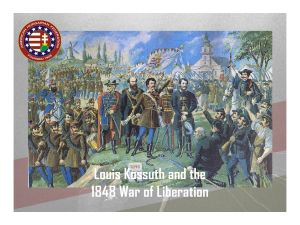
1852… “All for the People and All by the People; Nothing About the People Without the People – That is Democracy!” These are the words of Hungarian patriot Louis Kossuth, leader of the 1848 democratic revolution, spoken before the Ohio State Legislature… 11 years before Lincoln’s Gettysburg Address. Kossuth would go on to speak before half the US population, spawn a fashion craze (top hat and moustache-less beard), and be called “the foremost soldier of freedom in this age” by Ralph Waldo Emerson. A gift of AHF to the people of the United States, his statue now sits proudly in the US Capitol – it reads, “Father of Hungarian Democracy.”

1940’s… Hungary, fearing the brutality of Bolshevism in the east and desperate to regain her lost territories and reunite Hungarians in the Carpathian Basin, found support only in Italy and Germany and joined the Axis. But even during the horrors of WWII, stories of resistance emerged.
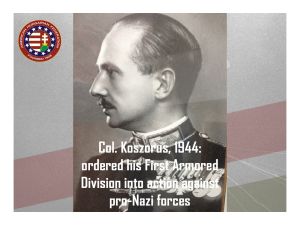
Col. Ferenc Koszorus asks Regent Horthy for orders to deploy his First Armored Division into action against pro-Nazi forces in July 1944, preventing the deportation of hundreds of thousands of Jews from Budapest. This unparalleled action was the only case known in which an Axis power used military force for the purpose of preventing deportations. The action gave away Hungarian troop positions, but delayed the Nazi takeover for 3.5 months, and permitted Raoul Wallenberg to coordinate his successful rescue mission.
1945… Despite Soviet occupation and intimidation, Hungarians resoundingly rejected the Communist Party and elected the Smallholders Party. But history was again not on Hungary’s side. A few short years later, she was forced to accept a brutal, Soviet-installed government.
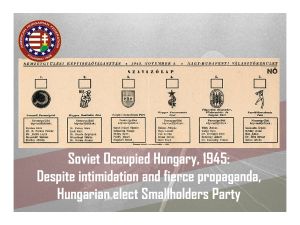
1956… Hungarians rise and make first tear in the iron curtain
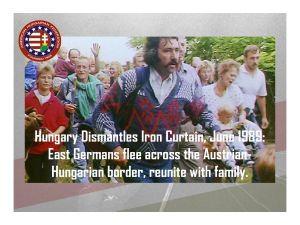
1989… In spring 1989, with Soviet Troops still present, Hungary again pushed the envelope and began dismantling its fortified border with Austria. A few months later, this second tear in the Iron Curtain opened when hundreds of East Germans fled across the Austrian-Hungarian border. By the end of 1989, Hungary would be free and soon join NATO and the EU.
Let us examine the Roots of the Conflict…
The Treaty of Trianon in 1920, a treaty the United States has never ratified, was devastating and unprecendented. At the time scholars warned a weakened Hungary would lead to a largely defenseless Central Europe and make Bolshevism’s westward march inevitable.
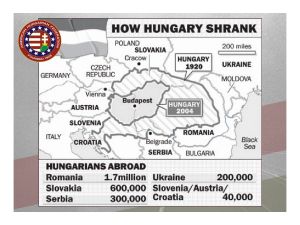
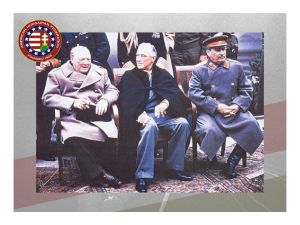
The Yalta Conference in 1945 fulfilled this prophecy as the United States, Great Britain and the Soviet Union allocated “spheres of influence” over territories liberated from Nazi Germany’s occupation. Hungary was handed over to the communist-bolshevist Soviet Union for their exclusive governance in the post-war era.
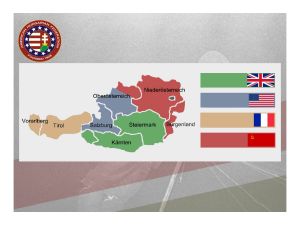
The Hungarian Peace Treaty of 1947, following WWII, stipulated that the Soviet Union was required to vacate her occupation troops from Hungary when they withdrew their occupation forces from Austria in unison with the US and the UK. In 1955, the Austrian State Treaty and ensuing declaration of neutrality established Austria as a demilitarized and neutral country, raising Hungarian hopes of also becoming neutral. However, the Soviet Union never withdrew its forces claiming the Warsaw Pact Treaty, signed before the Peace Treaty of 1947, provided legal justification to the Soviet military presence.
Khrushchev’s “secret speech” in February 1956, denouncing the crimes of Stalin and his cult of personality, led reformers across the Eastern bloc began to openly express their discontent.

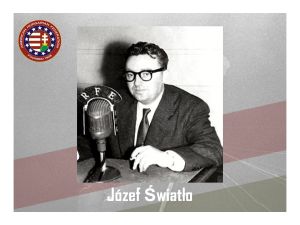
Radio Free Europe broadcast by Polish dissident (and former communist Security Officer) Jozef Swiatlo strongly influence the mood in Poland.
In June 1956, 80% of the Cegielski factory fail to show up for work. Soon, 100,000 people gather to demonstrate in Stalin square (Mickiewicz square now) demanding better wages and to protest unjust quotas, shouting “we want bread, we want freedom.” Other joined the procession and soon riots broke out when news spread that workers had been arrested and taken to the UB jail.

Demonstrators attacked the jail, released prisoners and armed themselves with weapons from the jail’s storeroom. Army units and their tanks move into Poznań.
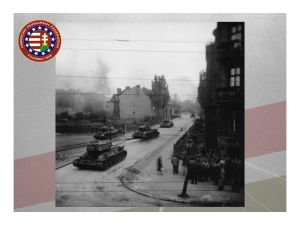
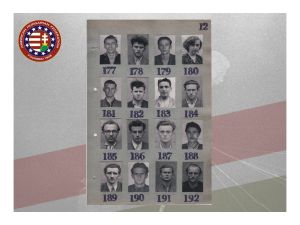
The struggle between the demonstrators, the UB and the army continues throughout the night. Fifty-seven persons get killed and 450 wounded, including 13-year old Romek Sztralkowski. Authorities start arresting the participants in the Poznań events and torture them brutally, including removing women’s teeth.
On October 19, 1956, the Eighth Plenary Meeting of the Central Committee of the Polish United Workers’ Party (PZPR), the communist party devised a shrewd solution:
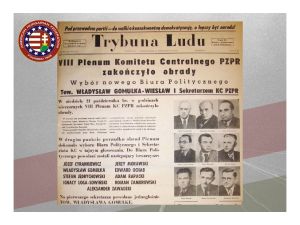
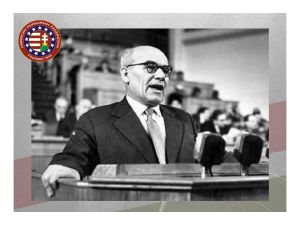
Appoint a Polish nationalist communist, Wladyslaw Gomulka, a reformer and former activist who was himself released from prison shortly after Stalin’s death, to head the regime. He quickly has the last of the Poznan prisoners released and institutes reforms. Tensions, at least in Poland, are temporarily diffused.
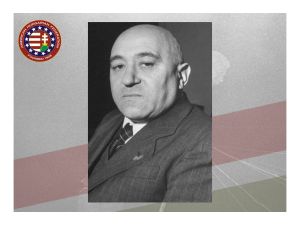
In Hungary too, Khrushchev recalled the brutal, hard-line ruler, Matyas Rakosi. Rather than have the sedating effect of Gomulka’s appointment in Poland, Rakosi’s removal stimulated demands for greater freedom.
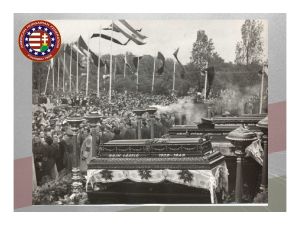
On October 6, 1956, at the funeral of the victims of a mock political trial – Laszlo Rajk and his comrades, is attended by 200,000 people.
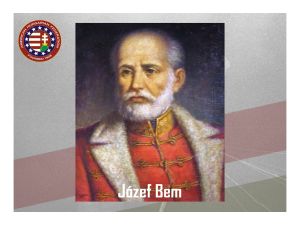
Hungarian-Polish friendship goes back many centuries and Hungarians sympathized greatly with the Polish uprising and call for freedom. Polish General Jozef Bem became a Hungarian National Hero for his actions in assisting the resistance against the Austrian Hapsburgs and Russian Czarist forces in the 1848 War of Liberation.
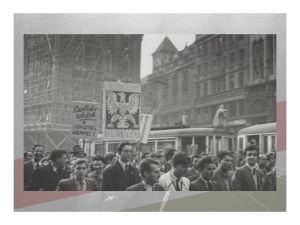
On October 22, 1956, Hungarian students at the Technical University, sympathizing greatly with their ancient allies, and compiled a list of sixteen points containing key national policy demands.
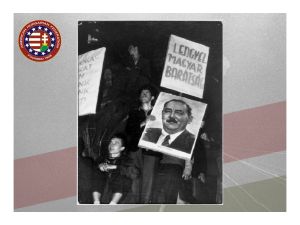
They announced a demonstration in front of General Bem and Petofi statues in Budapest for October 23rd.
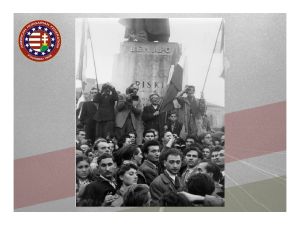
Tens of thousands, including my mother, marched to the foot of the General Bem statue in solidarity with the anti-communist demonstrations in Poznan.

The students were anxious to proclaim their 16 points:
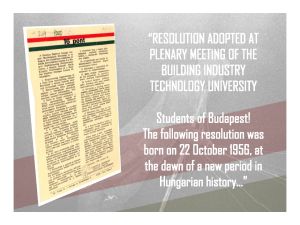
“The following resolution was born on 22 October 1956, at the dawn of a new period in Hungarian history, in the Hall of the Building Industry Technological University as a result of the spontaneous movement of several thousand of the Hungarian youth who love their Fatherland:”
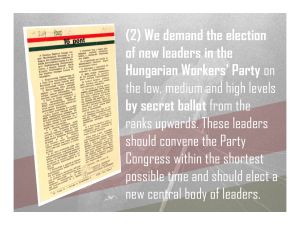
- We demand the withdrawal of Soviet Forces

- We demand new elections to the Hungarian Workers’ Party
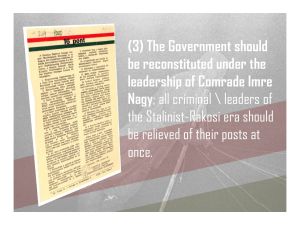
- We demand a new government under Imre Nagy and all Rakosi-era Stalinist leaders removed.
- We demand a public trial in the criminal case of Mihaly Farkas and his accomplices and that Matyas Rakosi be brought home and brought before a People’s Court of judgment.

- We demand general elections in this country and the right to strike.

- We demand a re-adjustment of Hungarian-Soviet and Hungarian-Yugoslav relations on the basis of equality and non-intervention.
- We demand the re-organization of the Hungarian economy by SPECIALISTS to replace the planned economy.
- We demand transparency in our foreign trade agreements and reparations payments, sincere information concerning the country’s uranium deposits, and the Russian concession, and demand that Hungary should have the right to sell the uranium ore freely at world market prices in exchange for hard currency.
- We demand the complete revision of norms in industry and an urgent and radical adjustment of wages to meet the demands of workers and intellectuals. We demand that minimum living wages for workers should be fixed.
- We demand the rehabilitation of innocent persons, immediate repatriation of prisoners-of-war and of civilians deported to the Soviet Union, including prisoners who have been condemned beyond the frontiers of Hungary.
- We demand complete freedom of opinion and expression, freedom of the Press and a free Radio.

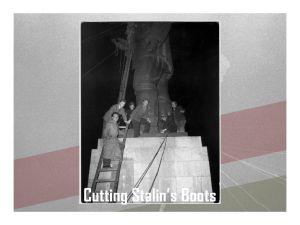
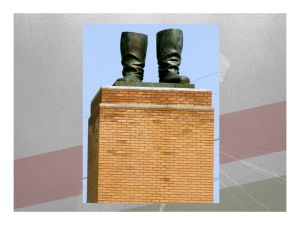
- We demand that the Stalin statue-the symbol of Stalinist tyranny and political oppression-should be removed and replaced by a memorial worthy of the freedom fighters and martyrs of 1848-49.
- In place of the existing coat of arms, which is foreign to the Hungarian people, we wish the re-introduction of the old Hungarian Kossuth arms, new Hungarian Army uniforms worthy of our national traditions, and demand that 15 March should be a national holiday and 6 October a day of national mourning.
- The youth of the Technological University of Budapest unanimously express their complete solidarity with the Polish and Warsaw workers and youth in connection with the Polish national independence movement.
- The students of the Building Industry Technological University will organize local units of MEFESZ as quickly as possible, and have resolved to convene a Youth Parliament.
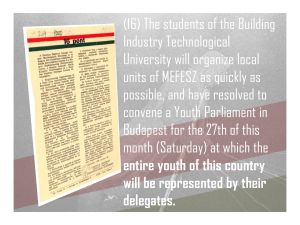
16 (continued): Students will gather in the Gorkij Fasor before the Writers’ Union Headquarters tomorrow, the 23rd, at 2.30 p.m., whence they will proceed to the Pálffy Tér (Bem Ter) to the Bem statue, on which they will lay wreaths in sign of their sympathy with the Polish freedom movement. The workers of the factories are invited to join in this procession.
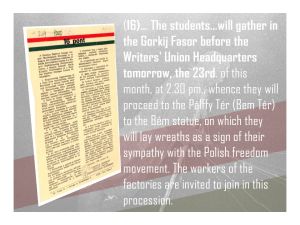
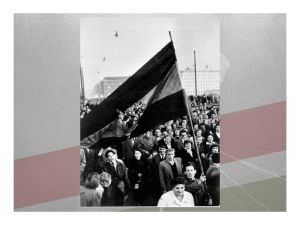
Protestors at the Bem statue in Buda would soon be marching, carrying Hungarian and Polish flags, to Parliament Square in Pest as crowds swelled to hundreds of thousands.

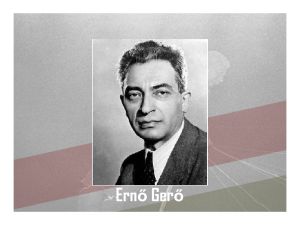
Others would eventually reach government-controlled Hungarian Radio only to hear communist leader Erno Gero call the peaceful protesters “enemies of the people.”
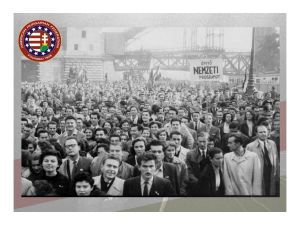
Angry at Gero’s comments, the crowd attempted to gain entry to the radio station to proclaim the 16 points. The protest soon turned into a bloodbath as Hungarian Secret Police opened fire on the crowd.
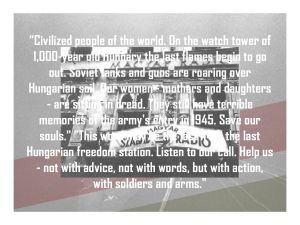
Again, on October 25th, Hungarian Secret Police (AVO) opened fire on protesters in front of parliament calling for the resignation of communist leader Gero.
Hungarian Army units join the insurgents as the communist party disintegrates. There was now no turning back.
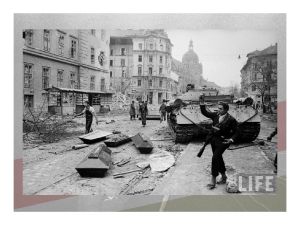
Under the angelic voice of Radio Free Europe, Hungarians bravely fought and, for 12 days, won their freedom, expelling Soviet Forces. Imre Nagy announced withdrawal from the Warsaw Pact and declared neutrality on November 1st asking the United Nations for observers and protection.
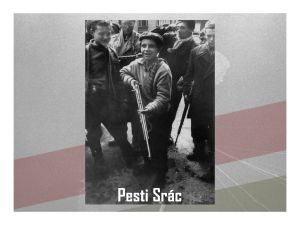
A “Pest Srac” is seen here – kids who took up arms agaisnt communist tyranny.
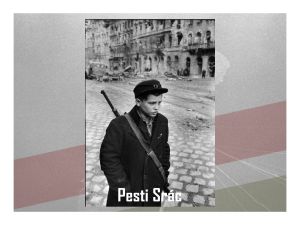
On November 4th, 5000 Soviet tanks and 200,000 troops poured into Hungary to quash the rebellion. Fierce fighting takes place until November 15th – hopes for Western help are dashed.
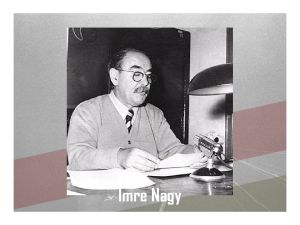
Imre Nagy makes his final plea for Western help. As Soviet forces regained control, Nagy sought refuge in the Yugoslav Embassy, but was arrested, and executed in 1958 along with Paul Maleter, head of Hungarian Defense Forces after being held in a secret location in Rumania for 2 years.
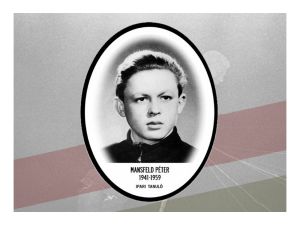
A particularly tragic example of the brutality of the regime was that of Peter Mansfeld, a “Pesti Srac” or Young Boy from Pest who, at the age of 16, became a Freedom Fighter. He was held political prisoner in “Hell’s Highway”, tortured and repeatedly beaten until he finally found rest 1959, when he turned 18 – the age the communist police could legally hang him, a week after his birthday.
1956 shook the communist world:
Rumania – In Rumania, the Hungarians of Transylvania watched events closely. Minor stirrings caused a quick crackdown. Hungarians were ousted from the Rumanian communist party, the Rumanian government shut down schools and eliminated the autonomous Szekely (Szekler) region. 1956 in Rumania marked the beginning of the severe curtailment of minority rights and the push to forcibly assimilate historic Hungarian communities. Some of the consequences are still with us today – the famed Bolyai University was eliminated as a Hungarian-language institution and has yet to be reinstated. Thousands of church and synagogue properties illegally confiscated by Ceausescu are still not restored. Szekler autonomy has also not been re-established. But in 1989, Hungarians showed Ceausescu and the securitate that they had reason to fear as they rose up in Temesvar (Timisoara) and triggered. led by Bishop Laszlo Tokes, the Rumanian revolution leading to the end of Ceausescu and the communist state.
North Korea – While the crackdown against Hungarians in Rumania given its close proximity to Hungary and ethnic tensions is not too surprising, it is interesting that the effects of the Hungarian revolt for felt as far away as Korea. James Person of the Cold War History Project of the Woodrow Wilson Institute discovered some 600 documents at Russian state archives. He discovered a strong reform movement under way in North Korea in early 1956. As in Eastern Bloc Europe, North Korean reformers were encouraged by Khrushchev’s denunciation of Stalin earlier that year. They urged Kim Il Sung to end his cult of personality and liberalize the party. But Kim Il Sung proved more Stalinist than Stalin and rejected the reform movement. The Soviet Union’s diverted attention on Budapest and the Suez Crisis was just what Kim needed to purge his government of reformers and strengthen his totalitarian control.
The Communist Internationale – A revolution of the people against socialism was an embarrassment. Within the West, 1956 had several political effects. Thousands of members resigned from Western communist parties while parties themselves split. 1956 prevented the noncommunist Left from cooperating with communists against their conservative and liberal opponents. In some countries, such as France and Italy, this disintegration deprived the Left of power for another quarter-century. Throughout Western Europe it solidified support for NATO and the American alliance.
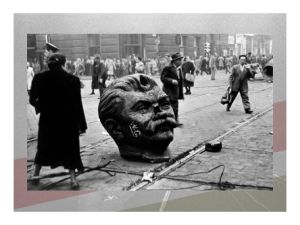
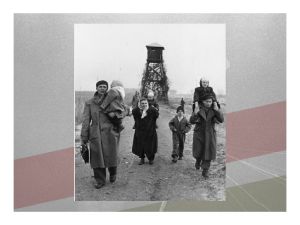
The United States and the Hungarian Emigration – Over 200,000 Hungarians fled their homeland bringing their talents to the shores of many nations. Some 48,000 would eventually come to the United States. Some of these Hungarian refugees would join earlier emigrations and again contribute greatly to the United States – Andy Grove would found Intel; Billionaire Steven Udvar-Hazy would help build a “little” museum for the Smithsonian; Oscar-winner Vilmos Zsigmond, who took some of the disturbing video of 1956 Revolution we saw today, would become a legend of cinematography in Hollywood.
Not well known is that President Truman charged Col. Ferenc Koszorus, after his escape from Soviet-occupied Hungary, to organize and organization of a “decent and reliable element of Hungarian [military] veterans in order to have a pool from which to draw perspective recruits for para-military activities.” President Eisenhower, despite the strong Republican rhetoric of “rolling back communism,” dismantled it.

When the Eisenhower administration took the reins from Truman in 1953, statements made by the new Secretary of State, John Foster Dulles, suggested a more aggressive American foreign policy on Eastern Europe. Dulles promised to support an “explosive and dynamic” policy of “liberation.” Despite the continuing rollback rhetoric that encouraged Eastern-bloc nations to resist, rollback was exposed as a fraud and propaganda ploy. What is particularly tragic is that, despite having plans for such a contingency, Eisenhower overruled an airlift of supplies to help the beleaguered Freedom Fighters.
American Hungarian Federation President, Frank Koszorus, Jr., son of Col. Koszorus, wrote in response to Charles Krauthammer’s analysis of CNN’s “Cold War” in 1989:
“While it would be a fabrication to portray President Eisenhower as Soviet leader Nikita Khrushchev’s co-conspirator, he had far more leeway to support the events in Budapest… Rather than pressure Britain, France and Israel to withdraw from Egypt and insist the UN Security Council address the Suez crisis from October 28 to November 1, Mr. Eisenhower could have accepted Secretary of State John Dulles’s proposal of October 25 to place the Hungarian question on the Security Council’s agenda….

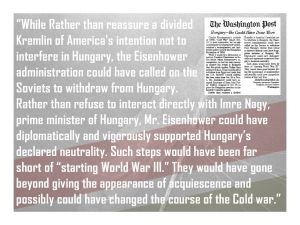
…Rather than reassure a divided Kremlin of America’s intention not to interfere in Hungary, the Eisenhower administration could have called on the Soviets to withdraw from Hungary. Rather than refuse to interact directly with Imre Nagy, prime minister of Hungary, Mr. Eisenhower could have diplomatically and vigorously supported Hungary’s declared neutrality.”
Such steps would have been far short of “starting World War III.” They would have gone beyond giving the appearance of acquiescence and possibly could have changed the course of the Cold war.”
Finally, the role of Radio Free Europe as a catalyst for 1956 has been debated. Most would argue that any radio broadcast or external media cannot be responsible for setting off violent conflict on their own. But I know it played an important role because Hungarians believed the West would not leave them alone. My mother shared with me how the message of freedom resonated so greatly.
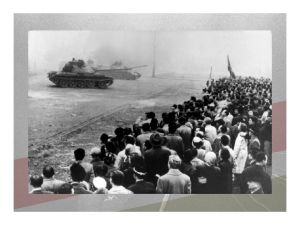
So, why Hungary? Fighting against foreign domination is part of the national character – as is fending for yourself. Some analysts have made the argument that Soviet armed intervention in Hungary was not inevitable and suggest that if the revolutionary Hungarian Prime Minister and reformer Imre Nagy had been more of a leader, a Hungarian “Gomulka,” he would have controlled events on the streets and would have been able to reach a Titoist–like compromise with Moscow.
While we can never know, I tend to disagree… because I know my mother.

While it is true that the Freedom Fighters on the ground along with most of their supporters did indeed have the illusion that help was coming from the West, once shots were fired and fighting escalated, no “leader” could have sought half solutions. Hungarians wanted freedom and independence, not Goulash Socialism. Although it was widely believed that Hungary’s declaration to exit the Warsaw Pact caused the Soviet intervention, minutes of the October 31 meeting of the Soviet Presidium record that the decision to intervene militarily was taken one day before Hungary declared its neutrality and withdrawal from the Warsaw Pact.
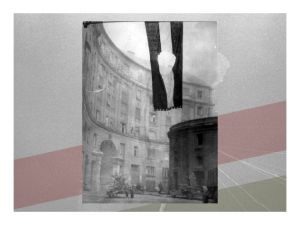
Although unfamiliar with the details of this rich history and national character, a few today are quick to conclude (and have the international community believe) that the Hungarian people are less than committed to democracy. History would suggest otherwise.
In conclusion, I’d like to share a few thoughts on how 1956 influenced my own character:

I AM A CHILD OF 1956…Not because my mother was wounded, risked her life, braved bullets, bombs, soviet tanks, land mines, communist secret police, red army troops and hid from flares on cold November nights as she escaped across the iron curtain…

I AM A CHILD OF 1956…Not because I heard mother’s stories of how she would paint the underside of porcelain dishes in black shoe polish, placing them in the path of soviet tanks which would stop to inspect these “land mines” only to open themselves up to a little Stalinist-named surprise: the Molotov cocktail…
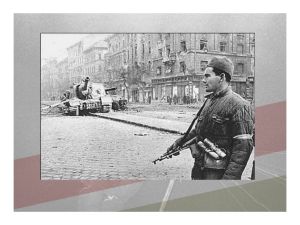
I AM A CHILD OF 1956…Not because I am so deeply proud of her and Hungary for standing up to communist tyranny against odds so great, few have dared to attempt…
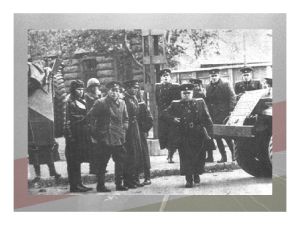
I AM A CHILD OF 1956…Not because of Hungary’s 1000-year history of democratic tradition and struggle to maintain her unique identity and her independence…
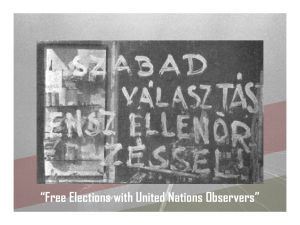
I AM A CHILD OF 1956…Because in Anyuka’s tears… in her struggles and perseverance…in her scars, in her eyes that exuded the sort of wisdom none should possess.
I learned freedom is not free… and that with Freedom comes great responsibility.
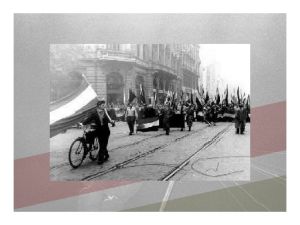
I AM A CHILD OF 1956…Because I learned that we must never forget – never forget what my mother and thousands like her fought and many died for: freedom, liberty, pluralism, democracy…
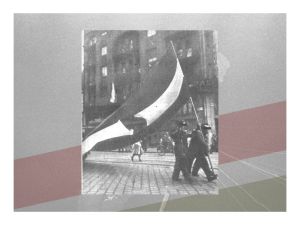
While oppressed people around the world struggle for freedom, we are not free…
While human and minority rights of Hungarian minorities are violated daily at the hands of governments that had promised to respect and protect them – their only crime being Hungarians in lands they inhabited for 1000 years and where foreign powers changed the borders around them – we are not free.
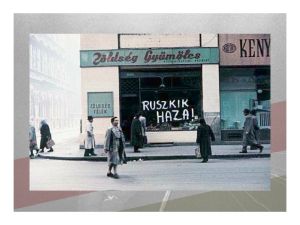
In these days of increasing polarization and renewed false propaganda machines here at home and in Hungary designed to divide us and appeal to our worst instincts, we owe it to those who died for our freedom to insist that we treat that freedom and each other with the utmost respect and stand together in humility with a zealous pursuit of the truth in the same spirit of brotherhood so exemplified in 1956 Hungary.
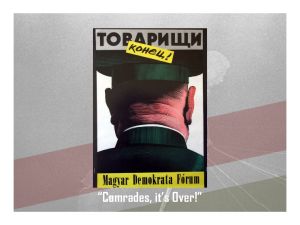
I am a child of ‘56 because I am ready eager to speak up when democracy and human rights are threatened.
I am a child of ‘56 because our work is not done… join us.
Join AHF online! AHF is an all-volunteer, non-partisan, 501(C)(3) non-profit educational and charitable organization serving the community since 1906. We need your support!
