
1/20/2015 – Politics.hu publishes Op-Ed by AHF President, Frank Koszorus, Jr., entitled “What is the endgame for U.S.-Hungarian relations?”
Related

1/20/2015 – Politics.hu publishes Op-Ed by AHF President, Frank Koszorus, Jr., entitled “What is the endgame for U.S.-Hungarian relations?” [Read and comment on on politics.hu]
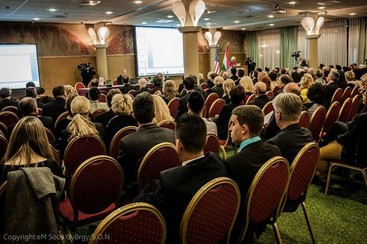
12/2/2014 – AHF sponsors Forum on on US – Hungarian Relations hosted by sister foundation in Hungary the Amerikaiak a Magyarokért Alapítvány (AMKA or Americans for Hungarians Foundation): Panel participants included André Goodfriend, the Charge d’ Affaires of the US embassy; Frank Koszorus Jr. the President of American Hungarian Federation, Dr. Lomnici Zoltán the spokesperson of the Civil Összefogás Fórum (CÖF); Hejj Tibor, the President of P-M-C Consulting who has sponsored many charity projects; and Gyula (Jules) Balogh, President of the Amerikaiak a Magyarokért Alapítvány. [read more]
In a Tweet on January 12, 2015, US Embassy Charge d’Affaires Andre Goodfriend quoted Stephen I, the first king of Hungary (975–1038), who urged his son Emeric to welcome foreigners. The Tweet… clearly made in response to the Hungarian Prime Minister’s recent policy statement… that Hungary and Europe should, with the exception of political asylum, curb economic immigration. Without addressing the merits of the policy itself, public commentary by a U.S. official regarding Hungary’s immigration policy could undermine American interests in the region and is ironic because immigrationis adivisive issue in theUnited States that involves an ongoing raging, intense debate. The Op-Ed is available on politics.hu or in full below:
What is the endgame for U.S.-Hungarian relations?
AHF’s Op-Ed is available on
During my trip to Hungary over the 2014 Thanksgiving holidays, as President of the American Hungarian Federation (AHF), I participated in The Budapest FORUM to improve US-Hungary relations which was co-sponsored by AHF and its sister foundation in Hungary, the Amerikaiak a Magyarokért Alapítvány, or AMKA). In addition to me, the participants included U.S. Charge d’ Affaires André Goodfriend and Gyula (Jules) Balogh, President of AMKA. The Forum was the first in a series to be held to address the hoped-for restoration of the excellent relations that the United States has had with Hungary for many years, but which has been deteriorating recently. This first of a kind forum brought together parties holding differing views on the political landscape of Hungary and the bilateral relations between the two natural allies. The purpose of the FORUM was to candidly exchange ideas and better understand these various perspectives.
During the constructive, spirited and polite discussion of the concerns Hungarians and American Hungarians had with the U.S. government’s approach to Hungary and issues the United States had with Hungary, I read a moving letter from an apolitical professor in Hungary who is a strong friend of the United States but who nevertheless reiterated the widely-held perception that the U.S. was demeaning and humiliating the Hungarian people with its overwhelming and incessant barrage of public comments and criticisms, much of which, many feel, are overstated, unwarranted and bereft of evenhandedness. The criticism often and inexplicably singles out Hungary and even extends to topics that are generally in the purview of matters left to internal discourse of sovereign states, e.g., historical events and figures.
This type of public involvement in Hungary’s internal affairs repeated itself on January 12, 2015 when Charge d’Affaires Goodfriend in a Tweet quoted Stephen I, the first king of Hungary (975–1038) and its patron saint, urging his son Emeric to welcome foreigners. The Tweet was highly publicized and clearly made in response to Hungarian Prime Minister Viktor Orban’s policy statement after the rally in Paris held on January 11 in response to the terrorist attack that Hungary and Europe should, with the exception of political asylum, curb economic immigration.
Without addressing the merits of the proposed policy itself, public commentary by a U.S. official regarding Hungary’s immigration policy is ironic and could undermine American interests in the region. It is especially ironic in this case because immigration is a divisive issue in the United States that involves an ongoing raging and intense debate. Indeed, immigration reform, including tougher border enforcement legislation, is a hotly debated issue that promises to be part of the American political landscape for some time to come.
Americans, officials and the man-on-the-street, would undoubtedly bristle if the French, German, British, Hungarian or any other ambassador to Washington were to ignore diplomatic etiquette and publicly pontificate about American immigration policies and legislation. It, therefore, shouldn’t come as a surprise if critical public statement about Hungary’s immigration views humiliate and alienate many Hungarians who support NATO and its now ever more critical mission. This, in turn, could have the unintended and detrimental consequence of undermining U.S. strategic interests in the region. Indeed, good bilateral relations between the United States and Hungary and a strong and united NATO are in the interest of both countries and necessary to meet the formidable challenges posed by Russia and terrorism.
Winning Hungarian public opinion, instead of alienating it with gratuitous remarks about internal matters such as immigration, is critical to advance these key American goals. Given her passion, perseverance and experience, we have every reason to hope that The Honorable Colleen Bell, the new U.S. ambassador to Budapest, will be sensitive to these issues and thereby diplomatically promote U.S. strategic goals in the region.
Join us online!
