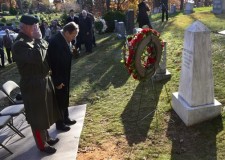
11/15/2014 – AHF, member organizations, and representatives of the Hungarian embassy in Washington DC placed flowers at the grave of Holocaust Hero, colonel Ferenc Koszorús, in Columbia Gardens Cemetery in Arlington. Koszorús, as the commander of Hungary’s first armoured division, thwarted a planned government coup dubbed the gendarmerie coup, which aimed to carry out the deportation of the Jews of Budapest on July 5 and 6 of 1944.
Related

Megemlékezést tartottak Koszorús Ferenc sírjánál: „Koszorús páratlan fellépése az egyetlen olyan ismert eset, amikor egy tengelyhatalom katonai erőt alkalmazott azért, hogy zsidók deportálását akadályozza meg” – idézte a fia az amerikai kongresszusba beválasztott egyetlen holokauszt-túlélőnek, Tom Lantosnak a képviselőházban elmondott szavait. [tovább]
Holokauszt-emlékév – Megemlékezést tartottak Koszorús Ferenc ezredes sírjánál: A megemlékezés virágait helyezték el szombaton Koszorús Ferenc ezredes sírjánál amerikai magyar szervezetek és a washingtoni magyar nagykövetség képviselői az arlingtoni Columbia Gardens Temetőben [tovább]

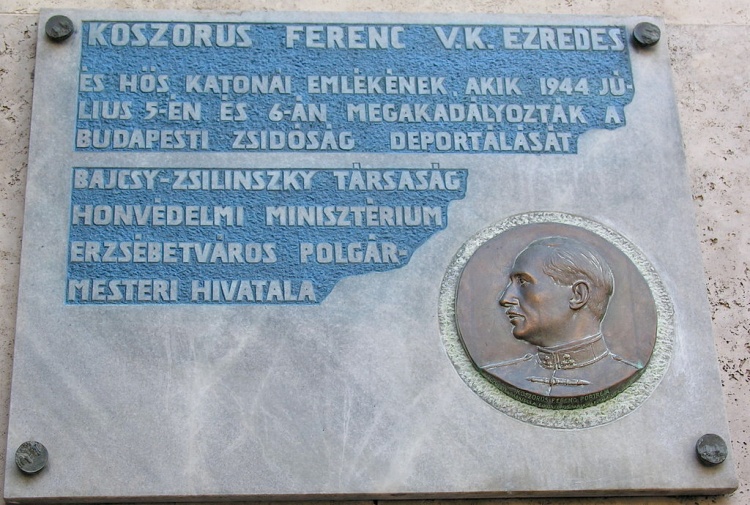
Koszorús Ferenc zsidók százezreit mentette meg: „A soá is elfoglalta méltó helyét történelmünkben legnagyobb nemzeti tragédiáink között, miénk a szégyene, a vesztesége és a gyásza is” – mondta Hende Csaba honvédelmi miniszter pénteken Koszorús Ferenc posztumusz vezérezredes emléktáblájának koszorúzási ünnepségén Budapesten, a Dohány utcában. [tovább]
6/8/2012 – Hungarian Review publishes article, “The Soldier Who Saved the Lives of Budapest’s Jews: Col. Ferenc Koszorus.” The courageous intervention of Col. Ferenc Koszorus and his loyal First Armored Division on July 6, 1944 blocked the deportation of the more than 250,000 Jews of Budapest. In paying tribute to Col. Koszorus, former Congressman Tom Lantos, a survivor of the Holocaust, noted that the Koszorus intervention “permitted… Wallenberg, who arrived in Budapest on July 9, 1944, to coordinate his successful and effective rescue mission.”
[read more]
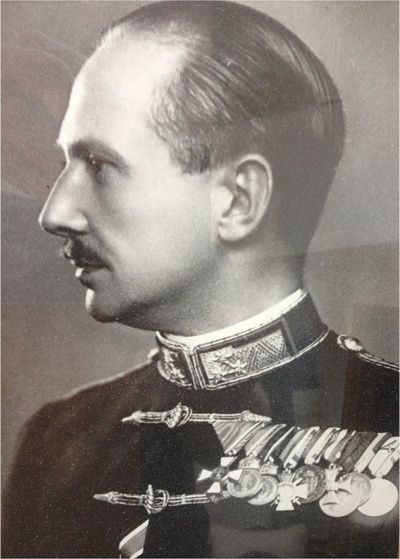
Following the orders of Regent Miklós Horthy, Colonel Koszorús ordered his division into action against pro-Nazi forces on 5th of July 1944, preventing the coup and the deportation of hundreds of thousands of Jews from Budapest. The action delayed the Nazi takeover for 3,5 months, allowing tens of thousands to escape or find refuge and also permitted Raoul Wallenberg to coordinate his successful and effective rescue mission. Colonel Koszorús’s unmatched action was the only known case of military action taken by an axis power to prevent the deportation of Jews, Ferenc Koszorús Jr, president of the American Hungarian Federation (AHF) said, citing the late congressman Tom Lantos.
After blocking the coup, Ferenc Koszorús was forced to escape the Gestapo and fled to the United States where he would eventually serve his adopted homeland in the US Topographic Command. After the war President Truman asked him to organize Hungarian veterans in exile and train them for the eventual liberation of Hungary liberated and occupied at once by the Soviet Union in 1945. Despite strong election rhetoric of “roll back communism,” the veterans in exile group was disbanded by the Eisenhower administration. Koszorus was posthumously elevated to the rank of general… read more about him below:
3/23/2011 – AHF honors Holocaust Hero Col. Ferenc Koszorus, Sr., reflects on Holocaust Memorial Month. AHF honors the millions of lives lost and the untold suffering caused by Nazism and Communism. But even during the horrors of WWII, stories of resistance to Nazi atrocities emerged.
[Read more] and see the Hungarian Review Article: “The Soldier Who Saved the Lives of Budapest’s Jews: Col. Ferenc Koszorus.”
Hungary, heavily influenced by her fear of the barbarism of Russian Bolshevism and her desire to regain lost territories and reunite Hungarians in the Carpathian Basin, had found support in Italy and Germany and joined the Axis, a tragic mistake. As Nazi barbarism spread, thousands of Jews from surrounding states had found refuge in Hungary whose Jewish population exceeded 800,000 in March 1944. While the Jewish community in Hungary had reason to hope that it would be spared the fate of other Jewish communities in the countries surrounding Hungary and elsewhere, March 1944 changed everything as Nazi German troops occupied Hungary. In doing so they brought the Final Solution to the largest remaining Jewish population in Europe. Within months over 400,000 people were deported and killed by a now almost perfect mass killing machine. Hundreds of thousands Jews remained, most in the capital of Budapest. Nazi forces and their Hungarian collaborators needed to take the capital to complete their work. They were in for a surprise.
Until 1944, Hungary had enacted a series of laws that increasingly restricted the civil liberties of Jews. But with the exception of the massacres of partisans and Jews in Novi Sad in 1942 (whose perpetrators fled to avoid prosecution by Hungarian authorities only to return to Hungary with the German occupying army in 1944) and the 16,000 “alien” Jews who were expelled to German-held Ruthenia in 1941,1 Hungary refused Nazi Germany’s demands that it deport Hungarian Jews or participate in the “Final Solution.”
When Hitler’s patience ran out with the conservative leaders in Budapest and their peace-feelers and contacts with Western allies, Nazi Germany invaded Hungary in March 1944, drastically changing the situation of Hungary and the Jews. Hitler installed a pro-German government which collaborated with the Nazis occupiers and helped to destroy Hungary’s Jewry, which had survived under the conservative government. Adolf Eichmann arrived to direct the deportation of Hungary’s Jews so that by the end of June, virtually the entire Jewish population of the provinces had been deported.
Until July 1944, the more than 200,000 Jews of Budapest were protected from deportation. Consequently, and at the instigation of the Nazi occupiers, Laszlo Baky, a secretary of state in the Ministry of Interior for “Jewish Affairs,” planned to begin and quickly complete the deportation of Jews from the capital. Hungarians foiled that plan, however.
Following the orders of Regent Horthy, Col. Koszorus ordered his First Armored Division into action against Laszlo Baky and pro-Nazi forces in July 5, 1944, preventing the coup and the deportation of hundreds of thousands of Jews from Budapest.2 This unparalleled action was the only case known in which an Axis power used military force for the purpose of preventing deportations. The action delayed the Nazi takeover for 3.5 months, allowing tens of thousands to escape or find refuge and also permitted Raoul Wallenberg to coordinate his successful and effective rescue mission. But history was again not on Hungary’s side. A few short years later, she was under a brutal, Soviet-installed government.
After blocking the coup, he was forced to escape the Gestapo and fled to the United States where he would eventually serve his adopted homeland in the US Topographic Command. President Truman asked him to organize Hungarian veterans in exile and train them for the eventual liberation of Hungary. President Eisenhower, despite the election rhetoric of “rolling back” Commnism, disbanded the unit before the 1956 Hungarian Revolution which surprised his administration.
The late Congressman Tom Lantos (D-CA) called Col. Koszorus a “Hero of the Hungarian Holocaust” as entered in the Congressional Record on May 26, 1994. In his introduction, Mr. Lantos said, “I rise today to recognize one of the great heros of the Hungarian holocaust. Ferenc Koszorus, who at great personal sacrifice to his own life, saved thousands of Hungarian Jews from deportation to Nazi death camps.” Congressman Lantos, recipient of AHF’s highest award, the Col. Commandant Michael Kovats Medal of Freedom passed away in 2008. General Koszorus
Koszorus, who passed away in 1974, was posthumously promoted to the rank of General by Prime Minister Antall after the fall of Communism. His wife, the late artist Gabriella Koszorus-Varsa researched and edited his memoirs and summarized his memoirs like this:
“The writings of Colonel Ferenc Koszorús contain wealth of fascinating and informative data relating to a critical period of Hungarian history. Based on personal experiences, his writings portray the tragic fate of Hungary during the Second World War, including the chaos caused by internal tension. These writings, moreover, not only chronicle certain key political and military events, they also offer solutions to exceedingly complex problems within the framework of high moral bearings, without which solutions prove to be ephemeral.
Col. Koszorús military competence, expertise, and outstanding character enhanced his clear-sighted judgement. The selfless dedication he exhibited also characterized his family. He is descended from Transylvanian nobility, born into a family that voluntarily relinquished its special privileges during the Hungarian Revolution of 1848 in a demonstration of solidarity with the Hungarian nation. In this spirit, Col. Koszorús acted decisively to further the interests of his beloved homeland, motivated solely by a desire to serve the common good, even at great personal risk to himself. He was not drawn to any form of political extremism at a time when many could not resist the lure of seemingly simple answers to intricate questions or career advancement.
In an extraordinary action taken in July of 1944, Col. Koszorús intervened to block an attempted coup by Laszló Baky. Koszorús’s valiant effort preserved the remnants of the legitimate Hungarian political system, prevented the overthrow of the Regent, and thwarted the deportation of the more than 250,000 Jews concentrated in Budapest. Only in Hungary did a military unit employ force against an attempted coup supported by Nazi collaborators, the German occupation forces, and Adolf Eichmann.
Col. Koszorús’s merit was not only that he carried out the Regent’s order at a time when such orders were generally disobeyed, but that he voluntarily offered his services to block Baky’s perfidious act. He specifically requested the Regents order by way of the Commanding Officer of the Royal Guard, General Károly Lázár to preserve the legality of his intervention and thereby remain faithful to his oath. It was his unshakable convictions that “without trustworthiness there is no `soldier’, without strict adherence to a soldier’s military oath, there is no trustworthiness.”
After blocking the Nazi coup, Col. Koszorús was sought by the German Gestapo. To avoid certain arrest and execution, he first fled to western Hungary, and then after becoming ill he took a medevac train to Austria and ultimately to Bavaria. He arrived in the United States with his family in 1951, after which he continued to serve both his former homeland as well as his adopted country, working for the U.S. Topographic Command.
In October of 1951, during the Truman administration, Congress authorized funds to organize and train legions of European immigrant veterans for the eventual liberation of their homelands. Finding Col. Koszorús to be untainted by either Nazism or Communism and judging him to be a reliable military man, the U.S. entrusted him with the task of establishing the Hungarian veteran armed force.
In addition to his new career, Col. Koszorús continued to research and write on a variety of topics relating to Central and Eastern Europe. Out of modesty, he did not initially publicize his voluntary and historic intervention against the conspirators. Only after becoming aware of the misunderstanding and disinformation surrounding the Baky affair did he take the advice of friends and publish in 1961 his version of the events, so that “this episode be preserved for posterity in a factual and objective manner.”
In 2009, as part of the Holocaust Memorial Month, the Embassy of Hungary sponsored the Carl Lutz and the Legendary Glass House in Budapest traveling exhibit in Washington, DC. The Carl Lutz Foundation, Hungarian American Coalition, Lantos Foundation for Human Rights and Justice, Mensch International Foundation and the Embassies of Switzerland and Israel are co-sponsors. The Federation believes it would be appropriate that the Embassy of Hungary, as a representative of all Hungarians, expand such exhibits to include Hungarian heroes of the Holocaust. [download the statement]
In the statement, AHF honored additional Hungarian heroes:
AHF REMEMBERS THE HEROES OF THE HUNGARIAN HOLOCAUST
The Federation takes this opportunity to remember Carl Lutz, Raoul Wallenberg and other foreign<
diplomats as well as the Hungarian heroes who at great personal peril saved many Jewish lives.
The Hungarians include but, of course, are not limited to the following individuals:
- Janos Esterhazy opposed the Slovak Nazi puppet regime of Jozef Tiso. At great peril to himself, he was the only member of the Slovak Parliament to vote against the law authorizing the deportation of Jews in 1942. Later, Esterhazy personally saved Jews from the Holocaust.
- General Vilmos Nagybaczoni-Nagy who upon being appointed minister of defense by the Kallay government took measures to end the gross abuse threatening the lives of Jews and others in the auxiliary labor force;
- Tibor Baranszky who, as secretary to Monsignor Angelo Rotta, the Vatican’s ambassador to Budapest, saved many lives by distributing protective letters to Jews on forced marches and elsewhere;
- Roman Catholic Priest Ferenc Kallo who gave Jews life‐saving certificates of baptism and who was killed by the Arrow Cross on October 29, 1944;
- Jozsef Antall Senior, who as a member of the ministry of internal affairs for civilian refugees
gave refuge to and thereby saved Jews and Poles and who enjoyed the support and confidence of Minister of Interior Ferenc Keresztes‐Fischer and Prime Ministers Pal Teleki and after his death Miklos Kallay; - Col. Ferenc Koszorus, posthumously promoted to the rank of General by Prime Minister Antall after the fall of Communism, who volunteered his services and mobilized the 1st Armored Division under his command to militarily intervene on July 5, 1944 to stop Laszlo Baky, a secretary of state in the Ministry of Interior for “Jewish Affairs,” from deporting the approximately 200,000 plus Jews from Budapest.2
The Federation believes that the extraordinary courage, moral strength and fortitude of these and
other individuals who despite overwhelming odds were willing to confront evil and act on behalf
of humanity serve as examples for all of humankind; they must never be forgotten.
________________________________________
1 When Minister of Interior Ferenc Keresztes-Fischer learned the details of these actions, he ordered them to be stopped.
2 On the 50th anniversary of the Hungarian Holocaust, Congressman Tom Lantos (for whom one of the co-sponsoring
organizations is named) referred to Col. Koszorus as “A Hero of the Hungarian Holocaust” and stated that “[a]s a result of his extraordinarily brave efforts, taken at great risk in an extremely volatile situation, the eventual takeover of Budapest by the Nazis was delayed by 3 1/2 months. This hiatus allowed thousands of Jews to seek safety in Budapest, thus sparing them from certain
execution. It also permitted the famous Raoul Wallenberg, who arrived in Budapest on July 9, 1944, to coordinate his successful
and effective rescue mission.” As is clear from Congressman Lantos’ remarks, had Col. Koszorus’ intervention not occurred,
Wallenberg would not have had many lives to save. Neither would have Lutz.