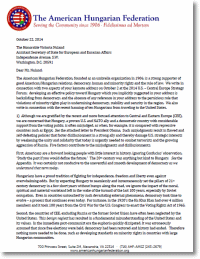

The AHF Letter to President Obama and Sec. Nuland is available for download:
English

10/22/14 – AHF submits letter to US Asst. Secretary of State Victoria Nuland: “The appearance of selective enforcement and the use of anti-corruption measures as a “big gun” for political purposes that are unrelated to corruption, coupled with the other issues noted in this letter merely befuddle and alienate the Hungarian people and undermine U.S. goals… Corruption cannot, must not be tolerated. It needs to be eradicated wherever found. If not halted, it will undermine democracy and the free market system. We, therefore, support U.S. anti-corruption initiatives. However, in order to be effective selective prosecution should be meticulously avoided.”
October 22, 2014
The Honorable Victoria Nuland
Assistant Secretary of State for European and Eurasian Affairs
Independence Avenue, S.W.
Washington, D.C. 20591
Dear Ms. Nuland:
The American Hungarian Federation, founded as an umbrella organization in 1906, is a strong supporter of good American/Hungarian relations, democracy, human and minority rights and the rule of law. We write in connection with two aspects of your keynote address on October 2 at the 2014 U.S. – Central Europe Strategy Forum: developing an effective policy toward Hungary which you implicitly suggested in your address is backsliding from democracy; and the absence of any reference in your address to the pernicious role that violations of minority rights play in undermining democracy, stability and security in the region. We also write in connection with the recent banning of ten Hungarians from traveling to the United States.
1) Although we are gratified by the recent and more focused attention to Central and Eastern Europe (CEE), we are concerned that Hungary, a proven U.S. and NATO ally and a democratic country with considerable support from the voting public, is often misjudged, as when, for example, it is compared with repressive countries such as Egypt. See the attached letter to President Obama. Such misjudgments result in flawed and self-defeating policies that foster disillusionment in a strong ally and thereby damage U.S. strategic interests by weakening the unity and solidarity that today is urgently needed to combat terrorists and the growing aggression of Russia. Five factors contribute to the misjudgments and disillusionments:
First, Americans are a forward looking people with little interest in history, ignoring Confucius’ observation, “Study the past if you would define the future.” The 20th century was anything but kind to Hungary. See the Appendix. It was certainly not conducive to the uneventful and smooth development of democracy as we understand that term today.
Hungarians have a proud tradition of fighting for independence, freedom and liberty even against overwhelming odds. But by expecting Hungary to seamlessly and instantaneously set the pillars of 21st century democracy in a few short years without bumps along the road, we ignore the impact of the moral, spiritual and material wasteland left in the wake of the turmoil of the last 100 years, especially by Soviet occupation. Even in countries untouched by such devastating external phenomena, democracy took time to evolve – a process that continues even today. For instance, in the 1920’s the Ku Klux Klan had over 4 million members and it took 100 years from the Civil War for the U.S. Congress to enact the Voting Rights Act of 1965.
Second, the countries of CEE, excluding Russia or the former Soviet Union have often been neglected by the United States. This benign neglect has resulted in a fundamental misunderstanding of the United States and its values. In the immediate post-communist era the euphoria quickly dissipated. It was erroneously assumed that since free elections were held, democracy had been restored and history had ended. Therefore nothing more needed to be done, such as developing standards on minority rights in countries with large Hungarian communities.
Third, to the extent the United States has been engaged in Hungary there has been a widespread perception for some time, as erroneous as it may be, that it has favored the Hungarian left. It is imperative that the U.S. should now address those democratic-minded Hungarians who supported and continue to support the center, center right and are bewildered by what they perceive has been an absence of evenhandedness. There is a chance, however, that if the U.S. fails to dispel the perception of favoritism, these disappointed long-time friends of America may adopt more cynical attitudes (with the disappointment playing into the hands of anti-Western radicals) and thus weaken the alliance. This development would be contrary to the interests of both countries.
Fourth, there has been a tendency by officials to publicly lecture Hungarians in what they perceive is a patronizing and humiliating manner. The lectures even extend to questions that are truly internal matters, such as Hungarians’ debates on their history. At the same time, there is little or no public criticism of repressive countries, such as Saudi Arabia.
Finally, the United States tends to overlook Hungary’s and the region’s painful post-communist transformation, exacerbated by economic stagnation, joblessness, recession and mismanagement of previous regimes.
The impact on Hungary and its current political environment of these five factors must be taken into consideration if we are to fine-tune and develop a sound and effective policy toward that country that advances U.S. interests and policy goals in the region and reestablishes strong bilateral ties.
2) We are puzzled why in an address relating to democracy and security in CEE you failed to mention the need for countries with Hungarian minority populations to respect minority rights. A government that fails or refuses to respect minority rights can hardly be deemed to be genuinely democratic, even if it has come to power through the ballot. This was clearly recognized during the first round of NATO’s enlargement when, for example, in March 1997 then Senator Biden said, “Senators will determine whether the prospective [NATO] members maintain democratic institutions, respect civil and minority rights . . . .” (Emphasis added.) See also:
- “NATO Enlargement: Promoting Western Values, Strengthening the Alliance” Statement before the United States Senate Committee on Foreign Relations
- Debate on NATO Enlargement 1997: Hearings before the House Committee on Foreign Relations, United States Senate
Minority rights have nothing to do with borders or separatism as some erroneously assert in order to ignore their international legal obligations. They have everything to do with meaningful and enduring stability in CEE. The Hungarian minorities who seek redress for their grievances strictly through democratic, i.e., non-violent, means themselves contribute substantially to sustainable stability in the region.
A fundamental change in Western thinking and policies, therefore, is urgently needed and long overdue. There must be visible support for measures that are intended to assist Hungarians living as minorities maintain their unique culture in their ancient homeland and to overcome the effects of discrimination, persecution, and in some instances violence they have faced. For instance, the U.S. ought to encourage Romania to return communal properties, e.g., churches, that were confiscated by the communists, to their respective Hungarian minorities and to grant minorities their legitimate demands for autonomy that they have long requested – generally cultural autonomy – to enable them to preserve their culture. Autonomy is a democratic mechanism that is successfully used in Europe. It is a form of internal self-determination that leaves borders intact, thus also promoting stability and security. The stability flowing from collective rights is of interest to Hungary, the U.S. and NATO. See also:
We, therefore, respectfully urge you to include the issue of minority rights for Hungarians as you continue to address democracy, stability and security in CEE.
3) The banning of corrupt individuals from entering the United States is another opportunity for Washington to advance a laudable goal. As noted by the U.S. Embassy in Budapest, “The U.S. Department of Justice has established an anti-kleptocracy unit to expand capacity to pursue cases in which ill-gotten wealth overseas is found to have a U.S. connection.” Corruption cannot, must not be tolerated. It needs to be eradicated wherever found. If not halted, it will undermine democracy and the free market system. We, therefore, support U.S. anti-corruption initiatives.
However, in order to be effective selective prosecution should be meticulously avoided. The anti-corruption campaign and bans should apply across the board where justified, regardless of political affiliation and not limited to just one political party as it appears is happening today. The bans should also be applied to individuals from other countries in the region that are notoriously corrupt, such as Romania. Moreover, it is essential that the anti-corruption drive not be seen as a manifestation of a blunt instrumentality of political pressure. That impression unfortunately is spreading. As one blogger, Eva Balogh, who is a harsh critic of the Hungarian government acknowledged in a post on October 17:
“On the surface the affair is solely about corruption, but the American reaction to these cases is politically charged. . . . There are several ways of dealing with such cases. For instance, one can pay a visit to the country’s foreign ministry and report that such behavior is unacceptable. At the same time the American official can express his hope that in the future there will be no discriminatory measures against American firms and that extortionist activities will stop. But in this case the United States government came out with the big gun. . . . This is, in my opinion, a political message to the Orbán government and part and parcel of a new, more forceful policy being conducted by the U.S. government toward Hungary.”
The appearance of selective enforcement and the use of anti-corruption measures as a “big gun” for political purposes that are unrelated to corruption, coupled with the other issues noted in this letter merely befuddle and alienate the Hungarian people and undermine U.S. goals. On the other hand, good bilateral relations with Hungary, drawing Hungary closer to the U.S., as well as the promotion of minority rights and the eradication of corruption throughout the region on an equitable basis are strategic interests of the United States in CEE. These are the policies, we respectfully urge, that should be pursued vigorously but judiciously. They are of great concern to our community. We, therefore, stand ready to assist you in these endeavors.
Thank you for considering these important issues.
Frank Koszorus, Jr.
National President
Public Member of the U.S. Delegation of the
1989 Conference on Security and Cooperation
in Europe on the Human Dimension
Bryan Dawson
Co-President
Chair of the AHF Information Committee
Appendix
Hungary and Hungarians in the Twentieth Century
Briefly summarized, Hungary was dragged into the devastating First World War; it underwent the Aster Revolution, followed by the Red Terror of the short-lived communist Bela Kun regime and then the White Terror that overthrew the communists; it was occupied by Romanian forces that looted the country; it then was forced to sign the punishing Treaty of Trianon (1920) in violation of President Wilson’s 14 points and which unjustifiably stripped Hungary of two thirds of its territory and one third of its ethnic Hungarian population who had no voice in the matter (many of whose ascendants today still face discrimination); it bordered Nazi Germany after Hitler incorporated Austria into the Third Reich; that resulted in Hungary being forced into the Second World War and to be ultimately occupied by Germany; with the assistance of Hungarian collaborators, the Nazis horrifically destroyed Hungary’s Jewry; Hungary also was turned into a last-ditch battleground by Hitler; it was then occupied by the Soviet Union which imposed a ruthless communist system on Hungary (and the region) that destroyed the middle class as the West looked the other way; Hungarians revolted in 1956 and were crushed by invading Soviet tanks while the West impotently looked on; and finally Hungary regained its independence in 1990 and embarked on rebuilding a democratic society.
Human and Minority Rights Denied Hungarian Minorities
Understating or ignoring minority rights for Hungarian minorities neither promotes democracy nor stability in Central and Eastern Europe. The U.S Department of State’s Country Reports on Human Rights Practices omit or downplay human and minority rights violations against ethnic-Hungarian communities. For example:
- The 2013 report on Ukraine:
- Omitted entirely the intimidation of ethnic-Hungarians, vandalism of national monuments, threats to use of Hungarian language, lack of political representation, and desires for cultural autonomy.
- The 2013 report on Slovakia:
- Similarly, the report on Slovakia downplays how the Slovak citizenship law came into being and fails to mention the law was enacted to discriminate against the large ethnic-Hungarian community in direct response to Hungary permitting ethnic-Hungarian to regain their Hungarian citizenship. It disregards the effects of this law and the very real impact on Slovak citizens of stripped of their citizenship.
- There is no mention of the discriminatory Slovak Language Law which criminalized the use of Hungarian
- There is also no mention of the re-affirmation of the Benes Decrees and its abhorrent concept of collective guilt.
- Finally, there was no mention of Slovakia’s refusal to exonerate Count Janos Esterhazy the only member of Slovak parliament to vote to save Slovakia’s Jews and who died in a communist prison.
- The 2013 report on Romania, while it does acknowledge significant discrimination against the Hungarian minority, it does so by referencing a third-party Hungarian organization, rather than coming to its own conclusions. There are also glaring omissions:
- Omitted from the report is Romania’s failure to fully restitute properties illegally confiscated from religious denominations after 1945 by Ceausescu’s communist regime and recent prosecution of former state secretary Attila Marko, Silviu Vlim and Tamas Marosan as a retaliatory act.
- Omitted is the threatened revocation of the Knight’s Order of the “Star of Romania” from the hero of the Romanian Revolution, Bishop László Tőkés. Omitted is the failure to abide by Romania’s own laws to provide for bilingual street signs and access to higher education in the mother tongue.
- There is no mention of Romania’s plans for redistricting to eliminate Hungarian majority counties.
- Finally, there is no mention of Romania’s complete refusal to consider re-establishment of autonomy rescinded by the hated Ceausescu regime.
References
- Deborah S. Cornelius, Hungary in World War II: Caught in the Cauldron, Fordham University Press, (2011)
- Bryan Cartledge, The Will to Survive: A History of Hungary, Columbia University Press, (2011)
- David A. Andelman, A Shattered Peace: Versailles 1919 and the Price We Pay Today, John Wiley & Sons, Inc., (2008)
- Stephen Borsody, ed., The Hungarians: A Divided Nation, Yale Russian and East European Publications, (1988)
- Csaba K. Zoltani, Transylvania Today: Diversity at Risk, Osiris, 2013
- John Flournoy Montgomery, Hungary: The Unwilling Satellite, Reprinted by Vista Books, (1993)
- Ignac Romsics, Hungary in the Twentieth Century, Corvina Osiris, (1999)
- Zsuzsa Hanto, Banished Families, Hungarian House, Kft., (2011)
- Martin Ben Swartz, A New Look at the 1956 Hungarian Revolution: Soviet Opportunism, American Acquiescence, UMI, (1989)
AHF attached the following October 10th letter to President Obama:
October 10, 2014
The President
The White House
1600 Pennsylvania Avenue, N.W.
Washington, D.C. 20500
Dear Mr. President:

The American Hungarian Federation, founded as an umbrella organization in 1906, is a strong supporter of good American/Hungarian relations, democracy, human and minority rights and the rule of law. We write in connection with your remarks at the Clinton Global Initiative in New York on September 23, 2014, describing your new initiative promoting civil society and Non-Government Organizations (NGOs) around the world.
Considering the Federation’s purposes and that many of our members have throughout their adult lives promoted civil society and NGOs (and some who took up arms against totalitarianisms), we applaud you for your principled stand and leadership. Civil society advocates are threatened, imprisoned and killed in many countries in the world. Hungary, we respectfully submit, is not one of them.
Hungary is a member of the EU and NATO and a democratic state where thousands of NGOs operate freely and where dissent is extensive and vigorous. Since the fall of communism, Hungary has had seven internationally recognized free national elections. Demonstrators in Budapest, including opposition political parties, can freely gather, protest and air whatever grievances they may have against government policies and freely voice their assertions of alleged governmental interference with Norwegian-backed and funded NGOs. Fairness dictates that at a minimum, an impartial review of these matters be concluded before there is a rush to judgment, especially one that equates Hungary with proven repressive countries.
Thus, although we believe that vigilance is necessary to preclude backsliding when it comes to democracy, we are justifiably puzzled and deeply concerned that you lumped Hungary in with Egypt and some of the worst dictatorships of the world in assessing the state of civil society freedoms. Indeed, in the latest Freedom House country rating report, Hungary scored 12 out of 12 points for protecting the associational and organizational rights of NGOs, which was better than the United States’ score of 11/12. Moreover, Hungary scored a perfect 12/12 for its electoral process, whereas the United States scored 11/12. Hungary scored 15/16 for freedom of expression and belief, the very same score as the United States. By sharp contrast, with respect to NGO freedoms, Egypt scored an abysmal 4/12, while Viet Nam, also mentioned in your address, scored a deplorable 1/12.
We therefore respectfully call upon you to retract that part of your statement that unjustifiably places Hungary in the same category with Egypt and other such repressive countries. Doing so would help alleviate the concern, confusion and disbelief found in our community about the United States views of Hungary, a democratic ally. It would also serve to advance the goals of the United States in the region.
We also respectfully urge you to consider the following two issues in connection with your new policies — partnering and protecting civil society groups, creating innovative centers, and increasing funding for the Community of Democracies:
(1) When it comes to supporting civil society groups in established and working democracies such as Hungary, transparent and very specific guidelines should be adopted and thorough reviews conducted as to which NGOs are to receive U.S. support, if any. Such guidelines and scrutiny are necessary to guarantee that groups — conservative or liberal, pro- or anti-government — that are actually politically partisan entities not receive American support on a disproportionate or discriminatory basis. Even if Hungarian law does not prohibit foreign donations to political campaigns as U.S. laws and regulations do, the absence of such scrutiny and evenhandedness would be less than fortunate. It would alienate democratic Hungarians and give the unavoidable appearance that the U.S. is interfering in the democratic processes of that country and with the democratically expressed wishes of its people when they cast their ballots. In fact, it would appear to some, as erroneous as that perception might be, as if the U.S. is seeking to overturn a democratic result. We fear that this perception would play into the hands of anti-Western radicals by fostering disillusionment in a strong ally and damage U.S. interests by weakening the unity and solidarity that today is so needed to combat terrorists and the growing aggression of Russia; and
(2) Attention should at long last be directed at countries neighboring Hungary which continue to discriminate against their Hungarian minorities. For example, Romania still fails to return communal and religious properties that had been confiscated by the previous communist regime and fails to investigate, prosecute or even condemn vandals who commit hate crimes by defacing Hungarian monuments with anti-Hungarian graffiti. Another example is Slovakia which has adopted discriminatory language and citizenship laws. Failure to address these and other well-documented violations of minority rights, acts of discrimination and instances of intolerance give the appearance of a double standard and would erode the effectiveness of your new policies.
Thank you for considering these important issues which we believe, if appropriately addressed, will substantially contribute to the success of your policies, promote and strengthen civil society, and advance good bi-lateral relations with Hungary — all interests of the United States. We stand ready to assist you in these endeavors.
Most respectfully:
Frank Koszorus, Jr.
National President
Public Member of the U.S. Delegation of the
1989 Conference on Security and Cooperation
in Europe on the Human Dimension
Bryan Dawson
Co-President
Chair of the AHF Information Committee
Join and Support Us Online!
