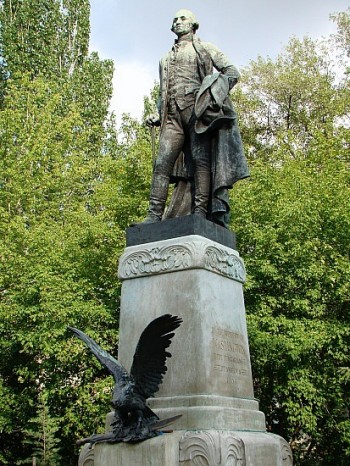
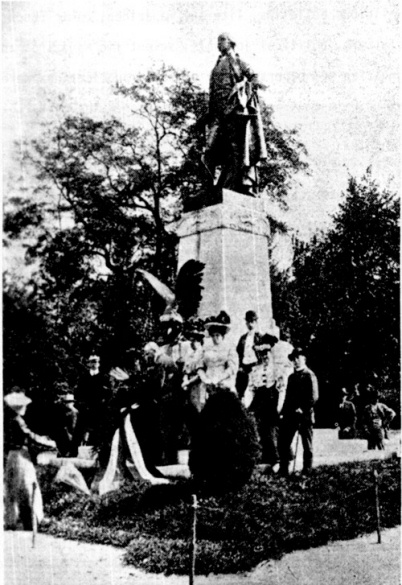
The George Washington Statue in Budapest by Gyula Bezerédy in 1906.
Related
- More AHF History
- AHF’s First President
- AHF page on Louis Kossuth
- 100th Anniverary Congressional Display
- Remarks
at the 100th Anniversary of the George Washington Statue in Budapest:
Philip T. Reeker, Deputy Chief of Mission, September 16, 2006
AHF’s 100 YEARS
CONGRESSIONAL DISPLAY
(by Bryan Dawson:
click on each
image for a larger version)
AHF and the Kossuth
Bust in the US Capitol
[read more]
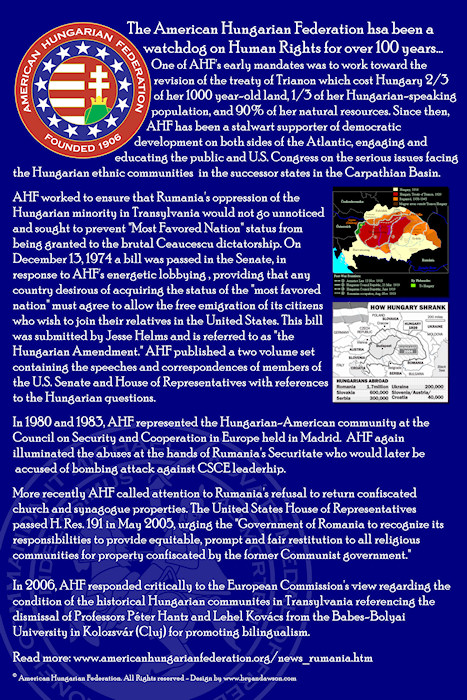
AHF as a watchdog for
human rights in Rumania
[read more]
Help us help the community! Support us securely online.
A Call for Unity
Between the Nations!
Louis Kossuth led the 1848 Hungarian
revolution for independence against the Hapsburgs. Crushed by the combined
royalist forces of Austria and Russia, many of the leaders of that ill-fated
revolt found their way to America where Kossuth would have a remarkable
impact. In 1902, to honor the “Father of Hungarian Democracy,”
a movement began to build a Louis Kossuth statue in Cleveland spearheaded
by the “Szabadság” Hungarian language newspaper and its
editor Kohányi Tihamér. Some 60,000 people attended the
unveiling, but there were no representatives from Hungary. As a sign of
unity between the nations and the symbolic ties to democratic struggle,
Hungarian-American leaders conceived an idea to place a statue of George
Washington in Budapest, the “Father of American Democracy.”
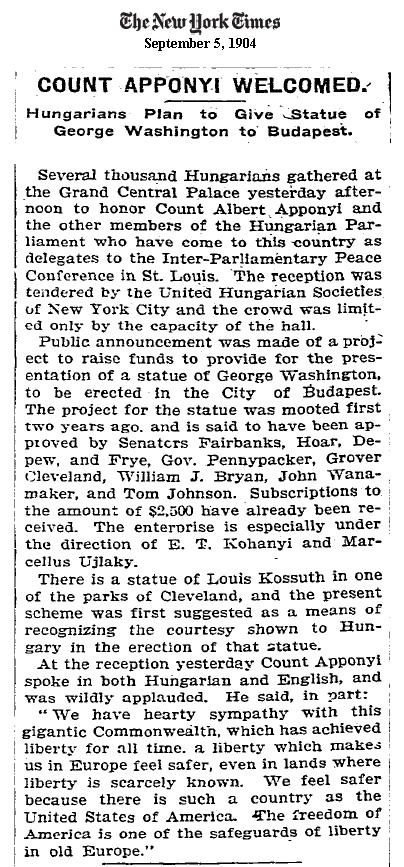
Kohányi Tihamér and Marcellus Ujlaky announced the effort at Budapests’ Grand Central Palace as the Hungarian nation honored the great Count Apponyi. With thousands in attendance, Count Apponyi speaking in English and Hungarian, remarked, “We have hearty sympathy with this gigantic commonwealth, which has achieved liberty for all time, a liberty which makes us in Europe feel safer, even in lands where liberty is scarcely known. We feel safer because there is such a country as the United States of America. The freedom of America is one of the safeguards of liberty in old Europe.” Future President Grover Cleveland, Senator Fairbanks and William Jennings Bryant personally approved of the effort.
September
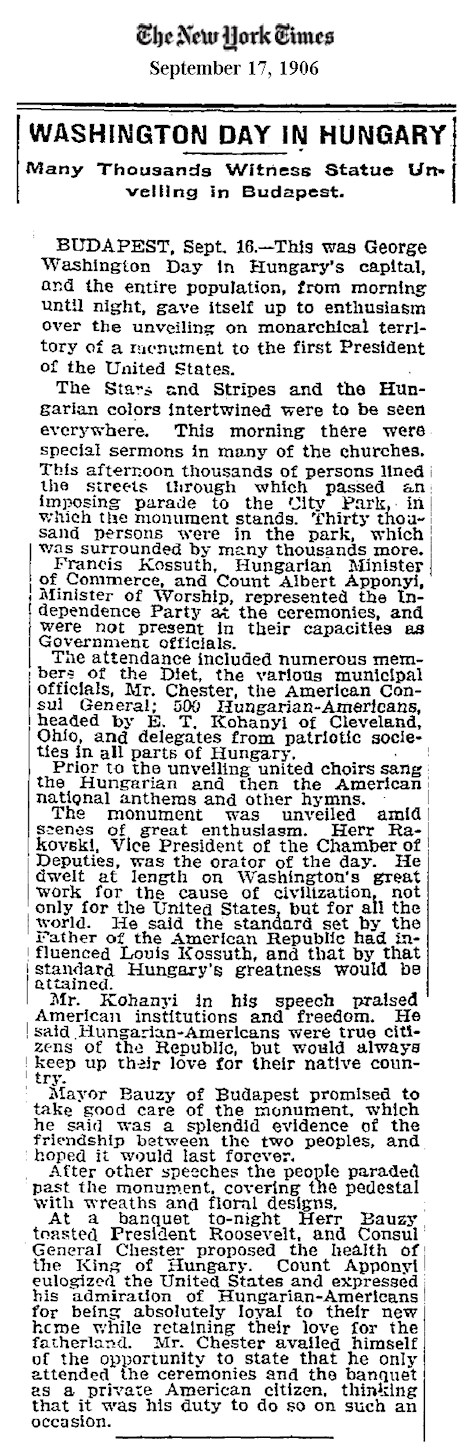
16, “George Washington Day” in Budapest
One of the first tasks of the newly established AHF was to establish a
“Statue Committee.” Fundraising was again successful and construction
began on a site in Budapest’s beautiful City Park (Város Liget).
In 1906, several hundred Hungarian-Americans and over 30,000Hungarians
attended the unveiling on September 16th led by AHF’s first President,
Kohányi Tihamér. Thousands lined the streets to watch the
parade through Budapest as the “Stars and Stripes and the Hungarian
colors intertwined were to be seen everywhere.”
Honoring
100 Years…
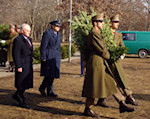
On February 22, 2006, U.S. Ambassador to Hungary George Walker joined
distinguished Hungarians at the wreath-laying ceremony commemorating the
founder and first President of the United States George Washington. In
his remarks,Ambassador Walker noted that September would mark the 100th
anniversary of the erection of the statue, and expressed great appreciation
on behalf of the people of the United States that Hungary has so honored
the founder of their nation.
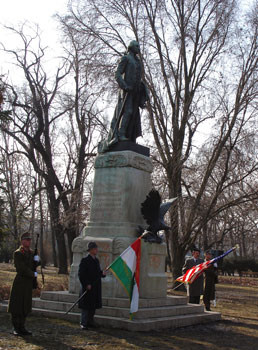

The Ambassador drew a parallel between the 1776 U.S. revolution and the Hungarian revolutions of 1848 and 1956.Although American forces were greatly outnumbered by the British in 1776, Washington refused to give up even when all the odds were against him.Similarly, the Hungarian forces were greatly outnumbered by foreign forces in both of the Hungarian revolutions; nevertheless the heroes refused to surrender. Ambassador Walker said that the courage, stamina and bravery of the heroes of 1848 and 1956 were an inspiration for people all over the world.
József T. Bocskay, President of the World Alliance of Certified Freedom Fighters’ mentioned that the Hungarians who immigrated to the U.S. in 1906 wished to have this statue erected to express their gratitude for the U.S. providing them with work and a livelihood. He noted that the wreath-laying ceremony is organized every year to thank the United States for the help given to Hungarians, especially the immigrants after 1956.
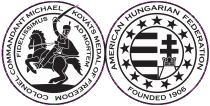
Member of Parliament András Pettkó paid tribute to Colonel Mihály Kováts, a hero of the 1776 revolution, who organized and led the cavalry of George Washington. The American Hungarian Federation named its highest award, the Col. Commandant Michael Kovats Medal of Freedom, after him. Mr. Pettkó quoted Hungarian historian Ödön Vasvári who, comparing Lajos Kossuth and George Washington, drew the conclusion that the difference between the two statesmen was that “Washington was able to realize what Kossuth had imagined before.” He also quoted from the February 22, 1856 speech of Kossuth who said that “the United States was the masterpiece of Washington” and that “George Washington was the creating father of democratic constitutionality.” Upon mentioning the Washington Award established by American Hungarians, András Petkó stressed that George Washington connected the American and the Hungarian people.

Top Hungarian leaders, U.S. Embassy officials and members of the Hungarian public celebrated the 100th anniversary of the unveiling of the George Washington statue in Városliget (City Park) on September 16, 2006. In addition to commemorating the great leader of the War of Independence and first President of the United States, participants also celebrated the talent and contributions of Hungarian immigrants, who raised the funds to set up Washington’s statue in Budapest, and the ’56 freedom fighters who, like Washington, fought for democratic values and personal liberties. U.S. Deputy Chief of Mission Philip T. Reeker emphasized that George Washington symbolizes struggle, sacrifice and mission to achieve what all people deserve: just government and civil rights. He recalled President Bush’s remarks at Gellért Hill in June 2006 that freedom and democracy can be delayed but cannot be denied. Drawing a parallel with the Kossuth statue in the U.S. Capitol, President Bush also emphasized that those who fight for liberties are heroes not only in their land but all around the world. Mr. Reeker added that freedom has many heroes and they are recognized by all who cherish democratic values.
Parliament Speaker Katalin Szili and Budapest Mayor Gábor Demszky underscored that George Washington set an example and created the foundations of a political structure which we consider as a model today.
During the event the Association of Certified Freedom Fighters presented the “Freedom Commemorative Medal” to President Bush, which was received by Mr. Reeker. Following the blessing of the statue, dignitaries laid a wreath to express their appreciation to the founder of our democracy.
The American Hungarian Federation®, is the oldest and largest Hungarian-American umbrella organization in the United States. AHF was founded in 1906 and incorporated in 1907 in Cleveland, Ohio as a non-profit association of Hungarian Fraternal societies, institutions and churches to “defend the interest of Americans of Hungarian origin in the United States.” Over the past 100 years, AHF’s mission has broadened to include support of people of Hungarian descent on both sides of the Atlantic and in the successor states of the Carpathian Basin. The American Hungarian Federation strives to unite the American Hungarian community through work that supports common goals. AHF is a non-partisan, independent organization representing the interests of its member organizations and the Hungarian American community.
Hungarian and American – from
the start!
AHF’s Motto, “Fidelissimus ad Mortem” (Faithful Unto Death),
was taken from a letter to Benjamin Franklin written by the Father of
the US Light Cavalry when he offered his sword in service to the United
States. The former Hussar Officer, Col. Commandant Mihaly Kovats, after
whom AHF named its
highest award and whose life and service is celebrated annually by US
Military Cadets at the Citadel Military Academy, died in battle against
the British in Charleston, S.C. in 1779.
Our Motto reflects our virtues and historically and inextricably ties Hungarians and Americans together and symbolizes Hungarians’ contribution to America right from the start. The loyalty to the US and desire for close relations between the two nations have been a guiding principle and have shaped AHF’s policies for over a 100 years.