5/19/2015 – Congressional Hearing on the “Future of US – Hungarian Relations.” AHF submits statement to the US House of Representatives House Committee on Foreign Affairs outlining steps the US can take to improve bilateral relations. “The focus of its statement is (1) the extent to which good relations with Hungary serve the strategic interests of the United States; (2) and the steps the United States can take to maintain and improve its relations with Hungary, including arriving at balanced and informed judgments relating to Hungary.” The full statement appears below and available for [download]
Related

Washingtonban Magyarország lesz a téma kedden – Komoly tiltakozás: Az Amerikai–Magyar Szövetség elnökétől nem idegen, hogy egyetemes magyar ügyekért kiálljon. Tiltakozott a Fehér Házban, a kongresszusban, a Helsinki Bizottságnál, ha a magyarságot igazságtalan sérelem érte. Koszorús Ferenc a dialógus híve, most mégis azt mondja, semmi értelme sincs annak a május 19-re összehívott kongresszusi meghallgatásnak, amelynek keretében az amerikai– magyar kapcsolatok jelenét és jövőjét vitatnák meg. [tovább]

3/19/2013 — United States Helsinki Commission holds Hearing entitled, “The Trajectory of Democracy – Why Hungary Matters” to “examine Hungary’s constitutional changes with a particular view to the independence of the judiciary, present-day Hungary’s relationship to its Holocaust-era past, and the implications of Hungary’s sweeping legal changes for civil society, including an independent media and religious organizations.”… AMERICAN HUNGARIAN FEDERATION ISSUES STATEMENT. [read more]
2/27/2013 – Watch the podcast of Subcommittee Hearing: Anti-Semitism: A Growing Threat to All Faiths. Tamás Fellegi, Ph.D., Managing Partner of EuroAtlantic Solutions (Former Minister of National Development Government of Hungary) represented Hungary on the distinguished panel. [See the timeline of remarks and read more]
1/24/2012 – AHF reacts to what it sees as politically motivated, unfair, unmerited, biased criticism of Hungary. “While democratic institution building should be encouraged and debated, it should be done based on facts, and in a fair, unbiased and evenhanded manner [it must be] bereft of partisanship (or even the appearance of partisanship) and undertaken solely in furtherance of promoting Western values, not political expediency.”
[read more]
U.S. HOUSE OF REPRESENTATIVES
HOUSE COMMITTEE ON FOREIGN AFFAIRS
SUBCOMMITTEE ON EUROPE, EURASIA AND EMERGING THREATS
Hearing On “The Future of U.S.-Hungarian Relations”
Statement of Frank Koszorus, Jr., National President, American Hungarian Federation, and Public Member of the U.S. Delegation of the 1989 Conference on Security and Cooperation in Europe on the Human Dimension
May 19, 2015
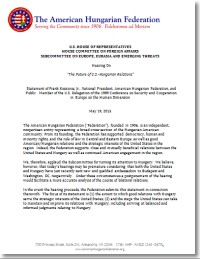
[download] AHF’s Statement
The American Hungarian Federation (“Federation”), founded in 1906, is an independent, nonpartisan entity representing a broad cross-section of the Hungarian American community. From its founding, the Federation has supported democracy, human and minority rights, and the rule of law in Central and Eastern Europe as well as good American/Hungarian relations and the strategic interests of the United States in the region. Indeed, the Federation supports close and mutually beneficial relations between the United States and Hungary as well as continued American engagement in the region.
We, therefore, applaud the Subcommittee for turning its attention to Hungary. We believe, however, that today’s hearings may be premature considering that both the United States and Hungary have just recently sent new and qualified ambassadors to Budapest and Washington, DC, respectively. Under these circumstances a postponement of the hearing would facilitate a more accurate analysis of the course of bilateral relations.
In the event the hearing proceeds, the Federation submits this statement in connection therewith. The focus of its statement is (1) the extent to which good relations with Hungary serve the strategic interests of the United States; (2) and the steps the United States can take to maintain and improve its relations with Hungary, including arriving at balanced and informed judgments relating to Hungary.
Hungarian policies and practices that are necessary to improve relations also require analysis but are beyond the scope of this statement other than to say that strengthening democracy and democratic institutions, combating corruption1 remaining a good NATO ally are key factors in promoting good bilateral relations with the United States.
United States interests are served by good bilateral relations as Hungary is a dependable ally. Due to its geographic location and record as a valuable and dependable ally, American interests are served by friendly relations with Hungary. Hungary’s international cooperation after the Cold War extends back to Prime Minister Jozsef Antall when Hungary became a very close and reliable friend and partner of the United States, especially manifested during the failed coup in Moscow in August 1991 and throughout the Balkan wars.
Hungary has not been a fair-weather friend. It assisted NATO in the alliance’s Kosovo campaign, despite considerable danger this posed to the vulnerable Hungarian minority in Vojvodina. Also, by refusing permission to Russia to fly over Hungarian airspace, the first Orban government frustrated Russian plans to seize Pristina airport. While many Hungarians, similar to Europeans in general, were skeptical about the war in Iraq, they were and are supportive of efforts to combat international terrorism.
The new Hungarian ambassador detailed Hungary’s participation in global security matters in a recent article as follows:
“Since our accession to NATO in 1999, Hungary has taken part in a host of large-scale NATO operations, including in Afghanistan and Kosovo. Sixteen years after our initial commitment to the NATO launched Kosovo Force, Hungary still has more than 330 military personnel keeping the peace in Kosovo. Beginning in 2003 Hungary started to deploy troops to Afghanistan to fight alongside U.S. forces against the Taliban, working to ensure that Afghanistan is never again a safe haven for terrorists. We reached peak strength with approximately 530 in 2012. Unfortunately six of our soldiers were killed in action in recent years. At present nearly 130 Hungarians are serving in Afghanistan as part of NATO’s Resolute Support Mission.
Additionally, Hungary has dedicated hundreds of troops to more than a dozen UN peacekeeping and peacemaking missions, including Iraq (1988-2003), Lebanon (2006-current), Georgia, (1994-2009), Uganda (1993-1994), Cyprus (1995-current) and Central African Republic (2014), among others.
Hungary is currently participating in three UN missions, dedicating approximately $40-$75 million annually. Hungary’s standing military force consists of fewer than 30,000 active duty personnel, just 2.4 percent of the size of the US military. So when hundreds of soldiers are sent to keep the peace in a foreign land, it’s not an insignificant military or economic cost. But it’s one that Hungarians feel is our moral duty.”2
In January 20014, even Senator John McCain who has been critical of Prime Minister Viktor Orban acknowledged Hungary’s significant role in advancing security and peace:
“We also discussed with both the Prime Minister and the opposition our many common foreign policy interests. We share a commitment to consolidating democracy in the Balkans, integrating Ukraine into Europe, fostering a free and peaceful Afghanistan, and deepening security cooperation in NATO, especially on counterterrorism … The United States is grateful for the strong international cooperation that we enjoy with Hungary, and its willingness to play a leadership role on behalf of international peace and security. We believe that the success of our alliance is measured, in large part, by what we do together to support a more democratic, secure, and prosperous future — not just in Europe but also beyong Europe”
In sum, there can be no doubt that Hungary is supportive of efforts to combat international terrorism and promote international security – key American goals and vital interests. These policies alone validate and mandate initiatives not only to maintain but to improve American Hungarian relations.
Steps the United States can take to improve relations with Hungary:
A . Constructive engagement. The Federation believes that the United States must remain engaged in Central and Eastern Europe (CEE) on a constructive and evenhanded basis to help strengthen democratic institutions and the stability that derives from democracy. With the exception of NATO’s enlargement, attention soon drifted away from CEE after the euphoria following the fall of the Berlin Wall. Some quickly lost sight of the economic, moral and spiritual damage left in the wake of close to fifty years of Communism that had been imposed on the region by Soviet bayonets. Free elections were held and therefore nothing more needed to be done seemed to be the attitude shared by some decision and opinion makers.
Hungary’s and the region’s dependence on Russian energy was ignored. That needs to be addressed today. As noted by the Central and East European Coalition’s 2015 Policy Brief (the Federation is a long-standing member):
“Energy security and safety are vital to the energy deficient CEE region. Currently, Russia is the primary and, in many cases, sole source of gas and oil supplies, which it manipulates to attain its political and economic objectives. This is evident with abrupt cut-offs of gas and oil to CEE countries, price escalations to selected CEE countries, and redirection and/or reductions of gas supplies to Europe, such as disrupted natural gas supplies to Ukraine in June 2014.
U.S. policies could assure a secure and safe source of energy to the CEE countries. First, U.S. policy shoul facilitate immediate and prioritized export of U.S. liquefied natural gas (LNG) supplies to NATO countries, an any other foreign country that promotes U.S. national security interests. Secondly, it is essential that U.S policy support interconnection of electrical and gas resources with their western EU counterparts to improv efficient utilization of energy supplies. Third, U.S. policies must provide certainty for investment an technology to provide for the geographic diversification of energy supplies and efficient utilization of resource in the CEE region.”
Despite great strides toward freedom, democracy and democratic institution building throughout the region, there is work to be done, as, for example, is evident from rising anti-Semitism in parts of the region and intolerant attitudes and discriminatory policies directed at the Hungarian minorities in some of the countries neighboring Hungary – an issue that is largely ignored by some who are proponents of the questionable notion that democracy is in jeopardy in Hungary.
These proponents ignore the fact that putting the internal affairs of democracies established on the western parliamentary model, such as Hungary, under a microscope, however, is unusual and requires rigorous analysis. If the microscope is brought to bear to evaluate the actions of the government, the two questions that always must be asked are as follows: do those actions transgress in any substantial manner the established institutional norms practiced by a consensus of democracies around the world? And do they transgress the democratic norms established within the country being discussed itself?
In engaging in this review, one must distinguish between political questions that may arise about a government’s effectiveness or the wisdom of its policies and actions that may have breached in any substantial way institutional norms of democracy as practiced around the world in its various forms.
Examining Hungary from this perspective, the legislative agenda of the current government, while perhaps politically controversial, does not rise to the grave level of putting democracy at risk. There has been robust, critical discussion in Hungary’s media about every aspect of the key laws in question that Parliament has passed, no state repression of the opposition’s right to publicly criticize and object, and no state efforts to deny the opposition its democratic right to peacefully win over the public to its side in the next elections. In addition, demonstrators have freely expressed their anti-government opinions, while foreign commentators have given interviews, and critical assessments have been published in the Hungarian media. On winning the election, the opposition can and undoubtedly will introduce its own legislative agenda, and if it has enough support in the electorate as Fidesz did, it can enact its own changes to the constitution as well. These are core elements of democracy well in play in Hungary today.
The Federation, however, is concerned with the insinuations that the process itself was somehow not democratic. One can agree or disagree with the outcomes, but to question the institutional integrity of the process ironically strips the credibility of the very democratic procedures at play that could be used to establish other outcomes by other elected governments as well.
It is also important to bear in mind, as John O’Sullivan suggests, that insofar “as there is a problem of democracy in Hungary, it is the weakness of the opposition. That is due, however, not to the policies of the government but to the implosion of the Left in the elections of 2010 and 2014. In the latter a coalition of five left-wing parties was able to muster less than a quarter of the total national vote. This meltdown can be traced in part to its strategy of appealing less to the electorate for its votes than to sympathetic EU factions for interventions into Hungary’s domestic policies.”3
B. Fair review requires knowledge of Hungary, its people and its history. The Federation does not believe that no steps could be taken to strengthen democracy, democratic institutions and Hungary’s economy or that no mistakes have been made. It is not suggesting that every critical comment is solely meant to disparage Hungary or that well-intentioned, judiciously timed and factually accurate public statements expressing shared values should not be made. Rather it believes that some of the international criticism is not evenhanded or based on facts but on generalizations and speculation, i.e., what might happen as a result of the new laws as opposed to what has happened. Such criticisms often reveal a lack of understanding of Hungary’s history and the character of its people who have repeatedly sacrificed and demonstrated their commitment to freedom, as in 1956 when they rose up against Soviet tyranny.4
John O’Sullivan points out that Hungary “is really terra incognita to most statesman and journalists abroad.” So he concludes, “the broad picture of Hungary as an authoritarian state under despotic government the distorting telescope through which Hungary is now viewed by many otherwise well-informed outsiders is at best a grotesque exaggeration.”5 Suggestions in furtherance of the vaunted goal of strengthening democracy must be free of even a hint of political partisanship and must be grounded in principles and objective analysis.
C. Incessant public lecturing can backfire and undermine U.S. strategic interests.
Recently a moving letter from an apolitical professor in Hungary who is a strong friend of the United States but who nevertheless reiterated the widely-held perception that the U.S. was demeaning and humiliating the Hungarian people with its overwhelming and incessant barrage of public criticisms, some of which, many feel, are overstated, lack context and are bereft of evenhandedness. The criticism even extends to topics that are generally in the purview of matters left to internal discourse of sovereign states, e.g., historical events and figures and immigration policies.
Public commentary by a U.S. official regarding Hungary’s immigration policies is especially ironic because immigration is a divisive issue in the United States that involves an ongoing raging and intense debate. Indeed, immigration reform, including tougher border enforcement legislation, is a hotly debated issue that promises to be part of the American political landscape for some time to come.
Americans would undoubtedly bristle if the British, Hungarian or any other ambassador to Washington were to ignore diplomatic etiquette and publicly pontificate about American immigration policies. It, therefore, shouldn’t come as a surprise if critical public statement about Hungary’s immigration views humiliate and alienate many Hungarians who support NATO and its now ever more critical mission. This, in turn, could have the unintended consequence of undermining U.S. strategic interests in the region. Indeed, good bilateral relations between the United States and Hungary and a strong and united NATO are in the interest of both countries and necessary to meet the formidable challenges posed by Russia and terrorism.
Conclusion. The tensions caused by the proclivity of some of our former diplomats in Hungary to raise matters in the Hungarian media that are generally addressed through normal diplomatic channels have dissipated since the arrival in Budapest of our new ambassador who seems to understand that the constant barrage of public criticism in the media had backfired and didn’t serve the strong U.S.-Hungary- NATO partnership. The Federation hopes that both sides will strive to continue this trend, correct past mistakes and thereby serve their respective but mutually identical interests.
_________________
1. Corruption, which is endemic not only in Central and Eastern Europe but in Western countries such as Italy, is especially worrisome because it not only undermines democratic institutions and economic well-being, it also enables Russia to pursue its aggressive policies by penetrating and influencing both the public and private sectors, including military preparedness. Consequently, corruption also poses a security threat to the region, the EU and the US.
Reka Szemerkenyi, “Hungary’s resolute commitment to peace keeping and antiterrorism,” The Hill, Congress Blog, May 15, 2015.
John O’Sullivan, “Orban’s Hungary: Image and Reality,” Hungarian Review, September 2014, p. 12.
4. Hungary and Hungarians in the Twentieth CenturyBriefly summarized, Hungary was dragged into the devastating First World War; it underwent the Aster Revolution, followed by the Red Terror of the short-lived communist Bela Kun regime and then the White Terror that overthrew the communists; it was occupied by Romanian forces that looted the country; it then was forced to sign the punishing Treaty of Trianon (1920) in violation of President Wilson’s 14 points and which unjustifiably stripped Hungary of two thirds of its territory and one third of its ethnic Hungarian population who had no voice in the matter (many of whose ascendants today still face discrimination); it bordered Nazi Germany after Hitler incorporated Austria into the Third Reich; that resulted in Hungary being forced into the Second World War and to be ultimately occupied by Germany; with the assistance of Hungarian collaborators, the Nazis horrifically destroyed Hungary’s Jewry; Hungary also was turned into a last-ditch battleground by Hitler; it was then occupied by the Soviet Union which imposed a ruthless communist system on Hungary (and the region) that destroyed the middle class as the West looked the other way; Hungarians revolted in 1956 and were crushed by invading Soviet tanks while the West impotently looked on; and finally Hungary regained its independence in 1990 and embarked on rebuilding a democratic society.
- O’Sullivan, pp. 10 and 11.
Join online!
