
12/3/2015 – American Hungarian Federation has follow-up meeting with Ambassador Colleen Bell… During his stay in Budapest, Mr. Koszorus also met with United States Ambassador Colleen Bell. The purpose of the meeting wasto follow up on AHF’s November 4, 2015 letter toAmbassador Bell in whichAHF suggested that U.S. interests – promotion of democracy and human rights, strategic and economic — may not always be served by public criticisms which are perceivedby the man-on-the-street in Hungary, whether a supporter of the government or not, to be demeaning and humiliating.
Related
[Go to ALL Ambassador Colleen Bell News]

3/18/2016 — AHF and PAC address Bill Clinton’s Hungary remarks: The Presidents of the American Hungarian Federation and the Polish American Congress issue a joint statement objecting to the collective characterization by former President Bill Clinton of the Hungarian and Polish people as tired of democracy and desirous of “authoritarian dictatorship.” The politically neutral but principled statement, which cites the long struggle of Hungarians and Poles against Soviet tyranny to achieve the civic freedoms they enjoy today, can be viewed in its entirety [read more]

5/6/2016 — AHF attends Friends of Hungary Conference, attends meeting with US Amb. Colleen Bell and submits letter: The Friends of Hungary Foundation held its third conference in Budapest on May 6 -8. Frank Koszorus, Jr., President of the American Hungarian Federation, attended the event along with Federation members and officers, Andras Ludanyi, Gyula Balogh, Zsuzsa Dreisziger, and Katalin Kadar Lynn. [read more]
The meeting also continued AHF’s constructive dialogue with Ambassador Bell regarding strengthening good U.S-Hungarian relations and the foundations of those relations.
“Ambassador Bell was more than gracious and we explored various possible initiatives to advance better U.S./Hungarian relations, which is in the interest of both countries and certainly of great concern to AHF and the Hungarian American community,” reflected Mr. Koszorus. “Ambassador Bell effectively and with great poise represents the United States and pursues this important goal,” he concluded.
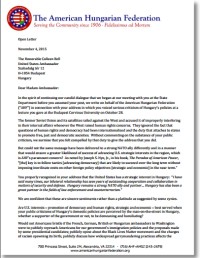
Download the Open letter to Ambassador Bell
In the open letter sent to Ambassador Bell on November 4th, AHF suggested that U.S. interests – promotion of democracy and human rights, strategic and economic — may not always be served bypublic criticisms which are perceived by the man-on-the-street in Hungary, whether a supporter of the government or not, to be demeaning and humiliating. The original letter is below:
American Hungarian Federation Submits Open Letter to Ambassador Bell– November 4, 2015
Dear Madam Ambassador:
In the spirit of continuing our candid dialogue that we began at our meeting with you at the State Department before you assumed your post, we write on behalf of the American Hungarian Federation (“AHF”) in connection with your address in which you voiced serious criticism of Hungary’s policies at a lecture you gave at the Budapest Corvinus University on October 28.
The former Soviet Union and its satellites railed against the West and accused it of improperly interfering in their internal affairs whenever the West raised human rights concerns. They ignored the fact that questions of human rights and democracy had been internationalized and the duty that attaches to states to promote free, just and democratic societies. Without commenting on the substance of your public criticism, we surmise that you felt compelled by that duty to give the address that you did.
But could not the same message have been delivered to a strong NATO ally differently and in a manner that would ensure a greater likelihood of success of advancing U.S. strategic interests in the region, which is AHF’s paramount concern? As noted by Joseph S. Nye, Jr., in his book, The Paradox of American Power, “[the] key is to follow tactics [advancing democracy] that are likely to succeed over the long term without imposing inordinate costs on other foreign policy objectives [strategic and economic] in the near term.”
You properly recognized in your address that the United States has a strategic interest in Hungary: “I have said many times, our bilateral relationship has seen years of outstanding cooperation and collaboration in matters of security and defense. Hungary remains a strong NATO ally and partner… Hungary has also been a great partner in the fields of law enforcement and counterterrorism.”
We are confident that these are sincere sentiments rather than a platitude as suggested by some cynics.
Are U.S. interests – promotion of democracy and human rights, strategic and economic – best served when your public criticisms of Hungary’s domestic policies are perceived by the man-on-the-street in Hungary, whether a supporter of the government or not, to be demeaning and humiliating?
Would not Americans bristle if the French, German, British or Hungarian ambassadors to Washington were to publicly reproach Americans for our government’s immigration policies and the proposals made by some presidential candidates; publicly opine about the Black Lives Matter movement and the charges of racism spawning its birth; publicly discuss how widespread gerrymandering practices affects the composition of our political party representation in numerous congressional districts; or publicly point to the lack of a single Republican vote in the Congress approving the Affordable Care Act?
It, therefore, shouldn’t come as a surprise if critical public statements about Hungary’s policies humiliate and alienate many democratic-minded Hungarians who support NATO and its now more than ever critical mission. Exacerbating the effect of such public criticism is the U.S. silence toward some countries neighboring Hungary where the members of the Hungarian minority face various forms of discrimination and intolerance. This silence gives the appearance of a double standard.
The cumulative effect of these perceptions could have the unintended and detrimental consequence of undermining U.S. strategic interests in the region. Indeed, good bilateral relations between the United States and Hungary and a strong and united NATO are in the interest of both countries and necessary to meet the formidable challenges posed by Russia, terrorism and other crises.
Winning Hungarian public opinion, instead of alienating it with gratuitous remarks about internal matters, is critical to the advancement of key American goals. As we criticize, we believe it is important to step back and place today’s Hungary into the context of that country’s recent history, a context too often ignored. While some of the practices raised may not completely mirror U.S. ones or need to be addressed, they are a far cry from the harsh realities of 40 years of Soviet-imposed rule that still has a lingering and deleterious effect on a nation that is striving to overcome that history – a history which was not of its making and which it was left to confront by itself at great sacrifice, as in 1956.
It also appears that the timing of your remarks may have been premature. Some believe that the Parliament was going to consider enacting legislation that would have addressed some of the concerns you and your predecessors have previously raised. Such proposals unfortunately are sure to be dead on arrival in light of the Corvinus address.
The key question that we respectfully suggest warrants re-examination and introspection is whether there might be better means of communicating U.S. concerns than such constant public criticism that haven’t yielded very much in terms of concrete results while carrying the very real danger of alienating friends? For example, wouldn’t the restoration of a vibrant independent United States Information Agency more effectively serve U.S. goals and interests, including the promotion of democracy and democratic institutions, than what appears to many to be unwarranted and unproductive lecturing?
Thank you for considering our views, which we offer in a spirit of respect and constructive dialogue. We look forward to continue working with you in the interest of strengthening U.S-Hungarian relations and the foundations of those relations.
Sincerely,
Frank Koszorus, Jr.
National President Public Member of the U.S. Delegation of the 1989 Conference on Security and Cooperation in Europe on the Human Dimension
Join us online!
