
Related

1/16/2013 – Az Amerikai Magyar Szövetség a Helsinki Bizottságnál tiltakozik: A legrégibb és legnagyobb amerikai magyar szervezet, az Amerikai Magyar Szövetség (AMSZ), amely mindig is támogatta a Helsinki Bizottságot az emberi jogokért, a demokráciáért vívott küzdelmében, levélben fordult Benjamin Cardin marylandi szenátorhoz, az amerikai Helsinki Bizottság elnökéhez. [tovább]
9/27/2012 – Miért támadja Magyarországot az amerikai szenátor?: A legnagyobb amerikai-magyar szervezet levélben fordult Benjamin Cardin, marylandi szenátorhoz, hogy aggodalmát fejezze ki a törvényhozó szokatlanul éles hangvételű, július 6-i “Veszélyben a demokrácia Magyarországon” című közleménye miatt.
[tovább magyarul]

7/14/2011 – American-Hungarian Federation strikes back at US senator over critical comments, by MTI:
The American Hungarian Federation (AHF) voiced “concern and perplexity” in a letter to Democrat Senator Benjamin L Cardin over his recent remarks concerning Hungary. [read more]
1/11/2013 – AHF again responds to Senator Ben Cardin, Co-Chair of the US Helsinki Commission. In his December 20, 2012 statement, the Senator was once again unfairly critical of Hungary. “We write in connection with your December 20 statement not because we believe that no steps can be taken to strengthen democracy in Hungary (such as permitting members of parliamentary caucuses to vote their conscience without being fined). Rather we believe that in order to be credible, criticism must be based on the complete record…As the Helsinki Commission’s public utterances carry great moral authority, we are concerned that (1) your assertions concerning Hungary omit relevant facts; and (2) your statement fails to raise the discrimination and intolerant policies toward ethnic Hungarians in some of the countries bordering Hungary. The statement therefore leaves the impression, unintended and unjustified as it may be, of bias, which could result in cynicism toward the Helsinki Commission and its valuable and necessary work.”
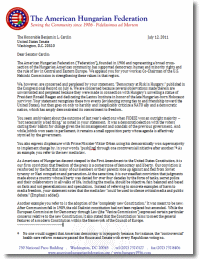
[Download] the AHF Letter to Senator Cardin
AHF’s full statement appears below. The Senator’s statement appears below it. Included in the letter, were links to AHF’s earlier summary of current issues related to the Hungarian minority Rumania.
The letter in full text appears below or [download]:
January 10, 2013
Honorable Benjamin L. Cardin
Co-Chairman, U.S. Helsinki Commission
Washington, D.C. 20510
Dear Mr. Chairman:
The American Hungarian Federation (“AHF”), founded in 1906 and representing a broad cross-section of the Hungarian American community, supports democracy in Central and Eastern Europe. It also supports the U.S. Helsinki Commission’s mission of monitoring compliance with the Helsinki Accords and promoting human rights and democracy. We write in connection with your December 20 statement not because we believe that no steps can be taken to strengthen democracy in Hungary (such as permitting members of parliamentary caucuses to vote their conscience without being fined). Rather we believe that in order to be credible, criticism must be based on the complete record.
As the Helsinki Commission’s public utterances carry great moral authority, we are concerned that (1) your assertions concerning Hungary omit relevant facts; and (2) your statement fails to raise the discrimination and intolerant policies toward ethnic Hungarians in some of the countries bordering Hungary. The statement therefore leaves the impression, unintended and unjustified as it may be, of bias, which could result in cynicism toward the Helsinki Commission and its valuable and necessary work.
Concerning Hungary, the only country named in the statement, you conclude that the government’s response to certain appalling anti-Semitic phenomena, such as far right politician Marton Gyongyosi urging the government to draw up lists of Jews who pose a “national security risk,” is wanting, “to say the least.” Do the following facts justify a modified conclusion: the government’s immediate condemnation of Gongyosi’s statement; or the demonstration protesting against Gyongyosi at which Fidesz parliamentary group leader Antal Rogan also spoke; or the legislation initiated by Fidesz in response to Gyongyosi’s outrageous statement that would allow for the sanctioning of MPs for using incendiary language; or both conservatives and liberals here (including this writer) and in Hungary jointly raising their voice in protest, which sent a loud message that anti-Semitism will not be tolerated; or the government establishing a Hungarian Holocaust Commission; or its raising pensions for the more than 8,000 Holocaust survivors?
And while your statement is silent about discriminatory and anti-Hungarian measures in some of the states neighboring Hungary, it criticizes Budapest for taking legitimate and democratic steps, such as extending citizenship, to protect Hungarian minorities. We urge you to “follow the trends” not only in Hungary, but also in the region and to publicly speak out against anti-Hungarian phenomena, many of which are official acts. Some of the most troubling measures are set forth in our December 1, 2011 and August 20, 2012 letters to you: [Slovakia_Cardin-Smith_2011-12-01.pdf] and [AHF_Statement_Miko_Helsinki.pdf]
These countries should be encouraged to build tolerant societies by respecting the rights of their Hungarian minorities. Ronald S. Lauder, President of the World Jewish Congress, aptly noted, “one of the basic tenets of liberal democracy is that minority rights are protected.” And as Congressman Tom Lantos eloquently reminded us, this protection should extend to all religious, national and ethnic groups, including Hungarians.
Sincerely,
Frank Koszorus, Jr.
National President
Public Member of the U.S. Delegation of the 1989 Conference on
Security and Cooperation in Europe on the Human Dimension
Statement of Senator Benjamin Cardin on the floor of the Senate, December 20, 2012
Mr. CARDIN. Mr. President, as the Senate chair of the Helsinki Commission, I have a longstanding interest in Central Europe. For many years the Helsinki Commission was one of the loudest and clearest voices to speak on behalf of those oppressed by communism and to call for democracy, human rights, and freedom from Soviet oppression. It has been a great triumph and joy to see the peoples of this region free from dictatorship.
Over the past two decades I have been profoundly heartened as newly freed countries of Central Europe have joined the United States and NATO and have become our partners in advocating for human rights and democracy around the globe. Leadership on those issues may be especially important now as some countries in the Middle East undertake transition, the outcome of which is far from certain. Even in Europe, in the western Balkans, there is a crying need for exemplary leadership, not backsliding.
Americans know from our own history that maintaining democracy and promoting human rights are never jobs that are finished. As my friend and former colleague Tom Lantos said, “The veneer of civilization is paper thin. We are its guardians, and we can never rest.”
For some time I have been concerned about the trajectory of developments in Hungary, where the scope and nature of systemic changes introduced after April 2010 have been the focus of considerable international attention.
At the end of November, Hungary was back in the headlines when Marton Gyongyosi, a member of the notorious extremist party Jobbik and also vice chairman of the Parliament’s Foreign Affairs Committee, suggested that Hungarian Jews are a threat to Hungary’s national security and those in government and Parliament should be registered. The ink was barely dry on letters protesting those comments when another Hungarian member of Parliament, Balazs Lenhardt, participated in a public demonstration last week where he burned an Israeli flag.
The fact is that these are only the latest extremist scandals to erupt in Budapest over the course of this year. In April, for example, just before Passover, a Jobbik MP gave a speech in Parliament weaving together subtle anti-Roma propaganda with overt anti-Semitism blood libel. After that, Jobbik was in the news when it was reported that one of its members in Parliament had requested and received certification from a DNA testing company that his or her blood was free of Jewish or Romani ancestry.
At issue in the face of these anti-Semitic and racist phenomena is the sufficiency of the Hungarian Government’s response and its role in ensuring respect for human rights and the rule of law. And the government’s response has been, to say the least, wanting.
First, it has been a hallmark of this government to focus on blood identity through the extension of Hungarian citizenship on a purely ethnic basis. The same Hungarian officials have played fast and loose with questions relating to its wartime responsibilities, prompting the U.S. Holocaust Memorial Museum to issue a public statement of concern regarding the rehabilitation of fascist ideologues and political leaders from World War II.
I am perhaps most alarmed by the government’s failure to stand against the organized threats from Jobbik. For example, in late August a mob estimated at 1,000 people terrorized a Roma neighborhood in Devecser, taunting the Romani families to come out and face the crowd. There were reportedly three members of Parliament from the Jobbik party participating in that mob, and some people were filmed throwing bricks or stones at the Romani homes. The failure to investigate, let alone condemn such acts of intimidation, makes Prime Minister Orban’s recent pledge to protect “his compatriots” ring hollow.
Of course, all this takes place in the context of fundamental questions about democracy itself in Hungary.
What are we to make of democracy in Hungary when more than 360 religious organizations are stripped of their registration overnight and when all faiths must now depend on the politicized decision-making of the Parliament to receive the rights that come with registration?
What are we to make of the fact that even after the European Commission and Hungary’s own Constitutional Court have ruled against the mass dismissal of judges in Hungary’s court-packing scheme, there is still no remedy for any of the dismissed judges?
What is the status of media freedom in Hungary, let alone the fight against anti-Semitism, if a journalist who writes about anti-Semitism faces possible sanction before the courts for doing so?
What are we to make of Hungary’s new election framework, which includes many troubling provisions, including a prohibition on campaign ads on commercial radio and TV, onerous new voter registration provisions, and limits on local election committees, which oversee elections?
I find it hard to imagine that Jews, Roma, and other minorities will be safe if freedom of the media and religion, the rule of law, the independence of the Judiciary, and the checks and balances essential for democracy are not also safeguarded. With that in mind, I will continue to follow the overall trends in Hungary and the implications for the region as a whole.
Join online!
