The 1956 Hungarian Revolution was the first tear in
the Iron Curtain. Hungarians from all walks of life rose up against insurmountable
odds to fight the brutal Soviet installed Hungarian communist government.
Thousands died fighting, others tortured and executed, while 200,000 were
forced to flee. We must never forget and always honor their memory.
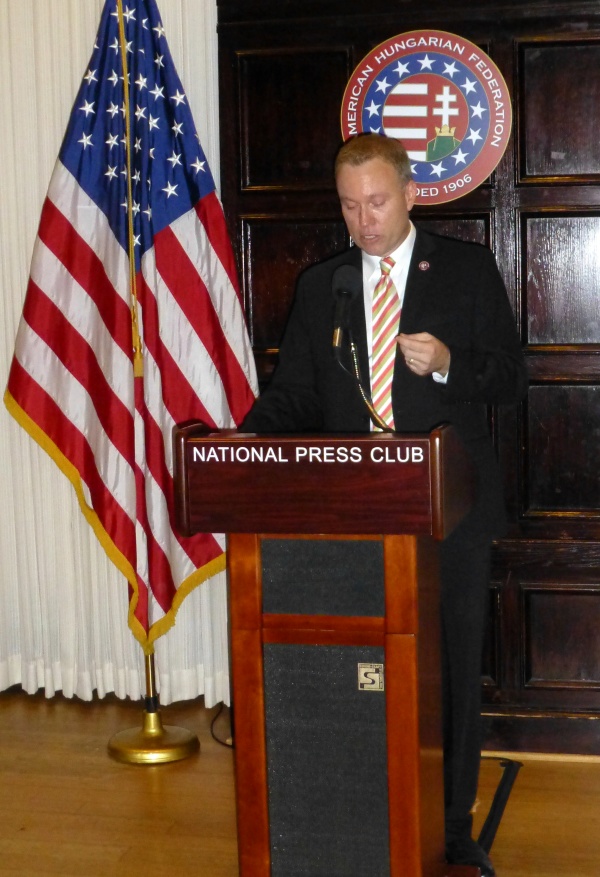
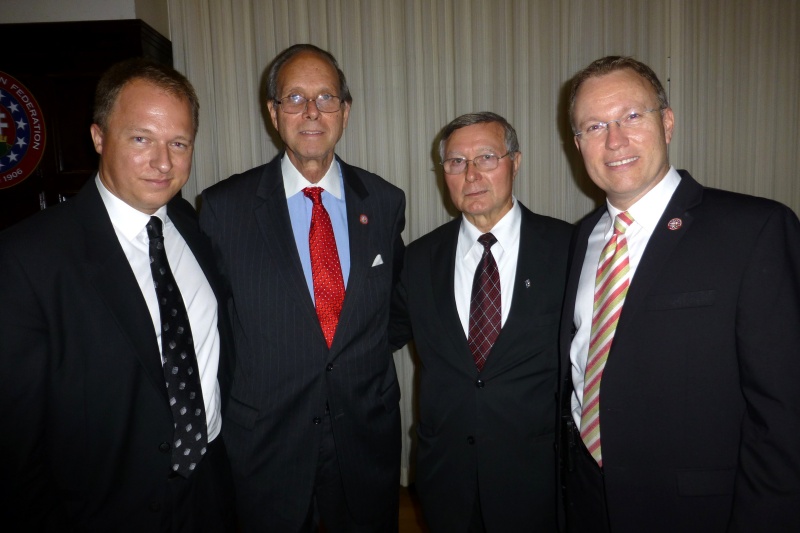
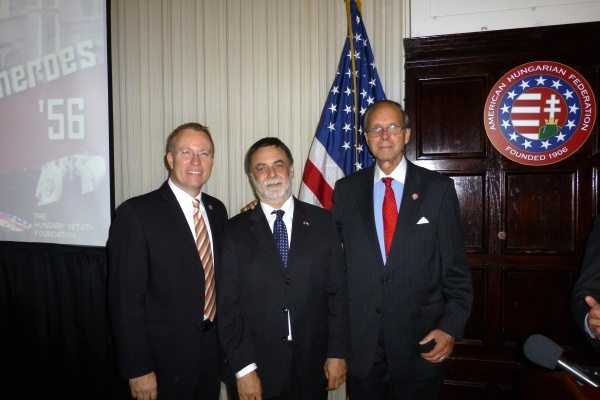
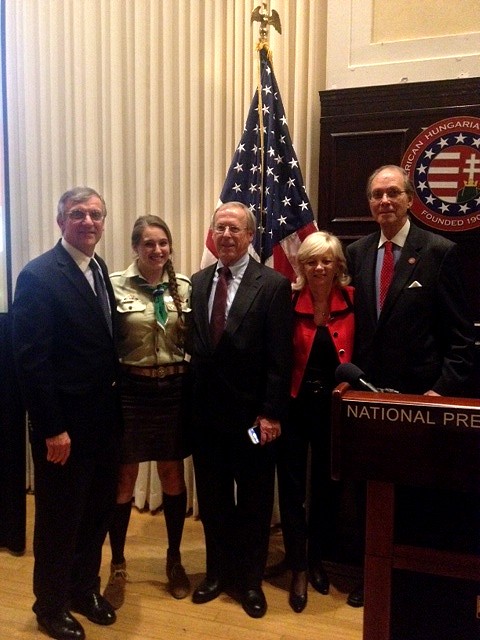
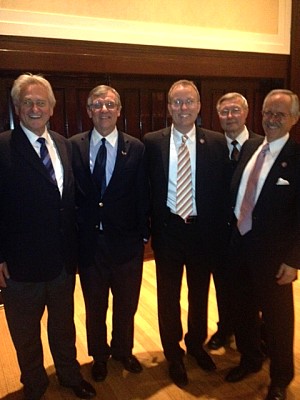
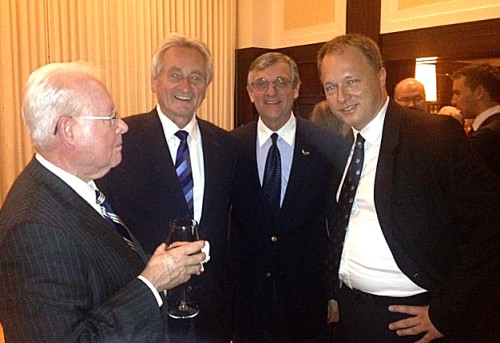
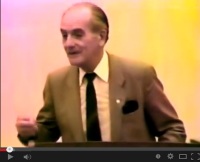
10/23/2013 – 1956-2013: AHF hosts reception in Honor of the 1956 Hungarian Revolution. The event was held at the National Press Club on October 18, 2013. The Press Club’s Holeman Lounge was filled to capacity. The guest speaker was Ferenc Kumin, Deputy State Secretary for International Communications, Hungarian Prime Minister’s Office. Bryan Dawson, AHF Executive Chairman, served as Master of Ceremonies and would deliver the keynote address, “I am a Child of 1956.” He recognized honored guests from the Hungarian Embassy, the Woodrow Wilson Center, the National Press Club, the US State Department, the Polish American Congress, the United States Information Agency (USIA), students from local universities and others.
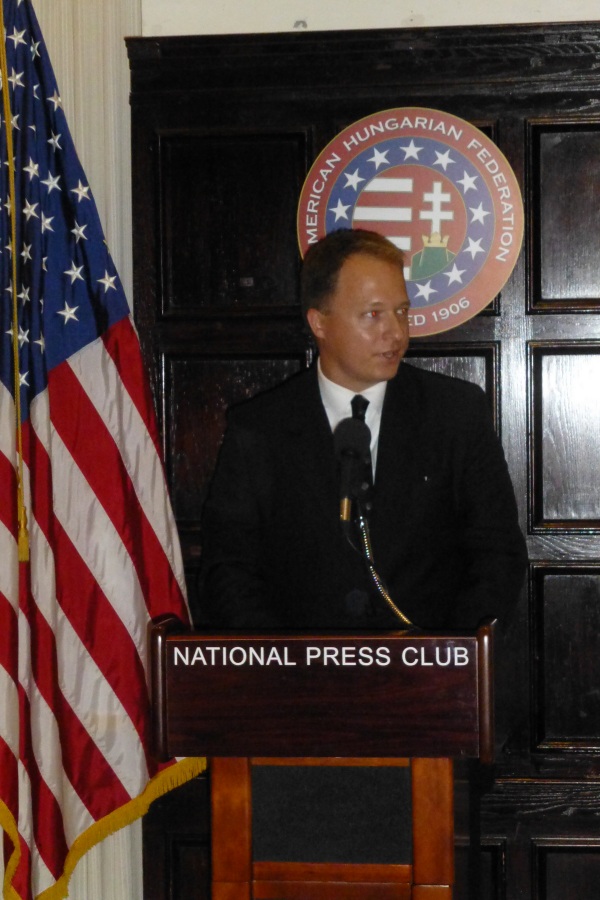
Mr. Dawson opened the event with a collection of video footage from 1956 as they were aired to Western audiences during these fateful events. He introduced AHF President Frank Koszorus who reflected on 1956 and Hungary’s national character which gave rise to many struggles for freedom and urged all to avoid “putting politics before history and by questioning the Hungarian nation’s commitment to democracy.” Mr. Koszorus noted AHF’s key role in assisting 1956 Refugees as they arrived in the United States:
“Their enormous sacrifice seemed futile [in 1956] but today it is universally recognized as having contributed to the ultimate demise of Soviet domination of Central and Eastern Europe and the restoration of constitutional democracy and independence in Hungary and the region.
The American Hungarian Federation is an organization founded in 1906 which strives to unify our community.
We honor the heroes of 1956 today as we did during those fateful days when AHF activated its Hungarian Relief Program, raised over $525,000 and, worked closely with the International Rescue Committee and others, to aid in the refugee resettlement effort.
Since then, AHF has been committed to keep the memory of 1956 alive. As we contemplate the promise of Hungary 1956, we are reminded that that promise must never be forgotten or abandoned, as the heroes of 1956 deserve nothing less. That is why it is distressing to witness some abusing democratic ideals by putting politics before history and by questioning the Hungarian nation’s commitment to democracy.
One just needs to remember: the Golden Bull issued 7 years after the Magna Carta in1222, which set forth the rights of all freemen; or the Diet of Torda in the 16th century which declared the equality of the Lutheran, Calvinist, Unitarian and Catholic denominations; or the Revolution of 1848 when Hungarians rose up against Hapsburg oppression with Lajos Kossuth, “champion of liberty,” at the helm of this struggle; or July 1944 when a Hungarian armored division blocked the deportation of more than 200,000 Jews in Nazi-occupied Hungary; or 1945 when despite Soviet occupation, Hungarians resoundingly rejected the Communist Party and elected the Smallholders Party.” [download Frank Koszorus’ remarks]
Secretary Ferenc Kumin reflected on how heartening it was to see the continuing importance given to the anniversary of the 1956 Hungarian Revolution, a subject that was taboo in Hungary under communism, and thanked the Federation, whose members include many 1956 Freedom Fighters, for holding the commemoration. He said a “new type of relations” has developed with Hungarian communities abroad, including the United States. “Hungary considers the diaspora Hungarians ‘a natural part’ of the nation.” He expressed thanks to the United States for accepting the refugees from Hungary and added that the mere fact he could address members of the diaspora as the representative of a free and democratic Hungary was an achievement worthy of the ideals and hopes of the freedom fighters of 1956.
Bryan Dawson, whose mother was wounded fighting the communists in 1956, delivered a brief, but very personal keynote address entitled, “I am a Child of 1956” which reflected on the Hungarian character, the ingenuity and heroism of the Hungarian Freedom Fighter, and the revolution’s effects on his own upbringing. He urged an end to petty partisan politics, resistance to false propaganda, called for a renewed focus on honest debate, and described the continuing oppression facing many communities worldwide including the ethnic-Hungarian communities living in the sucessor states in the Carpathian Basin, concluding “our work is not done.”
[Download] Bryan Dawson’s speech, “I am a Child of 1956.”
“I am a child of 1956 not because my mother was wounded, risked her life, braved bullets, bombs, soviet tanks, land mines, communist secret police, red army troops and hid from flares on cold November nights as she escaped across the iron curtain…
Not because I heard mother’s stories of how she and her fellow Freedom Fighters would paint the underside of porcelain dishes in black shoe polish, placing them upside-down in the path of Soviet tanks which would stop to inspect these “land mines” only to open themselves up to a little Stalinist-named surprise: the Molotov cocktail…
Not because I am so deeply proud of her and Hungary for standing up to communist tyranny against odds so great, few have dared to attempt…
Not because of Hungary’s 1000-year history of democratic tradition and struggle to maintain her unique identity and her independence…
I am a child of 56 because in Anyuka’s tears… in her struggles & perseverance…in her scars, in her eyes that exuded the sort of wisdom none should possess – I learned freedom is not free.
I am a child of 56 because I learned that with freedom comes great responsibility. That to whom much is given, much is expected.
I am a child of 56 because I learned that we must never forget – never forget what my mother and thousands like her fought and many died for: freedom, liberty, pluralism, democracy.
While oppressed people around the world struggle for freedom, we are not free…
In these days of increasing polarization and renewed false propaganda machines here at home and in Hungary designed to divide us, we owe it to those who died for our freedom to insist that we treat our precious freedom and each other with the utmost respect andstand together in humility with a zealous pursuit of the truth in thesame spirit of brotherhood soexemplified in1956 Hungary.
I am a child of 1956 because I am ready to fight; eager to speak up when democracy and human rights are threatened…
I am a child of 1956 because our work is not done – join me.”
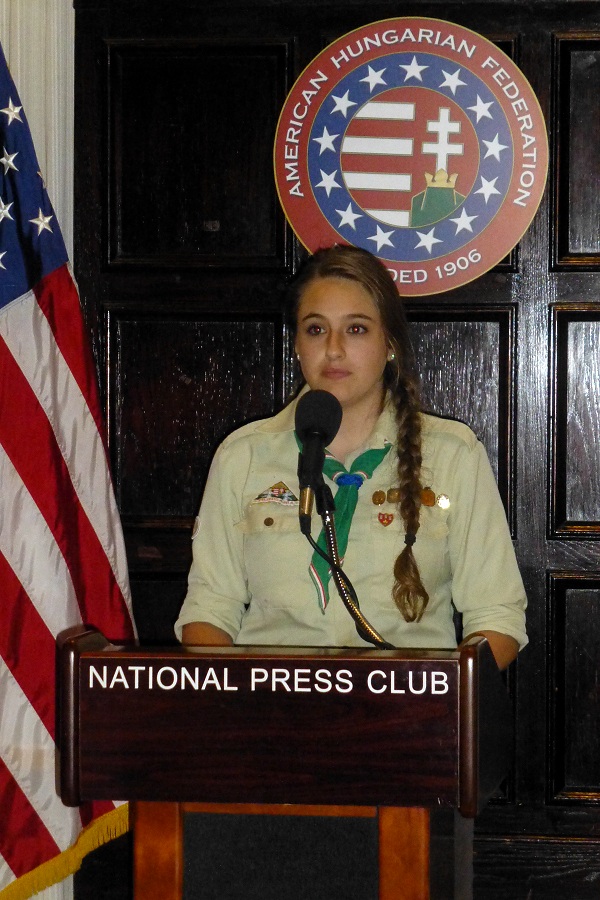
Sari Barczay, leader of the Hungarian Scouts of Washington, D.C., delivered a stirring rendition of Tollas Tibor’s stirring poem, “Bebádogoznak Minden Ablakot” (They’ve Walled up Every Window):
Of life without, only this gleam was left,
A tiny patch of stars, a glimpse of sun.
In daily gloom, within dim walls bereft,
We watched the vent for this as day was done.
This too they stole, this streak of sunlight thin,
The’ve walled up every window tight with tin.
In memory’s eye, I mark the azure sea
At Naples, and beside the shining shore
Vesuvius waits and smokes. Can you, like me,
See happy, sun-browned swimmers by the score?
We live in night like men who blind have been:
They’ve walled up every window tight with tin.
Our ten mouths gasping for the missing air,
Ten of us lie, in one close kennel pent,
As fish-gills on the bank might gasp despair.
To eat the food, which stinks of excrement,
Our stomachs lack the power to begin:
They’ve walled up every window tight with tin.
From the bright fragrance of the Alpine peaks
The west wind blows freshness of bouquets;
Of virtue to the soul that distance speaks,
And smiling summits swell the hymn of praise.
But phthisis grips my cell-mate, dark as sin,
They’ve walled up every window tight with tin.
For us no more the steamer’s whistle blows;
All maiden laughter from our sense is wiped;
No pleasure in our ears sonorous flows;
No summer plays an organ, myriad-piped.
Our cells are deaf, all sound is dead herein:
They’ve walled up every window tight with tin.
By Barcelona, in a garden fair,
The warm voice of a tawny woman croons;
The streets are pied with dances here and there;
A gay guitar gives dusk its tinkling tunes.
Our leaden days flow silent in chagrin:
They’ve walled up every window tight with tin.
We probe in darkness towards the velvet skies
As if within a coffin we were nailed,
We only touch our rags and agonize
Or, feel our hands by vermin-hosts assailed.
We once caressed the sunlight, like soft skin.
They’ve walled up every window tight with tin.
There is a ball in London; like a rose
A girl glides, in her silks, on floors that gleam;
In all the bloom of lustrous hair she glows,
Soft-mirrored in the vanished wainscot, like a dream.
The West is dancing. Has it Magyar kin?|
They’ve walled up every window tight with tin.
Our tongues recall the pleasant taste of Spring
Then swallow with a groan our morsel dank
Whose fecal horror chokes its entering
And turns our bellies sick, our reason blank;
Yet even this our famine forces in.
They’ve walled up every window tight with tin.
Sleep locks our hungered bodies in its spell
And there I sate a gourmet’s appetites
On all that Paris offers — see as well,
Climbing above the city’s neon lights,
The Silent Ghost – but here no dawns begin:
They’ve walled up every window tight with tin.
The radios shout hoarsely of new deals,
Of freedom and of justice due to man,
But here my dungeoned body only feels
The million lashes of foul Moscow’s plan.
From Vác to far Peking, his slaves make din:
“Beware! Beware! Or through the entire world
They’ll wall up every window tight with tin.”
(Translated by Watson Kirkconnell)
Az életből csak ennyi fény maradt,
Csillagos ég, tenyérnyi napsugár.
Ezt vártuk nap-nap, homályos falak
Üregéből esténként-délután.
S elvették ezt is, a tenyérnyi napot:
Bebádogoztak minden ablakot.
Tágult szemekkel kék tengerét látom
Nápolynak, s fénylő partjai felett
Még vár a Vezúv, pipál és a tájon
Barnára lesült boldog emberek.
Látjátok? Éjben élünk, mint vakok,
Bebádogoztak minden ablakot.
Tízen fekszünk egy fullasztó szűk lyukba’,
A szánk kapkodja be a levegőt,
Mint partra vetett halak kopoltyúja
Tátogunk némán – s érzed, nincs erőd
Szívni az étel s ürülék szagot:
Bebádogoztak minden ablakot.
Az Alpeseknek fenyves illatából
Míg csokrot küld a hűs nyugati szél
És lelket öblít fenn a tiszta távol
S mosolygó hegyek hószaga kísér,
Itt tegnap társam tüdőbajt kapott,
Bebádogoztak minden ablakot.
Csendet hasít a sétahajó kürtje.
A falon sikló leánykacagás
Nem visszhangzik már zengőn a fülünkbe
S az ezersípú nyár nem orgonáz.
Süket a cellánk, minden hang halott,
Bebádogoztak minden ablakot.
Túl Barcelona kertjein szitálva
Egy barna asszony meleg hangja búg
És alkonyatba pendül a gitárja.
Hol táncolóktól tarka még az út;
S fülünkbe folynak az ólmos napok…
Bebádogoznak minden ablakot.
Tapintanánk a bársonyos egekbe,
Ujjunk hegyéből kiserken a vér.
Mint koporsóba, be vagyunk szegezve,
Csak daróc szúr, vagy poloska ha ér.
Simogatnánk a sugaras napot –
S bebádogoztak minden ablakot.
Londonban bál van, sima termén siklik
A sok selyembe öltözött leány.
Puha hajuknak hamvassága izzik
Lágy bútoroknak tükrös hajnalán.
Nyugat táncol – tán végképp eladott?! …
S bebádogoztak minden ablakot.
Nyelvünket mosta friss tavasz zamatja
Most nyögve nyeljük nyirkos kortyait
Az alvadt bűznek, hol minden falatra
Émelygő gyomrod felfordulna itt.
De lenyeljük e végső falatot:
Bebádogoztak minden ablakot.
Az éhség marta testünket telt álom
Lakatja jól – és ínyenc ételek
Ízét kínálja Párizs – szinte látom,
Hogy kúszik el a neonfény felett
A Néma Rém – s nem lesz több hajnalod …
Bebádogoznak minden ablakot!
A rádiók csak üvöltsék rekedten
A szabadságot s az ember jogát.
Itt érzi csak befalazott testem
A milliókkal Moszkva ostorát.
S Váctól Pekingig zúgják a rabok:
– Ha nem vigyáztok, az egész világon
Bebádogoznak minden ablakot!
Join AHF online! AHF is an all-volunteer, non-partisan, 501(C)(3) non-profit educational and charitable organization serving the community since 1906. We need your support!