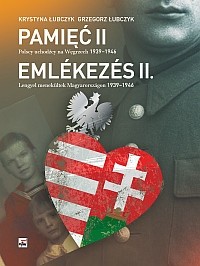
AHF Book Review: Rememberance (Pamięć): Polish Refugees in Hungary 1939-1946 (Emlékezés – Lengyel Menekültek Magyarorszagon 1939-1946) by Grzegorz and Krystyna Lubczyk.
Related
Poland, who shared a border with Hungary for centuries, and the United States never ratified the treaty. At the time President Wilson said: “The proposal to dismember Hungary is absurd” and later Sir Winston Churchill said: “Ancient poets and theologians could not imagine such suffering, which Trianon brought to the innocent.” Others warned that a fragmented, weakened Central Europe and dismembered Hungary would open the door to Soviet expansionism. We are sad to report that they were all right.
This two-volume book tells the story of Polish WWII Refugees in Hungary. Nearly 120,000 Polish refugees stayed in Hungary during WWII, staying in nearly 200 locations throughout the country between 1939 and 1946.
The first volume gave an overview of the entire story of Polish WWII refugees in Hungary, while the second volume focused on personal stories. Grzegorz Lubczyk is a former Ambassador of Poland to Hungary.
Remembering Hungarian Succor for Poles During World War Two By Csaba Zoltani
Throughout its history, Hungary offered refuge to a wide variety of ethnicities trying to escape persecution in their homelands. At the beginning and throughout the Second World War, Poles, including considerable number of its military, sought and received refuge from Nazi and Stalinist persecution. Eventually most of the soldiers went on and joined the Allied war effort and played an important part in the defeat of Nazi Germany.
A new two volume work by the former Polish ambassador to Hungary, Grzegorz Łubczyk and his wife Krystyna under the patronage of the Polish president, document the story of the Polish refugees in Hungary in Emlékezés (Pamięć or Rememberance) Polish Refugees in Hungary 1939-1946. The first volume gives an overview of what transpired and the second volume gives personal stories of many of the nearly 120,000 Polish refugees who were granted redoubt at nearly 200 locations scattered throughout Hungary.
The primary locations were near Miskolc, at sites in north-west Hungary and Lake Balaton. One of the largest was the Nagykata camp. The Hungarian government set up the XXI Directorate of the Ministry of Defense to help the Polish military refugees. Its director was Colonel Zoltán Baló who distinguished himself through his work and posthumously received the Polish Officer’s Cross of the Order Zasługi. A street is also named after him in Warsaw. In time, despite strong German and Soviet opposition, a large number of the military personnel , were clandestinely smuggled out of the country, initially through Yugoslavia, that made it possible for them to rejoin the war effort against Nazi Germany.
Others stayed and Hungary tried to make life for the Polish refugees bearable. At Balatonboglár a Polish high school and lycée was set up enabling the young men and women to complete their education interrupted by the war.
An interesting sidebar to the story is that József Antall Sr., father of the Hungarian prime minister after the fall of communism, was entrusted with the refugee matters and supported the work of Henryk Slawik of the Citizen’s Committee for Help for Polish Refugees in Hungary. This group produced identification papers for Polish Jews using Slavic-sounding surnames that gave some protection to the bearer, especially when attempting to leave the country.
Buy the book on the Hungarian Website: Booker.hu