|
Tweet |
 |
 |
|||||||
 |
 |
 |
 |
 |
 |
 |
||
| In Memoriam: Gergely "Bajusz" Pongratz | ||||||||
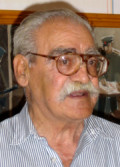 5/18/2005 - Gergely
"Bajusz" Pongratz... One of the youthful
rebel heroes of the 1956 Hungarian Revolution was Gergely Pongratz (Bajusz or "Moustache" was his nickname). He and his
four his brothers were heavily involved in the organization of the revolt
and fighting and their names were known to the Soviets. Under his command, the Corvin Passage fighters destroyed at least a dozen Soviet tanks, and resisted several waves of assault. Following the conflict, the Pongrátz brothers escaped capture and by 1957 had moved to the United States along with their
two sisters. Gergely returned to Hungary in 1990. With
his own money, he established the '56 Museum near Szeged. Themuseum
is filled with memorabilia of the revolt--- a Russian tank, flags, maps,
newspaper articles, photos of the Freedom Fighters (both survivors and
those killed in battle or later hanged), maps, and a large assortment
of the weapons used in the 1956 revolution.
He was Chairman of the Hungarian Freedom Fighters' Association. 5/18/2005 - Gergely
"Bajusz" Pongratz... One of the youthful
rebel heroes of the 1956 Hungarian Revolution was Gergely Pongratz (Bajusz or "Moustache" was his nickname). He and his
four his brothers were heavily involved in the organization of the revolt
and fighting and their names were known to the Soviets. Under his command, the Corvin Passage fighters destroyed at least a dozen Soviet tanks, and resisted several waves of assault. Following the conflict, the Pongrátz brothers escaped capture and by 1957 had moved to the United States along with their
two sisters. Gergely returned to Hungary in 1990. With
his own money, he established the '56 Museum near Szeged. Themuseum
is filled with memorabilia of the revolt--- a Russian tank, flags, maps,
newspaper articles, photos of the Freedom Fighters (both survivors and
those killed in battle or later hanged), maps, and a large assortment
of the weapons used in the 1956 revolution.
He was Chairman of the Hungarian Freedom Fighters' Association.
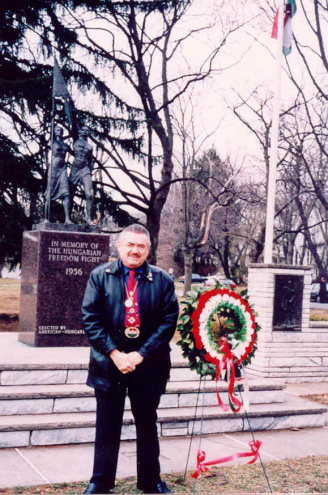
Gergely has also built a chapel to the memory of the heroes of the Revolution of 1956 and, hoping to keep the memories of the revolution alive, had just opened a free summer camp where young people can learn about this part of their national heritage. Mass is celebrated in the chapel once a month and on national and religious holidays. On the chapel's walls are plaques the names of dead Hungarian heroes. Bajusz Bacsi will be sorely missed. In his book titled "Corvin Köz 1956," Gergely Pongrátz, quotes from the Congressional Record (Volume 106, Part 14, Eighty-sixth Congress, Second Session. 31 August, 1960. 18783-18790.) by Congressman Michael A. Feighan, regarding a telegram sent by the US State Department to Yugoslav dictator Tito on the 2nd of November, 1956, which states: "The Government of the United States does not look with favor upon governments unfriendly to the Soviet Union on the border of the Soviet Union." -------------------------------- BUDAPEST, Hungary (AP) - Gergely Pongratz, a leader [and hero] of Hungary's anti-communist revolution of 1956, has died at age 73. Pongratz suffered a heart attack on Wednesday in the southern Hungarian town of Kiskunmajsa where he lived, said Dezso Abraham, secretary general of the World Council of Hungarian 56ers revolutionary veterans group. During the revolution, Pongratz was commander of one of the key resistance groups fighting the Soviet army. Based around the Corvin Passage in downtown Budapest, some 2,000 revolutionaries, including four of Pongratz's brothers, were able to hold off the advancing Soviet troops for several days, destroying some 25 enemy tanks. "The Corvin Passage battles were an inspiration for the revolution and their fighting spirit was taken up by the whole country," Abraham said. After Soviet shelling crushed the Corvin Passage resistance on Nov. 10, Pongratz continued to take part in revolutionary activities until leaving Hungary a few weeks later. After the revolution, which lasted less than a month, Pongratz lived mostly in Spain before settling in the United States in the 1970s. He returned to Hungary in 1991, after the fall of the communist regime. Nicknamed "Bajusz," or moustache, during the uprising due to his stylish whiskers, Pongratz, set up a museum in 1999 dedicated to the revolution. Located on the outskirts of the town of Kiskunmajsa, some 160 kilometres south of Budapest, the exhibit includes a T-55 Soviet tank similar to those used in 1956. Born Feb. 18, 1932 in Gherla, a city in heavily Hungarian-populated western Romania, Pongratz moved to Hungary with his family after the Second World War. He was working as an agricultural engineer in the countryside when the revolution broke out on Oct. 23, 1956, and quickly went to Budapest to join the struggle. Pongratz, who was divorced, is survived by a son and daughter living in the United States, Abraham said. See [ALL AHF MEMORIALS] or go [back to all AHF news] |
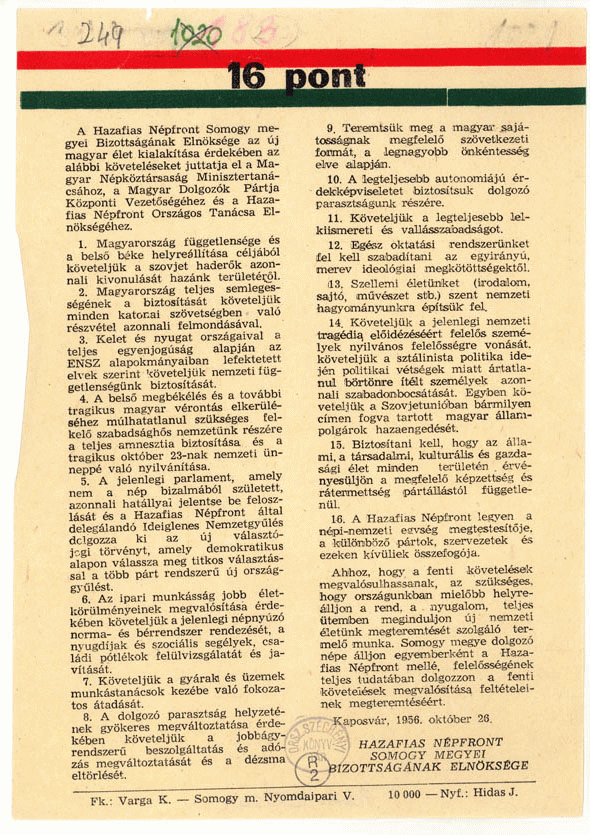
The 1956 Hungarian Revolution was the first tear in the Iron Curtain. Hungarians from all walks of life rose up against insurmountable odds to fight the brutal Soviet installed Hungarian communist government. Thousands died fighting, others tortured and executed, while 200,000 were forced to flee. 2006 marked the 50th Anniversary of the Hungarian Revolution.
Downloads:
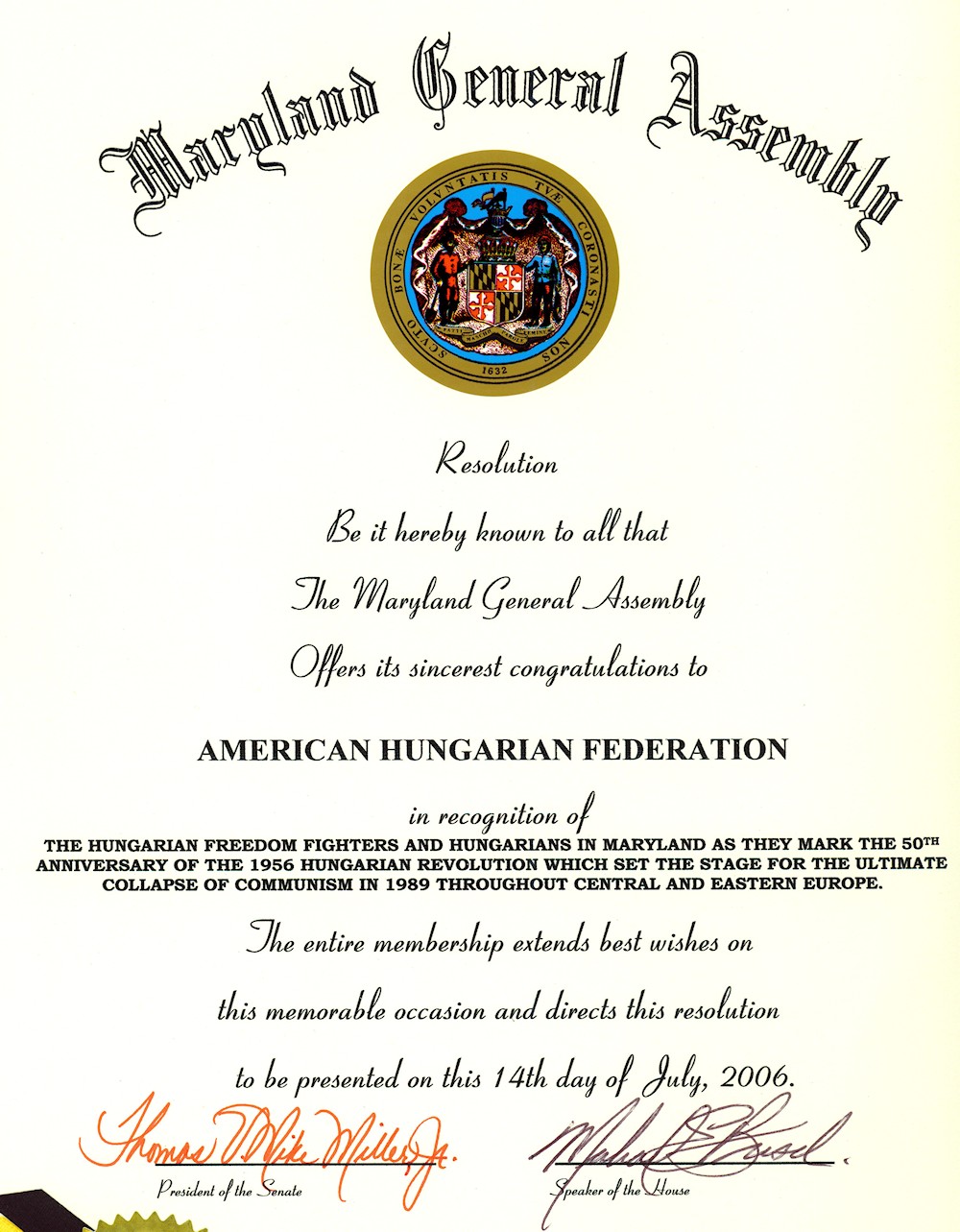
States that have passed the 1956 Revolution 50th Anniversary Resolution: | Texas | Ohio | Colorado | Maryland | Virginia |
The Houston Chronicle also published an Op-Ed calling attention to the resolution by Hungarian Honorary Consul Phillip Aronoff in Houston and Bryan Dawson-Szilagyi, AHF Chairman of the Executive Committee.
Links
Downloads:
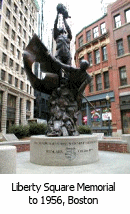
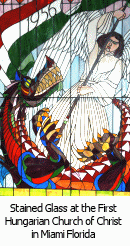
Memorials Dedicated to 1956 "October 23, 1956, is a day that will live forever
in the annals of free men and nations. It was a day of courage, conscience
and triumph. No other day since history began has shown more clearly the
eternal unquenchability of man's desire to be free, whatever the odds
against success, whatever the sacrifice required."-
President John F. Kennedy,
"The Blood of the Hungarians" I am not one of those who wish to see the people of Hungary take up arms again in a rising certain to be crushed, under the eyes of the nations of the world, who would spare them neither applause nor pious tears, but who would go back at one to their slippers by the fireside like a football crowd on a Sunday evening after a cup final. There are already too many dead on the field, and we cannot be generous with any but our own blood. The blood of Hungary has re-emerged too precious to Europe and to freedom for us not to be jealous of it to the last drop. But I am not one of those who think that there can be a compromise, even one made with resignation, even provisional, with a regime of terror which has as much right to call itself socialist as the executioners of the Inquisition had to call themselves Christians. And on this anniversary of liberty, I hope with all my heart that the silent resistance of the people of Hungary will endure, will grow stronger, and, reinforced by all the voices which we can raise on their behalf, will induce unanimous international opinion to boycott their oppressors. And if world opinion is too feeble or egoistical to do justice to a martyred people, and if our voices also are too weak, I hope that Hungary’s resistance will endure until the counter-revolutionary State collapses everywhere in the East under the weight of its lies and contradictions. Hungary conquered and in chains has done more for freedom and justice than any people for twenty years. But for this lesson to get through and convince those in the West who shut their eyes and ears, it was necessary, and it can be no comfort to us, for the people of Hungary to shed so much blood which is already drying in our memories. In Europe’s isolation today, we have only one way of being true to Hungary, and that is never to betray, among ourselves and everywhere, what the Hungarian heroes died for, never to condone, among ourselves and everywhere, even indirectly, those who killed them. It would indeed be difficult for us to be worthy of such sacrifices. But we can try to be so, in uniting Europe at last, in forgetting our quarrels, in correcting our own errors, in increasing our creativeness, and our solidarity. We have faith that there is on the march in the world, parallel with the forces of oppression and death which are darkening our history, a force of conviction and life, an immense movement of emancipation which is culture and which is born of freedom to create and of freedom to work. Those Hungarian workers and intellectuals, beside whom we stand today with such impotent sorrow, understood this and have made us the better understand it. That is why, if their distress is ours, their hope is ours also. In spite of their misery, their chains, their exile, they have left us a glorious heritage which we must deserve: freedom, which they did not win, but which in one single day they gave back to us. (October 23, 1957) AHF dedicates this work - Read this in German, Hungarian, French, and Spanish on this AHF member site, the [American Hungarian Museum] Join online!
|

 New
Video posted to the AHF 1956 Portal! "News Magazine of the Screen"
presented "Flight from Hungary" in early 1957 featuring video
taken after the brutal Soviet re-occupation. "This is battered Budapest
under the brutal Russian boot, Soviet tanks roam the streets under the
ruins they laid as communist secret police hunt down heroic Freedom Fighters.
25,000 Hungarians are dead." A fascinating video, it also includes
news about the Suez Crisis and more glimpes into life during this time.
[
New
Video posted to the AHF 1956 Portal! "News Magazine of the Screen"
presented "Flight from Hungary" in early 1957 featuring video
taken after the brutal Soviet re-occupation. "This is battered Budapest
under the brutal Russian boot, Soviet tanks roam the streets under the
ruins they laid as communist secret police hunt down heroic Freedom Fighters.
25,000 Hungarians are dead." A fascinating video, it also includes
news about the Suez Crisis and more glimpes into life during this time.
[


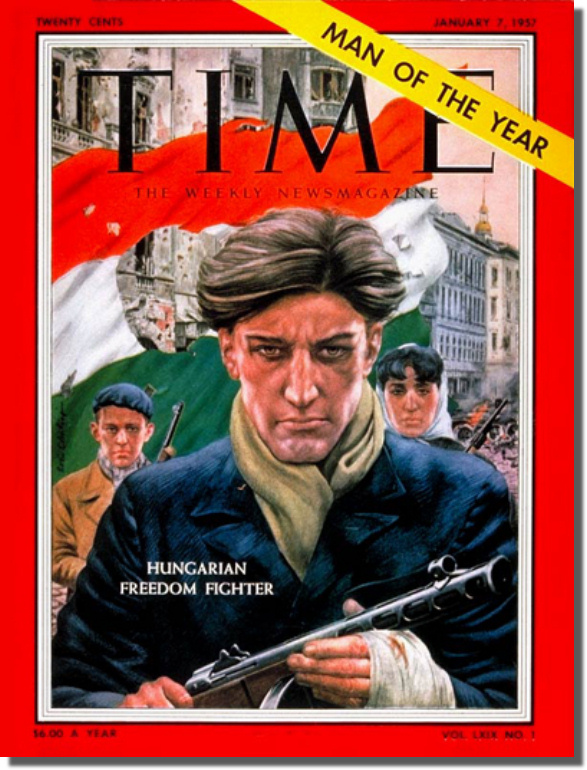


 Time
Magazine
Time
Magazine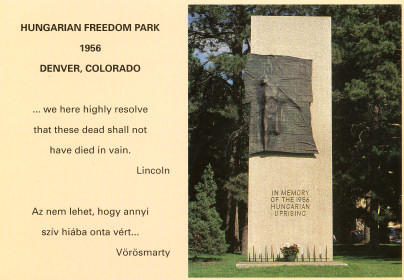

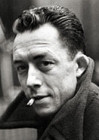 Albert
Camus' Stirring Letter to the World:
Albert
Camus' Stirring Letter to the World: