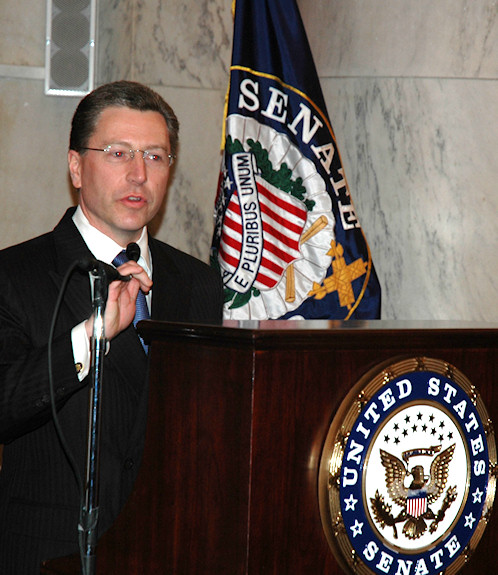
5/29/2012 - AHF participates in drafting CEEC Policy Brief on NATO expansion and calls on community to Support S. 2177, the NATO Enhancement Act, introduced by Sen. Richard Lugar to encourage
further enlargement of NATO and to deepen U.S. strategic partnerships with NATO allies [read more] 5/29/2012 - AHF participates in drafting CEEC Policy Brief on NATO expansion and calls on community to Support S. 2177, the NATO Enhancement Act, introduced by Sen. Richard Lugar to encourage
further enlargement of NATO and to deepen U.S. strategic partnerships with NATO allies [read more]
 4/2/2009 - American Hungarian Federation Actively Participates in CEEC Congressional Policy Reception in Honor of NATO and its Enlargement... AHF secured the US Senate's famous Russell Caucus Room on Capitol Hill for the March 25th policy reception sponsored by the Central and Eastern European Coalition (CEEC). AHF Co-President, Frank Koszorus, Jr., outlined the accomplishments of the CEEC. 2009 marked the 10th anniversary of Hungary's accession to the alliance. [read more] 4/2/2009 - American Hungarian Federation Actively Participates in CEEC Congressional Policy Reception in Honor of NATO and its Enlargement... AHF secured the US Senate's famous Russell Caucus Room on Capitol Hill for the March 25th policy reception sponsored by the Central and Eastern European Coalition (CEEC). AHF Co-President, Frank Koszorus, Jr., outlined the accomplishments of the CEEC. 2009 marked the 10th anniversary of Hungary's accession to the alliance. [read more]
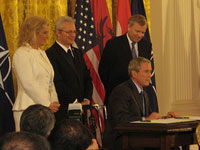 10/24/2008 – The American Hungarian Federation Participates in White House Briefing and Ceremony for NATO Accession Protocols for Croatia and Albania. During a briefing at the White House on Friday, October 24, President George W. Bush thanked leaders from the Central and East European Coalition (the “CEEC”) for their support of NATO enlargement. The briefing preceded a ceremony in which President Bush signed NATO Accession Protocols for Croatia and Albania. Frank Koszorus, Jr. and Zoltan Bagdy, co-presidents of the American Hungarian Federation (the “Federation”) – an active member of the CEEC – attended both events. [read more] 10/24/2008 – The American Hungarian Federation Participates in White House Briefing and Ceremony for NATO Accession Protocols for Croatia and Albania. During a briefing at the White House on Friday, October 24, President George W. Bush thanked leaders from the Central and East European Coalition (the “CEEC”) for their support of NATO enlargement. The briefing preceded a ceremony in which President Bush signed NATO Accession Protocols for Croatia and Albania. Frank Koszorus, Jr. and Zoltan Bagdy, co-presidents of the American Hungarian Federation (the “Federation”) – an active member of the CEEC – attended both events. [read more]
7/17/2007
- Hungary's Accession to NATO: An expanded
report. The American Hungarian Federation of Metropolitan Washington,
D.C. expands an earlier unpublished report on Hungary's accession to NATO
to provide researchers a unique perspective on the key events and successful
efforts relating to NATO’s enlargement and the debate to include
Hungary in the alliance.
Advocacy focused on three issues: (1) the rapid expansion of NATO to
include Hungary; (2) the importance of ensuring that minority rights not
be ignored during the accession period and beyond; and (3) the rejection
of a policy that would grant Russia a “veto” in NATO matters.
It was also asserted that NATO must neither deviate from its core function
of protecting members from outside aggression nor treat its new members,
including Hungary, differently when they join the alliance. Finally, because
the Committee’s chair believed that the enlargement of NATO was
in the interest of the United States and all Hungarians, it cautioned
against the expansion process being used to favor partisan political interests
in Hungary during the national elections in the spring/summer of 1998.
[download
the report]
 6/14/2007
- Enduring Strains of Communism
in Central and Eastern Europe: A distinguished panel of experts convened
by Hudson’s Center for European Studies offered their perspectives.
With the dedication this week of the memorial to victims of communism
in Washington, D.C., and recent friction between Russia and the United
States over the placement of missile-defense systems in former Soviet
satellites, the issue of communism’s enduring legacy in Central
and Eastern Europe is one that has become a renewed focused of the world’s
attention. With this as its context, Hudson Institute’s Center for
European Studies convened a panel discussion on Russia’s continuing
influence in the former Soviet satellites and republics as well as challenges
domestically derived from the lingering effects of the communist system.
Energy security, the rule of law, and the need to strengthen NATO will
all feature as part of our discussion.[read
more] 6/14/2007
- Enduring Strains of Communism
in Central and Eastern Europe: A distinguished panel of experts convened
by Hudson’s Center for European Studies offered their perspectives.
With the dedication this week of the memorial to victims of communism
in Washington, D.C., and recent friction between Russia and the United
States over the placement of missile-defense systems in former Soviet
satellites, the issue of communism’s enduring legacy in Central
and Eastern Europe is one that has become a renewed focused of the world’s
attention. With this as its context, Hudson Institute’s Center for
European Studies convened a panel discussion on Russia’s continuing
influence in the former Soviet satellites and republics as well as challenges
domestically derived from the lingering effects of the communist system.
Energy security, the rule of law, and the need to strengthen NATO will
all feature as part of our discussion.[read
more]
3/29/2004 - Supporting NATO Expansion and Minority Rights... Frank Koszorus,
Jr., AHF Co-President and representative to
the Central and East European Coalition (CEEC), joins US Secretary
of Defense Donald Rumsfeld and gives speech on NATO expansion on
Capitol Hill re-iterating concerns over protection of Hungarians and other
minorities in Rumania and the Carpathian Basin. Two events took place
in Washington, D.C. related to the latest round of NATO’s enlargement
– a White House ceremony and a gala reception.
The White House Event. President George W. Bush welcomed seven new nations to the
NATO alliance at a South Lawn ceremony. The prime ministers of the
new members and of three aspirant nations as well as senior government
officials, including Vice President Richard B. Cheney, Secretary of State
Colin L. Powell and Secretary of Defense Donald H. Rumsfeld, General
Richard B. Myers, Chairman of the Joint Chiefs of Staff, National Security
Advisor Condoleeza Rice, NATO Secretary General Jaap de Hoop Scheffer,
and congressional leaders attended the ceremony. The President’s remarks can be found on the White House’s website.
The Gala Reception. Later that evening, a gala reception organized by the embassies
“in cooperation” with the Central East European Coalition was held at
the Corcoran Gallery of Art. The
heads of state of the “Vilnius 10” countries, along with other delegation
members and a representative from each CEEC member joined Secretary Rumsfeld
on the marble staircase in the grand hall of the Corcoran Gallery. Regina Narusis of the Lithuanian American Community was the
master of ceremonies. Secretary
Rumsfeld delivered the keynote address and Mr. Koszorus spoke on behalf
of the CEEC. His remarks
focused on the role the CEEC played for over ten years in advocating enlargement
to include every country that both wanted to join NATO and satisfied the
alliance’s membership criteria. Mr. Koszorus concluded by noting that,
“we realize that our work is far from complete. . . .
[S]ince an indispensable component of security in Central and Eastern Europe
is a commitment to democracy, including the respect for the rule of law, human and minority rights, we must ensure
that those values are strengthened to give NATO not only military personnel
and military capabilities, but also the values that defined the Alliance
for decades and gave it the moral strength to prevail in the Cold War. [Download
the Speech]
[go to all AHF news]
10/27/2003 - AHF and CHACR Urging Congress
to Include Minority Rights as a basis for Rumanian accession to NATO...The
U.S. Senate passed a resolution on October 27, 2003 on the occasion of
Rumanian president Iliescu’s visit to Washington. The Senate expressed
its appreciation for the “strong and vibrant relations between the United
States and Romania.” The resolution also recognized “ the steps the Government
of Romania has taken and continues to take in economic, political, and
social reforms, including reforms to improve protections of the rights
of minorities.”
In the House of Representatives, however, members of the Hungarian American
congressional caucus echoed the concerns of the Hungarian American community
when submitting a letter to President Bush on the eve of his meeting with
President Iliescu.
Two Co-Chairs and other Members of the Hungarian American Caucus -- Tom
Lantos (D-CA), Ernest J. Istook (R-OK), Marcy Kaptur (D-OH) and Stephanie
Tubbs Jones (D-OH) -- urged President Bush to raise a number of concerns
with President Iliescu. These concerns focused on corruption, freedom
of the press, independent judiciary and the rule of law issues in Rumania.
In addition, the Representatives urged the quick, fair and complete restitution
of hurch properties, the safeguarding of the rights of Rumania's large
historic Hungarian community and education about the Holocaust. They concluded
by expressing their "conviction that we in the United States consider
treatment of religious and ethnic minorities an important measure of democracy."
The letter to President Bush underscores the significance of the Hungarian
Caucus. In light of the Senate resolution, the letter of the caucus Members
represents the only official statement from the U.S. government that expressed
concerns and issues close to the heart of the Hungarian American community.
In addition, AHF-DC further contributed to the debate about the need
for Rumania to implement democratic reforms and respect the rights of
the Hungarian community. In addition to minority rights per se,
AHF-DC's submission also raised questions concerning fundamental
rights and the rule of law since they relate directly to
how a society treats its religious and national minorities. See memorandum
in the download section on the right.
[<< Back to All AHF News]
| Related Links
- April 29, 2003 - US Senate Testimony: "NATO Enlargement: Promoting Western Values, Strengthening the Alliance." Calling attention to minority protections. before the United States Senate Committee on Foreign Relations.
- March 25, 2009 - US Senate Reception on the Occasion of the Policy Reception in Honor of NATO and Its Enlargement - : Remarks of Frank Koszorus, Jr.
- April 2009 - CEEC statement on NATO Enlargement and Supporting the Open Door Policy.
- July 2007 - Hungary's Accession to NATO: An expanded report by Frank Koszorus, Jr.
- October - November 1997: The Debate on NATO Enlargement:
Hearings Before the U.S. Senate Committee on Foreign Relations. Testimony of Frank Koszorus, Jr., President, AHFDC. An interesting exchange with Sen. John Kerry.
- June 20, 1996 - U.S. Policy Toward NATO Enlargement: Hearing before the Committee on International Relations,
United States House of Representatives 104th Congress, Second Session: Testimony of Frank Koszorus, Jr., President, AHFDC.
- June 2007 - Hudson Institute Panel: Enduring Strains of Communism
in Central and Eastern Europe
- March 29, 2004 - On the Occasion of NATO Expansion, Corcoran Gallery of Art. AHF Remarks by Frank Koszorus, Jr.: NATO
Enlargement and Minority Rights
- October 24, 2003 - AHF Memorandum on Romanian President Iliescu Visit
Join online!

|