



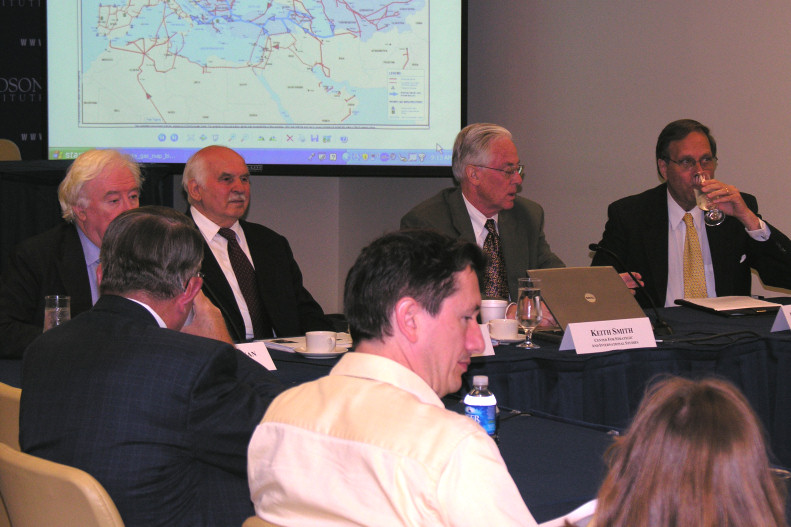
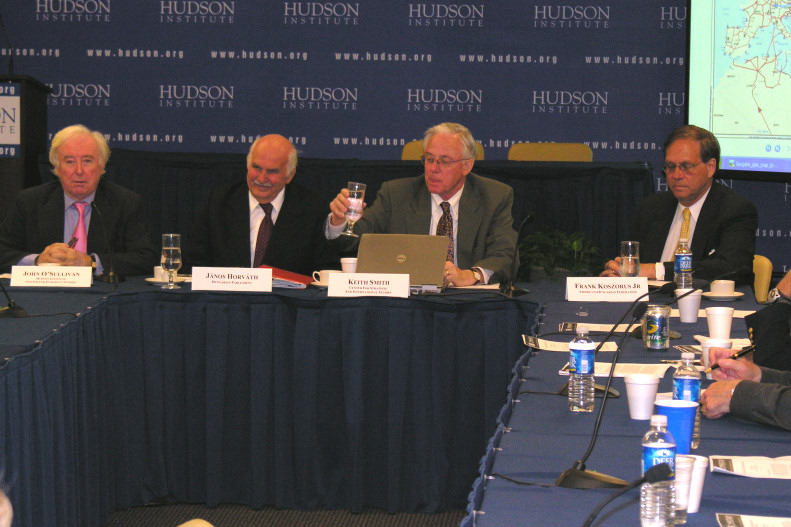
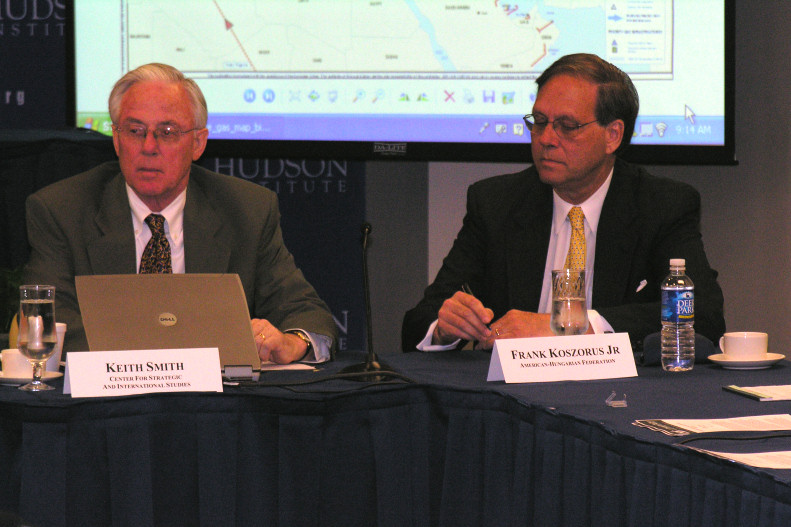
Hudson Institute Panel:
Enduring Strains
of Communism in Central and Eastern Europe
| |
|
||||||
| |
|
|
|
|
|
|
|
|
Hudson Institute Panel: |
|||||||
|
"I would like to share some thoughts with you from my perspective as an advocate and a student of Central and Eastern Europe and to touch on some issues for discussion this morning. As a backdrop to my comments, I would suggest that the countries of Central and Eastern Europe, excluding Russia or the former Soviet Union of course, have often been neglected by the United States. My underlying theme will be that the United States must remain engaged in the region to help strengthen democratic institutions and the stability that derives from democracy. Why? Simply stated, a strong and stable NATO will also be in a better position to substantially contribute to the war against terrorists and resist Russia’s alarming and naked attempts to expand its influence in the region. This instinctive popular support is at risk in Hungary and elsewhere throughout the region. Some, including Anne Applebaum in her June 5th column in The Washington Post, go so far as to say that “New Europe no longer exists.” Although damage (caused in part by the benign neglect referred to above) has been done, I’m not sure we’ve reached this point of no return. Nevertheless, growing skepticism cannot be denied. Let us briefly examine some of the developments, besides Iraq, that
have contributed to the erosion of popular support toward the United States.
Charles Fenyvesi, speaking from this platform last year went so far
as to note: “On this unhappy anniversary, the sobering fact is that
the October 23 revolution did not win, despite what the beneficiaries
of the November 4 Soviet invasion have been saying, and others repeat
because the quip sounds smart and it soothes many a guilty conscience.
It’s time to take a deep breath and acknowledge that the men of
November 4 won. At least for the moment.” This is not an academic question because even before the fall of the Berlin Wall, many of these voters have been steadfast supporters of a Washington-led NATO, in contrast to former enemies of NATO. There is a chance, however, that if the U.S. fails to dispel the perception of favoritism, these disappointed long-time friends of America may adopt more cynical attitudes and thus weaken the alliance and affirm Anne Applebaum’s conclusion. Such a development would damage U.S. interests, as it is beyond dispute that a successful war against international terrorists requires steadfast and genuine friends. I would also suggest that real security in the region, involves promoting group rights, the rule of law, and constitutional democracy, as opposed to illiberal democracy (characterized by the tyranny of the majority). As the tragic events in the nineties demonstrated, a primary cause of tensions and violence in the region is discrimination against and intolerance toward national, ethnic and religious minorities by the majority. A persistent problem in many parts of Central and Eastern Europe is the mistreatment of the Roma and conspicuous anti-Semitism. A government that fails or refuses to respect minority rights can hardly be deemed to be genuinely democratic, even if it has come to power through the ballot. Moreover, granting legitimate group rights to historical groups would defuse tensions and engender political stability in the Carpathian Basin. The issue of minority rights has nothing to do with borders as some erroneously contend or assert in order to ignore their international legal obligations. It has everything to do with meaningful and enduring stability in Central Europe, however. The Hungarian minorities who seek redress for their grievances strictly through democratic, i.e., non-violent, means themselves contribute substantially to sustainable stability in the region. The stability flowing from collective rights is not only of interest to Hungary, but it is also of interest to the U.S. and NATO. A fundamental change in Western thinking and policy is urgently needed
and long overdue. There must be visible support for measures that are
intended to assist Hungarians living as minorities maintain their unique
culture in their ancient homeland and to overcome the effects of the various
forms of discrimination, persecution, and in some instances violence they
have faced. For instance, the U.S. ought to encourage Romania and Slovakia
to return communal properties, e.g., churches, that were confiscated by
the Communists, to their respective Hungarian minorities and to grant
minorities their legitimate demands for autonomy. I would conclude by noting that another overriding and compelling reason for strengthening our ties with our genuine friends in Central and Eastern Europe is Russia. It is quite evident that Russia has not reconciled its loss of empire and is using other means, e.g., energy policies and intimidation as in Estonia, to expand its influence in the region and weaken NATO. Russia’s policies and willing partners in Central and Eastern Europe highlight the dangers of old impulses and broken but not totally eliminated old networks. Just this week we participated in the dedication of the Victims of Communism memorial and recalled the 100 million victims of the scourge of Communism. The suffering has been too much, the sacrifices too great to let the “men of November 4,” to use Charley Fenyvesi’s phrase, prevail. |
These are .PDF files.
Related Articles
Two events took place in Washington, D.C. related to the latest round of NATO’s enlargement – a White House ceremony and a gala reception. AHF 1st Vice President Frank Koszorus, Jr. attended both events along with other Hungarian American leaders. [more]
In the House of Representatives, however, members of the Hungarian American congressional caucus echoed the concerns of the Hungarian American community when submitting a letter to President Bush on the eve of his meeting with President Iliescu. [more]
Join online!
|



 3/29/2004
- Supporting NATO Expansion and Minority Rights... AHF 1st Vice President
Frank Koszorus and the Hungarian American Coalition's representative
3/29/2004
- Supporting NATO Expansion and Minority Rights... AHF 1st Vice President
Frank Koszorus and the Hungarian American Coalition's representative Sign
up for the AHF mailing list.
Sign
up for the AHF mailing list.