


| |
|
|||||||
| |
|
|
|
|
|
|
||
| The Hungarian Citizenship Law | ||||||||
The newly elected center-right Fidesz Civic Party, who recently won a 2/3 majority in parliament, had long promised such a measure. According to the bill, “all Hungarians and Hungarian communities are part of a unified Hungarian nation, which exists over state boundaries and is an essential element of the Hungarian identity.” In 2004, the Hungarian parliament, then controlled by the socialists under Prime Minister Ferenc Gyurcsany, put the matter to a public referendum. The measure failed to get enough votes to validate the results, despite getting more "yes" votes. Although AHF felt the referendum was unneccessary as citizenship for Hungarians is a moral and ethical issue that should never have been questioned, it issued a statement urging voters to vote "yes." The new citizenship law comes at a time of tension between Hungary and Slovakia over a number of issues such as the Slovak Langauage Law under which the use of the minority language in official communication would be punishable in towns and villages where the ethnic community makes up less than 20 percent of the total population. The amendment also stipulates that all documentation of minority schools should be duplicated in the state language. Some of the bravado could be attributed to the fact that general elections are set for june 2010, and the right-wing nationalist government of Prime Minister Robert Fico, whose parliament inexplicably reaffirmed the horrific Benes Decrees, is seeking re-election. It is important to note that it wasn't the Treaty of Trianon, nor the post-WWI victorious powers, nor the dictatorial regimes of newly formed Rumania, Slovakia, and Yugoslavia / Serbia, but rather the communist Hungarian government itself that cancelled citizenship for the millions of Hungarians living across newly drawn borders after Trianon. Whether or not neighboring countries accept dual citizenship, many see this is a long overdue symbolic measure. AHF Executive Chairman, Bryan Dawson, who has family in Hungary and Transylvania, remarked, "these [Hungarian] communities didn't move. Artificial borders were created around them, their lands taken, and, despite beatings, decrees and language laws, and lack of support from consecutive Hungarian governments, they survive and hold on to 1000 year-old traditions in Central Europe and Carpathian Basin. I hope their despair can be replaced with the hope that they too can be part of one magyar nation again."
[<< Back to News from Slovakia] |
Slovak Constitution: “no one must be deprived of the citizenship of the Slovak Republic against his will.” The Slovak Citizenship Act, specifically targets Hungarians and was amended to combat Hungary granting citizenship freely to Slovaks, was adopted last year shortly after Hungary announced its plans to grant citizenship to ethnic Hungarians abroad. The law in force in Slovakia clearly states that anyone accepting the citizenship of another country will be stripped of their Slovak citizenship.
Coverage of the Oliver Boldoghy Case
Statement of the Ministry of Foreign Affairs of the Slovak Republic to the case of Olivér Boldoghy. While complying with general principles and norms of international law concerning citizenship, every state has a sovereign right to set its own legal regulation of citizenship. The current situation and the Oliver Boldoghy-case result from non-standard Hungarian citizenship regulation granting the Hungarian citizenship on the basis of ethnicity without any real ties of the person to the state. [read more]
Slovak Language Law Related Articles Under the Slovak Language Law, the use of the minority language in official communication would be punishable in towns and villages where the ethnic community makes up less than 20 percent of the total population. The amendment requires that all documentation of minority schools should be duplicated in the state language. The law stipulates that the names of streets and buildings anywhere in Slovakia must be stated in the Slovak language [despite 1100-year-old tradition] and it also introduces sanctions of up to €5,000 ($7,000) on those who break rules promoting the use of Slovak in public and for municipalities and public offices for not using the Slovak language "properly."
LANGUAGE laws may protect minority rights or infringe them. Slovakia’s new law, which comes into force on September 1st, is under fire for its harshness. It imposes fines of up to €5,000 ($7,000) on those who break rules promoting the use of Slovak in public. [read more] << Go to AHF's Coverage of the Slovak Language Law Why did Hungarians lose Citizenship?
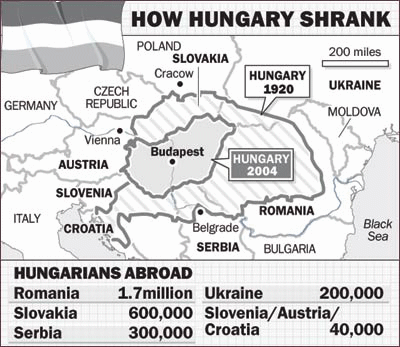
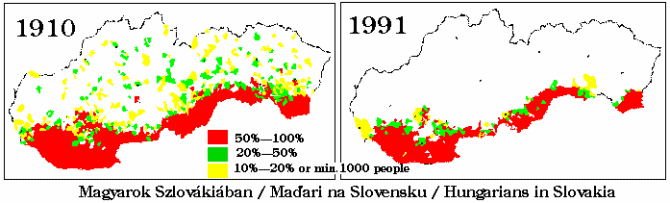
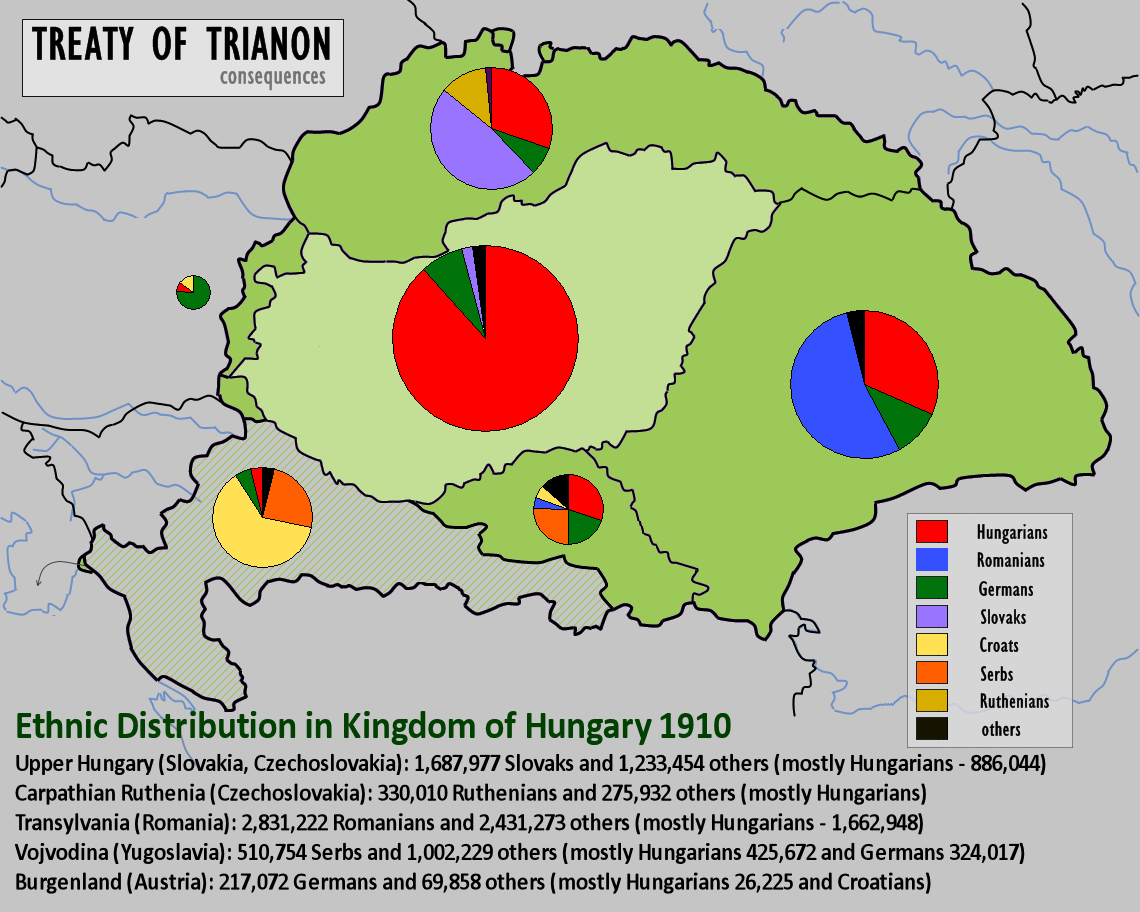
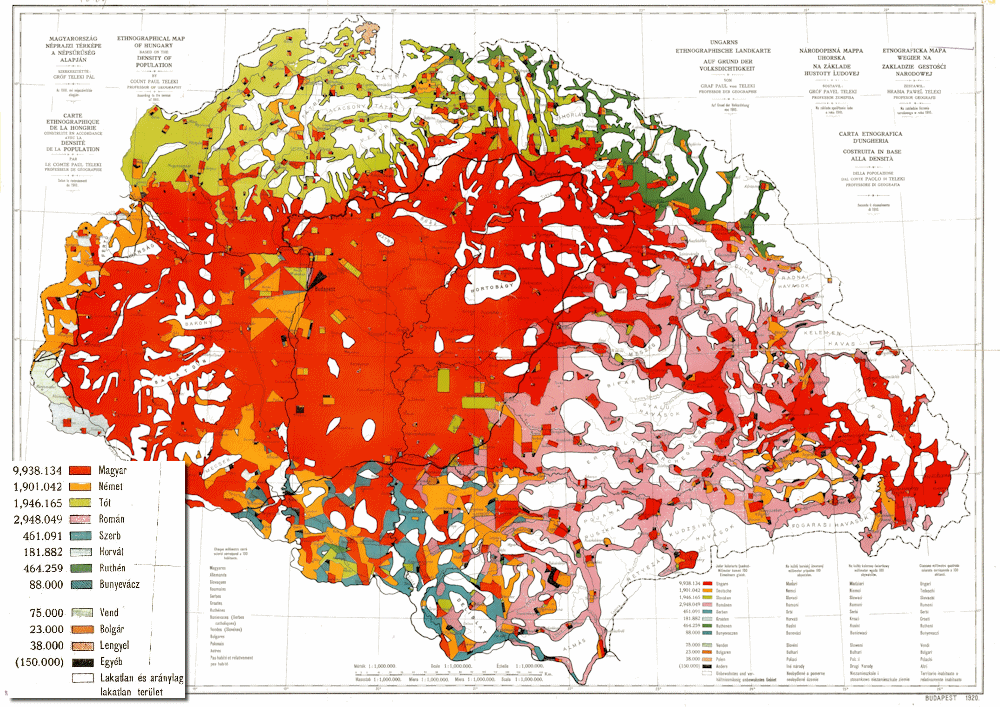
When did Hungarians lose Citizenship? In a show of "Socialist" brotherhood, the Hungarian communist government signed an agreement with Ceaucescu's Rumania in 1979 renounced Transylvania's 2.5 - 3 million-strong Hungarian community. Previous communist regimes did the same thing with Hungarians living and working in East Germany in 1969, Poland in 1961, and Czechoslovakia in 1960. Read the full article in Hungarian at Index.hu Why So Many Hungarians Across the Border? One thousand years of nation building successfully delineated groups based on culture, religion, geography, and other attributes to create the countries with which we are so familiar. While some Western European nations would continue power struggles and princely battles and civil wars, Hungary, founded in 896, was a peaceful multi-ethnic state for a 1000 years and her borders were virtually unchanged. Until 1920... The Treaty of Trianon in 1920... in the aftermath of WWI, was extremely harsh on Hungary and unjustifiably one-sided. The resulting "treaty" lost Hungary an unprecedented 2/3 of her territory, and 1/2 of her total population or 1/3 of her Hungarian-speaking population. Add to this the loss of up to 90% of vast natural resources, industry, railways, and other infrastructure. In the newly created Slovakia, the tragedy of 1920 that befell the historic Hungarian communities was only the beginning. The Benes Decrees sent millions of people, who had lived in the region for many centuries, off in sealed wagons, away from their homes, their families - not to mention the odd ones who died on the trip. Tens of thousands of these were Hungarian. More recently, the Slovak Language Law makes the use of the minority language in official communication punishable in towns and villages where the ethnic community makes up less than 20 percent of the total population. The amendment requires that all documentation of minority schools should be duplicated in the state language. The law stipulates that the names of streets and buildings anywhere in Slovakia must be stated in the Slovak language [despite 1100-year-old tradition] and it also introduces sanctions of 100 to 5000 euros for municipalities and public offices for not using the Slovak language "properly." The following graphic shows ethnic distribution in Slovakia and population decline from 1910 - 1991:
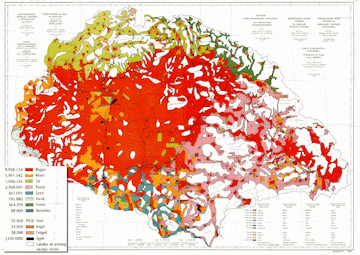
Ethnic Distribution in the Kingdom of Hungary in 1910 (Hungarians shown in red)
Hungarian populations declined significantly after forced removals such as the Benes Decrees and other pograms, the effects of WWI, and Trianon in 1920. With continued pressure and discriminative policies such as the 2009 Slovak Language Law, this trend continued over the past 90 years.
Related Links
Related Articles By Any Other Name: Hungary, Apartheid,
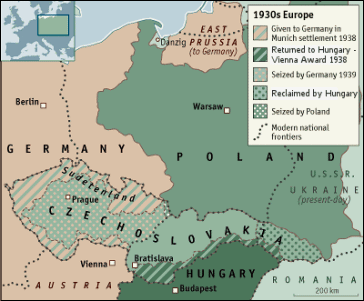
and the Benes Decrees These decrees sent millions of people, who had lived in the region for many centuries, off in sealed wagons, away from their homes, their families - not to mention the odd ones who died on the trip. WHAT THE BENES DECREES SAY One may be forgiven for suspecting, by the casual way the Benes Decrees are often disparaged by commentators, that many of those who write about the Decrees have never taken the trouble to [read them]. Living as I have for over 20 years in South Africa, I know this language well. It is the language of Apartheid. There is no moral difference, to my mind, in withdrawing civil rights, confiscating private property and deporting people, whether they be Black South Africans sent to some "Homeland/Bantustan," or Armenians, or deported Chechens, or Germans and Hungarians. The Hungarians who lived in what is now Slovakia and Trans-Carpathian Ukraine (which was given to Stalin by a grateful Benes in 1945) were more than one million strong in 1910. By 1930, thanks to the above-mentioned "administrative" cleansing, their numbers had been reduced to 585,434. After Hungary reclaimed its lands in 1939, people began moving back to their homes. In 1941-45, there were about 761,000 in what is today Slovakia alone. [read more] Allied Omertá: The "Benes Decrees" began in the mind of Czech statesman Edvard Benes sometime in 1940. He made some quite clear statements about his plans by 1941. The plans? To kill and/or expel all people of German or Hungarian ethnicity/language from a reunited Czechoslovakia, which had fallen apart at the start of the war. This is the sort of thing you would expect from a Himmler or a Beria, not a guy who is lionised in Western history books, and generally books about Central Europe, as the only true "democrat" in the region. But Czechoslovakia was never a complete democracy. Just as interwar Hungary, or Poland, or Yugoslavia, were not. Not quite. In Czechoslovakia, designed as a "national homeland" for Slavs, the Slavic Rusyns had to have two votes to equal one Czech vote! Democracy? [read more] THE PRESIDENTIAL DECREES
OF EDWARD BENES The first Czechoslovak Republic (1918-1938) was recreated in 1945 at the end of World War II and existed until the end of 1992. In both cases, Czechoslovakia utterly failed to form a governmental structure that secured freedom, prosperity, peace, and equal rights for all citizens of the state. In 1918, the newly founded Czechoslovak Republic was entirely carved out of the Austro-Hungarian dual monarchy by a unilateral decision of the victorious entente powers. The dictated peace treaties of Versailles, Saint-Germain-en-Laye and Trianon were not an outcome of a true peace conference at which the defeated would also have been given the opportunity to enunciate the limits of acceptable conditions for peace. Such a peace conference was never assembled. The Versailles peace treaty with Germany was condemned by non-interested parties. In fact, the US Secretary of State, Robert Lansing, had declared that "the Versailles treaty menaces the existence of civilization," and two popes had stigmatized the instrument. Benedict XV condemned it for "the lack of an elevated sense of justice, the absence of dignity, morality or Christian nobility," and Pius XI, in his 1922 encyclical "Ubi arcam Dei," deplored an artificial peace set down on paper "which instead of arousing noble sentiments increases and legitimizes the spirit of vengeance and rancour." The peace treaty of Trianon (1920) with Hungary resulted in the dismemberment of the thousand- year- old Hungarian Kingdom, as a result of an unbelievably inimical attitude of the allied representatives toward the Magyars. The consequence to Hungary was a loss of 71.5% of its territory and 63.6% of its population. The extreme tragedy of Hungary can be illustrated by comparing the smaller losses in 1871 of France to Germany, in which France gave up 2.6% of its territory and 4.1% of its population to Germany. The Trianon treaty forced three and a half million Magyars to live, without their consent, in Czechoslovakia, the Kingdom of the Serbs, Croats and Slovenians and Rumania, with the stroke of a pen. The right of self-determination of nations, solemnly promised in the 14 points of US President Woodrow Wilson, was apparently forgotten. [more] Corvinus.com - Czech and Slovak Affairs Page The Hungarian Problem Newly Elected Prime Minister Viktor Orban said it well: "The borders of the Hungarian nation and the Hungarian State do not coincide." This is true, as witness the fact that fully one-third of all Hungarians are minorities in neighbouring countries, most just on the far side of the border. This is, naturally, a problem for Hungarians. It is also a problem for all the states who got Hungarian lands. Many in neighbouring countries, and politicians in many more, have said in the past, and no doubt will say in the future: "Why don't they just go home?!!" But they are home!
The key weakness of these treaties was that neither ever asked - or cared - what the local population wanted. Did they want to join a new state (e.g., Czechoslovakia) did they want to stay with Hungary, or did they want independence or autonomy or what? The fact that these questions have never even been asked, let alone answered, in a supposedly democratic age, remains the central problem of the Hungarian minorities in the countries immediately surrounding Hungary. [more] [back to all AHF news] A
Case Study on Trianon
The Hungarian peace delegation signed the peace treaty consisting of 14 points at the so-called Great Trianon palace, near Paris, on June 4, 1920. Hungary's fate was determined for an unforeseeable future by the second part of the treaty which defined the new borders. According to this section Hungary's area (without Croatia) would be reduced from 282,000 km2 to 93,000 km2, whereas its population decreased from 18 million to 7.6 million. This meant that Hungary lost two thirds of its territory, whereas Germany lost but 10 percent and Bulgaria but 8 percent to the benefit of their victorious neighbors. As regards population, Hungary lost more than 60 percent of its inhabitants as opposed to the 10 percent lost by Germany. In the lands taken away from Hungary there lived approximately 10 million persons. Persons of Hungarian nationality constituted 3,424,000 in the areas taken away from Hungary. Of these 1,084,000 were attached to Czechoslovakia, 1,705,000 to Romania, 564,000 to Yugoslavia, and 65,000 to Austria. Thus 33.5 percent of all Hungarians came under foreign rule, i.e., every third Hungarian. For the sake of comparison. while the treaties of Versailles and Neuilly placed only one German or one Bulgarian out of every twenty under foreign rule, the Trianon treaty placed seven out of twenty Hungarians in the same position. Furthermore about one half of the Hungarian minority attached to the neighboring states was ethnically directly next to the main body of Hungarians on the other side of the borders. Had the peace treaties signed in the Paris suburbs really tried to bring about, however incidentally, nation-states, then it would have had to leave at least 11/4 to 2 million more Hungarians inside Hungary. In contrast the 42 million inhabitants of the successor states there were about 16 million minorities, as a consequence of which Czechoslovakia, Romania, and Yugoslavia became multinational states much like the Austro-Hungarian Monarchy had been. What is more, according to the census of 1910 the percentage of Hungarians in Hungary had reached 54.4 percent, whereas in the nations that came about as a result of the peace treaties, in Czechoslovakia and Yugoslavia, the leading Czech and Serbian elements constituted but a minority as compared to the other ethnic groups. The Treaty of Trianon was a great blow to Hungary in economic terms as well. Hungary was deprived of 62.2 percent of its railroad network, 73.8 percent of its public roads, 64.6 percent of its canals, 88 percent of its forests, 83 percent of its iron ore mines and of all its salt mines. At the Peace Conference the Entente powers, in order to satisfy the imperialist greed of their allies in central Europe, cut across roads, canals, railroad lines, split cities and villages in two, deprived mines of their entrances, etc. There was but one modification of the frontier: thanks to Italian intercession
and the stand taken by patriotic forces in Western Hungary, a plebiscite
was obtained in Sopron and its environs. At the plebiscite of December
4, 1921, 65 percent of the population opted for Hungary. Join online!
Help us help the community! Join securely online. [back to all AHF news]
|
 12/5/2011 -
  11/28/2011 -
  "Álláspontjának Tisztázására Szólította Fel az EBESZ Kisebbségügyi Főbiztosát az Amerikai Magyar Szövetség" - MTI 2011. szeptember 30., péntek 1:14