
|
Tweet |
 |
 |
|||||||
 |
 |
 |
 |
 |
 |
 |
||
|
Film, the Arts, & Media |
||||||||
Did you know... According to the Associated Press, (AP-NY-10-26-96 1604 EDT) people with some claim to Hungarian ancestry have been nominated for Oscars 136 times since 1929, when the first ones were handed out, and have taken home more than 30 of the golden statuettes. Since the AP article was released in 1996, there have been more Oscar nominations and winners such as Adrien Brody for "The Pianist" and multiple Oscar nominations for Frank Darabont ("The Green Mile," and "Shawshank Redemption." The Hungarian-born founder of the Paramount Pictures Empire and Loew's Theatres also produced the world's first full-length motion picture. There's an old joke from the '30s about a sign on a movie studio wall reading "It's not enough to be Hungarian. You have to have talent." The joke refers to how a relatively small country had such an impact on the history of the movies. Another sign above MGM's commissary wrote: "Just because you're Hungarian, doesn't mean you're a genius!" The Hungarian genius doesn't stop at Hollywood. Pulitzer Prize winners; Rock-and-Roll Hall of Fame inductees; Grammy and Tony Award winners; the 100 Greatest Women of Rock & Roll; the founders of Constructivism and the Bauhaus School; comedy and television pioneers; the greatest magicians; digital art and animation pioneers; and some of the greatest composers and conductors all include Hungarians. |
[<< Back to the Master Name Index] Sections:
|
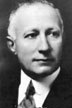 Adolph
Zukor - (b. 1873, Ricse, Hungary, d. 1976, Century City, CA) Adolph
Zukor - (b. 1873, Ricse, Hungary, d. 1976, Century City, CA) "Mr. Motion Pictures" and Oscar Winner |
||||||
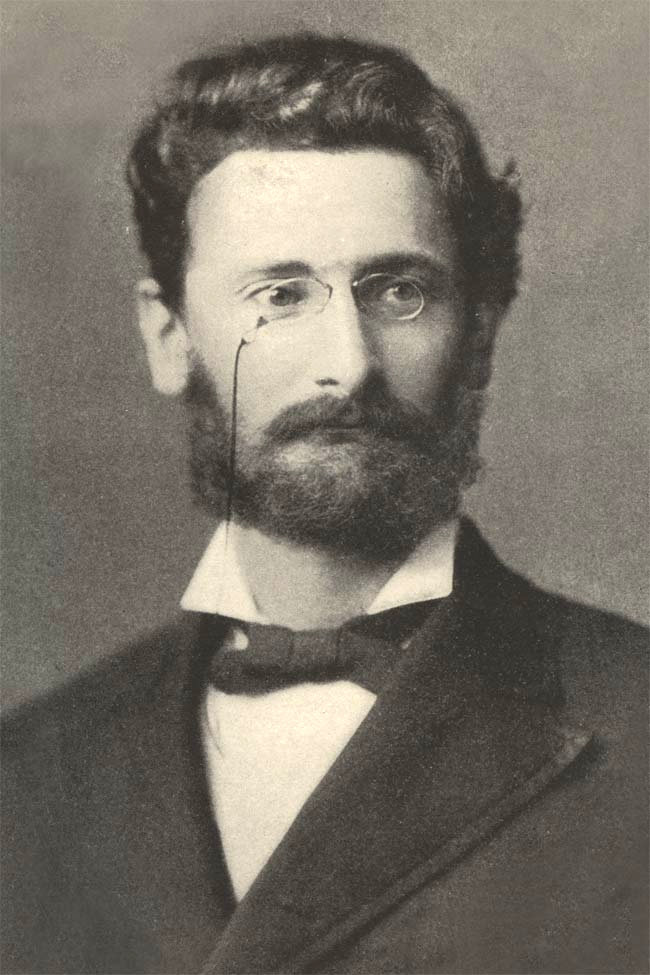 Joseph
Pulitzer - (b. 4/10/1847, Makó, Hungary, d. 10/29/1911, Charleston, SC) Joseph
Pulitzer - (b. 4/10/1847, Makó, Hungary, d. 10/29/1911, Charleston, SC)Publisher, Civil War Volunteer, Father of the "Pulitzer Prize": Responsible for building of the Statue of Liberty
This from www.pulitzer.org:
|
||||||
 Andrew
Vajna - Andrew
Vajna - Producer, Hollywood Legend: President of Cinergi Productions, co-Founder of Carolco Pictures Another Hungarian-born Hollywood "Mogul." Fled Soviet troops and left Hungary in 1956. During a career that spanned the globe, he has been one of the most important producers in Hollywood for the past 20 years. Carolco made motion picture history when it introduced a new cinematic hero, Rambo. Other Carolco projects include Music Box, Total Recall, Air America and Jacob's Ladder. Other films include Die Hard: With a Vengeance, Terminator, Color of Night, Judge Dredd, The Scarlett Letter, Oliver Stone's Nixon, Evita, An Alan Smithee Film: Burn Hollywood Burn, Shadow Conspiracy, Out of Order / A Miniszter félrelép and The 13th Warrior. Also founded Cinergi. His recent film, An American Rhapsody, won international critical acclaim. The film was close to Andrew Vajna as he is also Hungarian and left the country as a child. - Read more at Hollywood.com or this article. |
||||||
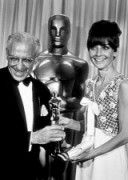 George
Cukor - (b. 7/7/1899, New York, d. 1/23/1983, Los Angeles) George
Cukor - (b. 7/7/1899, New York, d. 1/23/1983, Los Angeles) Double Oscar Winning Director (seen on left with Audrey Hepburn) Best known in his earlier days as the man who brought many a classic costume novel to the screen, George Cukor's 50-plus year directing career later expanded to include thrillers, screwball romantic comedies, and even musicals. Cukor lead eight of his leading ladies to Best Actress-nominated performances and himself received five Best Director nominations over the course of his career. Received the coveted prize for "Wizard of Oz," "My Fair Lady." Other well-known films include "It Should Happen to You" (1954) and A Star is Born (1954). - Read more at Reel
Classics or see
film summaries and commentary here! |
||||||
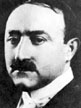 William
Fox - (born Vilmos Fried, 1/1/1879, Tulchva, Hungary, d. 5/8/1952,
New York) William
Fox - (born Vilmos Fried, 1/1/1879, Tulchva, Hungary, d. 5/8/1952,
New York) Producer and Hollywood Mogul - Founder of Fox Studios! Fox began his US career in the garment trade and moved into the penny arcade business in 1904. He went on to develop successful film exhibition, distribution, and production operations, merging all three interests with the formation, in 1915, of the Fox Film Corporation, one of the most powerful and creative studios of the silent era. At the peak of his power, Fox owned over 500 movie houses in the US (he bought control of the giant Loew's, Inc.) and the Gaumont Theatres chain in Great Britain. By the end of the 1920s the company had accumulated several top stars and directors and produced a number of prestigious films; the stock market crash of 1929, however, forced the overextended Fox to sell his shares in the corporation. His company merged with 20th Century Pictures to form 20th Century Fox in 1935. In 1936, a year after Fox studios merged with 20th Century, Fox bribed a judge during the liquidation of his holdings in bankruptcy proceedings. His sentence, a year in prison, began in 1941. Paroled in 1943, he was a pariah in Hollywood. Though secure from his many patent holdings, the industry for which he had been so visionary was closed to him. No industry representative came to eulogize at his funeral.
- See his impressive Filmography at IMDB, FabulousFox.com, or William Fox |
||||||
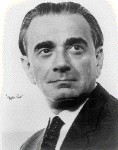 Miklós
Rózsa - (b. 1907, Budapest) Miklós
Rózsa - (b. 1907, Budapest) Triple Oscar Winning Film Composer Miklos Rozsa's exquisite string arrangements, powerful use of percussion and unconventional approach to composition would revolutionize the film score, raising the field to greater dramatic and evocative heights. A born musician, Rózsa began studying the violin at age five and became steeped in the folk music of his native land, an influence that could be detected in much of his later work. While his parents tried to steer him towards a more practical lifestyle, insisting he major in chemistry at the University of Leipzig, it wasn't long before he was enrolled in Leipzig Conservatory, training in musicology, preparing him for a long, successful and influential career in music. 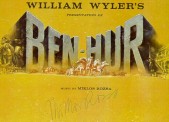 He began scoring films for fellow Hungarian Alexander Korda in England
in the 1930s and went with him to Hollywood to make The Thief of
Bagdad (1940). Rózsa's work ranges from the The Jungle Book (1942) to the intimate, disturbing accompaniment for Spellbound (1945) to the epic, scores of Julius Caesar (1953), Ben-Hur (1959) and El Cid (1961). For twenty years, from 1945
to 1965, he was a professor at the University of Southern California,
teaching and continuing to compose classical works. He began scoring films for fellow Hungarian Alexander Korda in England
in the 1930s and went with him to Hollywood to make The Thief of
Bagdad (1940). Rózsa's work ranges from the The Jungle Book (1942) to the intimate, disturbing accompaniment for Spellbound (1945) to the epic, scores of Julius Caesar (1953), Ben-Hur (1959) and El Cid (1961). For twenty years, from 1945
to 1965, he was a professor at the University of Southern California,
teaching and continuing to compose classical works.
Trivia: It was Rosza who began the vogue for recorded film scores, and he remained the most recorded of film composers for at least 40 years. Rozsa came up with the "dum dum dum dum" beginning of Dragnet! - See Miklos
Rozsa |
||||||
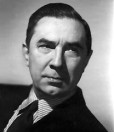 Béla
Lugósi - Béla
Lugósi - Actor - The Original Dracula! Born Béla Ferenc Deszö Blaskó in Lugos, Hungary, in the Bánát, another part of Hungary awarded to Rumania. Some early tidbits:
Bela had a truly remarkable film career. See:
- Visit the Béla Lugósi Homepage and see Béla Lugósi
Films |
||||||
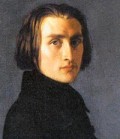 Franz
Liszt - (b. Oct. 22, 1811 - Doborján, Hungary (AKA, Raiding after
Austrian annexation); d. July 31, 1886 - Bayreuth, Germany) Franz
Liszt - (b. Oct. 22, 1811 - Doborján, Hungary (AKA, Raiding after
Austrian annexation); d. July 31, 1886 - Bayreuth, Germany) Classical Composer, "Greatest Pianist of All Time" A truly monumental
composer. From the Franz Liszt Page: "Franz Liszt has emerged
as one of the most awe-inspiring figures in all of music history.
Regarded as the greatest pianist of all time, who outplayed such greats
as Chopin and Thalberg, his genius extended far beyond the piano to
expand musical composition and performance well beyond its 19th Century
limitations. His unique compositions bewildered, inspired and inflamed
the imaginations of his own era, yet quite miraculously he also laid
the seeds for a series of schools that would flourish in the near
and distant future. Namely, the Late Romantic, Impressionist and Atonal
schools. For this Liszt is unique, and his immense-influence... monumental. He invented the symphonic poem, a new and elastic
single-movement form, which many subsequent composers, like Richard
Strauss & Saint-Saëns, embraced and
is at the core of much contemporary and even popular music forms today." |
||||||
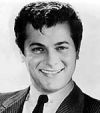 Tony Curtis Tony Curtis Oscar-Nominated Actor, Artist, and Hollywood Legend! The COOLEST cat ever to grace Hollywood! The son of a Hungarian immigrant (who had been an amateur actor in Budapest), Curtis was involved with street gangs as a child, but eventually joined the Navy during World War II. Upon his release, he used the GI educational program to study drama at New York's Dramatic Workshop. While playing the lead in a production of "Golden Boy," a Universal talent scout spotted him and Bernie Schwartz was signed to a seven-year contract (starting at $100 a week). His name was changed to "Anthony Curtis." He started his career at the movies in 1949. Tony has been called by critics, "The World's Favorite Movie Actor." Star of 106 films, including "The Defiant Ones," in 1958 (Oscar Nomination!), "Some Like it Hot" with Marilyn Monroe in 1959, "Trapeze," "Spartacus," "the Great Race," "Sweet Smell of Success" and "The Boston Strangler," in 1968. He also played the title role in a film about his fellow countryman, Houdini with his first wife, Janet Leigh, with whom he fathered the beautiful Jamie Lee Curtis. My favorite Tony quote: "What's the secret to a long and happy life? Young women's saliva!" As an artist, he has won international acclaim. From his site: "His bright acrylic canvases, which have been compared to Matisse, assemblages, collages and boxes are in the private collections of Billy Wilder, Arnold Schwarzenegger and Maria Shriver, Frank and Kathy Lee Gifford, Lew Wasserman, Frank Sinatra, Arsenio Hall, Walter Mathau, Burt Lancaster and Kirk Douglas. Tony's originals are also on display at the Butler Institute of American Art, the Naval Base at Pearl Harbor, The Toronto Museum, National Hungarian Museum, Harrods Department Store, Spago Restaurant, The Navy Memorial, The Mirage in Las Vegas, and the Caitlyn Gallery in St. Louis."
- For more biographical info, visit: IMDB or Mr.
Showbiz |
||||||
Born Chaim Witz in Haifa Israel in 1949, his mother Florence was a Hungarian survivor of a Nazi concentration camp, and his father Yechiel was a carpenter. Five years after his birth his parents separated, and when Chaim was only nine his mother brought him to live in the "Land of Opportunity" - the United States of America. Mother and son settled in Williamsburg, Brooklyn, New York. Here's what Gene once said in a Goldmine interview with Ken Sharp:
Gene also used comic books to learn English and was fascinated by the colors and pictures. The step from comics to horror movies and thrillers was a natural one after seeing a documentary on the great Lon Chaney. After seeing the historic Beatles appearance on the Ed Sullivan Show in 1964 Gene's life was changed. It would be in this, his fifteenth year, that his mother would give him a secondhand Kent guitar, which she purchased for $15.
Gene Speaks Hungarian, Turkish, Hebrew, and Spanish. He was also a sixth-grade teacher in Spanish Harlem! - Read all about KISS at the KISS
Asylum |
||||||
Kate Seredy was the only child of a schoolteacher, Louis Peter Seredy, and his wife, Anna Ireny. Seredy received a diploma to teach art from the Academy of Arts in Budapest. During World War I Seredy traveled to Paris and worked as a combat nurse. After the war she illustrated several books in Hungary. In 1922 Seredy moved from Budapest to the United States. She studied English, working as an illustrator and artist to support herself, while preparing to illustrate children's books. From 1933-1934 Seredy owned a children's bookstore. Though the store wasn't a success, she later credited it with helping her to understand children and what made a good children's book. Seredy had twelve children's books published, but she considered herself an illustrator before an author. She had a unique style, primarily based on drawing, and considered her books "an excuse for making pictures." Her papers and illustrations are held at the May Massee Collection at Emporia State University, Emporia, Kansas, and the University of Oregon Library. - read more on Wikipedia |
||||||
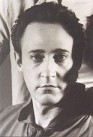 Brent
Spiner - (b. 2/2/1949, Houston, TX) Brent
Spiner - (b. 2/2/1949, Houston, TX)Actor and Trekkies' favorite android, Lieutenant Commander Data! "Born and raised in Houston, Texas, Spiner moved to New York after college, where he performed in numerous off-Broadway plays. "The play that finally pushed me over into the serious-actor category was a public theater production of 'The Seagull' [Anton Chekhov] for Joseph Papp," he says. Spiner eventually won roles in the Broadway musical productions of "Sunday in the Park with George," "The Three Musketeers" and "Big River," which was based on the story of Huckleberry Finn. After moving to Los Angeles in 1984, Spiner appeared in the Westwood Playhouse production of "Little Shop of Horrors." His other credits include the Woody Allen film "Stardust Memories," a cameo in the movie "The Miss Firecracker Contest" and guest-starring roles in such television series as Cheers, Twilight Zone, Night Court and Hill Street Blues. Spiner has also featured in the films "Phenomenon," "Independence Day" and "Out to Sea." In 2000, Brent portrayed Stromboli in Disney's musical live action version of "Geppetto." Spiner also appeared in the 2000 mini-series "A Girl Thing." - from Star Trek.com - See the interview in Timeout
NY Magazine |
||||||
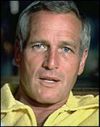 Paul
Newman - (b. 1/26/25, Cleveland) Paul
Newman - (b. 1/26/25, Cleveland)Oscar Winning Actor - Eight Oscar Nominations! His numerous acclaimed films include: "Cool Hand Luke," "Hud," "The Hustler," "Cat on a Hot Tin Roof," "Butch Cassidy and the Sundance Kid," "The Sting," "The Verdict," "Absence of Malice," "The Verdict," and "The Color of Money" in which he finally won the Oscar on his seventh try. Paul Newman has managed to maintain his matinee-idol status for over 40 years. His famous baby blues were as striking at 70, when he collected his eighth Best Actor Oscar nomination, for 1994's Nobody's Fool, as they had been at 30, when he made his feature-film debut in 1954's The Chalice. Newman was born in the brew-drenched burg of Cleveland, Ohio, the second and youngest child of German and Hungarian parents. His father was a partner in a successful sporting goods store, and thus Newman was raised in Cleveland's swanky Shaker Heights. suburb. "The embarrassing thing is that the salad dressing is out-grossing my films." In the twilight of his storied career, he became an ardent philanthropist; by the time the Academy of Motion Picture Arts and Sciences honored him with its Jean Hersholt Humanitarian Award in 1994, Newman had raised over $80 million in support of various charities. Proceeds from his "Newman's Own" line of food products go to charity.
- AMC
TV and IMDB are excellent resources for all sorts of Paul Newman info. |
||||||
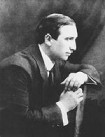 Michael
Curtiz - (b. Manó Kertész Kaminer, 12/24,1898 Budapest, d.
4/10/1962, Hollywood, California) Michael
Curtiz - (b. Manó Kertész Kaminer, 12/24,1898 Budapest, d.
4/10/1962, Hollywood, California)Oscar Winning Director of "Casablanca" From IMBD: He got his diploma at the School for Dramatic Arts in 1906. First he went to Pécs, then Szeged. He began acting in and then directing films in his native Hungary in 1912. The next year he went to Denmark to study the newest achievements of the new art in the studios of the then flourishing Nordisk company. Here he worked as assistant and director, acting as the main character in Atlantis (1913). Having returned in 1914 he went to the Jenõ Janovics film factory in Kolozsvár (Cluj). In 1915 he moved back to the capital. In 1916 he worked for the Kinoriport, then he became a director for Phönix until Fall 1918. He shot 38 production in Hungary altogether. In 1919 he filmed the popular poem of Antal Farkas with the title Jön az öcsém (1919). During the Commune he settled down in Vienna. He was one of the most productive and most educated artist in Hungary at the beginning of the era of the silent film.
Trivia: Member of the Hungarian fencing team at the 1912 Stockholm Olympics! - See Arjan's Michael
Curtiz page for movie posters, pictures, trivia, and more!
(Thanks for the images) |
||||||
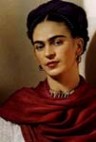 Frida
Kahlo (b. 1907, in Coyoacán, Mexico City; died 13th. July, 1954) Frida
Kahlo (b. 1907, in Coyoacán, Mexico City; died 13th. July, 1954)Acclaimed Artist and Mexican Icon: One of the most influential artists of the middle twentieth century She was born Magdalena Carmen Frida Kahlo y Calderón. Her father, Guillermo Kahlo, was a Jewish Hungarian immigrant photographer who had been born in Germany. Her mother, Matilde Calderon, was a Catholic Mexican whose origins were Spanish and Native American. She died when Frida Kahlo was in her twenties. Frida Kahlo suffered from polio when she was six. Nevertheless she was very tomboyish which won her father's favor. It was not common for girls to go to school at that time in Mexico, but her father had advanced ideas and in 1922 he sent her to the Preparatoria (National Preparatory School) which was the most prestigious educational institution in Mexico. The school had only just started taking girls, and Frida Kahlo was one of only 35 girls out 2000 pupils. It was at school where she met her future husband Diego Rivera who was fulfilling a mural painting commission there. In 1925 when she was 18 she was in a bus which collided with a tramcar causing serious injuries to her leg and pelvis. The accident destroyed her dream of becoming a doctor and affected the rest of her life. During her convalescence she started painting and sent some of her work to Diego Rivera. They would marry in August 1929. She shared his faith in communism and passionate interest in the indigenous cultures of Mexico. Rivera encouraged Kahlo in her work, extolling her as authentic, unspoiled and primitive, and stressing the Indian aspects of her heritage. During this period "Mexicanismo," the fervent embrace of pre-Hispanic Mexican history and culture, gave great currency to the notion of native roots. The suffering of women is a constant theme in her sometimes shocking pictures. The Frida Kahlo Museum was opened in her house in Coyoacán in 1958. Nicolas Muray (1892-1965) was a close friend and lover of Frida Kahlo. The Hungarian-born photographer's celebrity portraits appeared regularly in Vanity Fair and Harper's Bazaar. He also took numerous photographs of Kahlo and purchased many of Kahlo's paintings, helping her financially while she was struggling during her brief eleven-month divorce from Rivera. She was having an affair with Muray when she and Rivera filed for divorce in 1939; although it is unclear whether the cause of the separation was Kahlo's or Rivera's infidelity. These intimate letters attest to Kahlo's close relationship with Muray. Salma Hayek portrays her in the Hollywood film on Frida's life. |
||||||
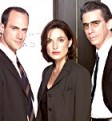 Mariska
Hargitay - (b. 1/23/64, Los Angeles) Mariska
Hargitay - (b. 1/23/64, Los Angeles)Actress The beautiful and talented daughter of Jayne Mansfeild and Mickey (Miklós) Hargitay, and a wonderful actor in her own right. Now starring in "Law and Order: Special Victims Unit." Hargitay is also known to millions of viewers from her recurring role on ER as Dr. Greene's (Anthony Edwards) girlfriend Cynthia Hooper in the 1997-98 season of the top-rated show. She also gained notice as a cast regular in the sitcom "Can't Hurry Love," guest roles on NBC's "Seinfeld," "Ellen," "thirtysomething," "Wiseguy" and "In the Heat of the Night" and as a regular on the popular series Falcon Crest and Prince Street. Hargitay was also seen in the made-for-television movies The Advocate's Devil and Night Sins. Her film credits include the critically acclaimed Leaving Las Vegas.Miss Beverly Hills (1982). She graduated from the University of California, Los Angeles, California; B.A., Theater. - See NBC.com for more! |
||||||
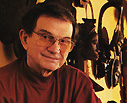 Charles
A. Csuri - Charles
A. Csuri - "Father of Digital Art!" "Charles Csuri could have played professional football. Named "All-American" for football at Ohio State, Csuri turned down offers to play professionally and chose to study art at the graduate level. In school, he became friends with Roy Lichtenstein; afterwards, both of them joined the faculty at Ohio State where he is now Professor Emiritus. Painting and teaching, Csuri became interested in the digital computer as a means of imaging in 1964, when he saw a computer generated face in a publication from the Department of Electrical Engineering. This started Csuri down the path which made him a Computer Graphics Pioneer."
Co-founder of Cranston and Csuri Productions whose credits include the acclaimed "Living Body" series. He has directed over 25 major research projects for the National Science Foundation, Navy and Air Force and the findings have been applied to flight simulation, computer aided design, and the special effects industry. In 1995 Csuri was featured in the cover article for Smithsonian Magazine. His work has been exhibited at, among other venues, the Smithsonian Institution and the Institute for Contemporary Art in London. He is represented in a number of collections, including that of New York's Museum of Modern Art. - See this great article at Ohio State: Digital
Patriarch or see his Ohio State professional
profile |
||||||
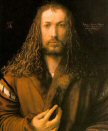 Albrecht
Durer (b. 5/21/1471, Nürnberg, d. 4/6/1528) Albrecht
Durer (b. 5/21/1471, Nürnberg, d. 4/6/1528)Reniassance Master - perhaps the Greatest "German" artist of the Renaissance era. Also the most important of the Renaissance Mathematicians - Father of Descriptive Geometry Albrecht Durer was the third son of Albrecht Ajtos and Barbara Holfer. He was one of their eighteen children. The Ajtos family came from Hungary. The name Ajtos means "door" in Hungarian. When Albrecht Ajtos senior and his brothers came to Germany they chose the name Türer which sounds like the German "Tür" meaning door. The name changed to Dürer but Albrecht Dürer senior always signed himself Türer rather than Dürer. Durer began his career in the Imperial Free City of Nürnberg with his father, a Hungarian goldsmith who had emigrated to Germany in 1455. Despite his goldsmith origins, however, by 1484 Durer had already begun painting. In 1486 he was apprenticed to the painter and printmaker Michael Wolgumut and began to work with woodcuts and copper engravings as well. His mastery of perspective came through his study of geometry and mathematical theories of proportion. Fascinated by mathematics, Durer traveled extensively. Durer began to explore the "mathematical secrets of art" and delved yet more deeply into the study of mathematics. After returning to Nürnberg, Dürer's health became still worse. He did not slacken his work on either mathematics or painting but most of his effort went into his work Treatise on proportion. Durer expressed his theories on proportion in The Four Books on Human Proportions. Although it was completed in 1523, Dürer realised that it required mathematical knowledge which went well beyond what any reader could be expected to have, so he decided to write a more elementary text. He published this more elementary treatise, in four books, in 1525 publishing the work through his own publishing company. This treatise, Unterweisung der Messung mit dem Zirkel und Richtscheit, is the first mathematics book published in German (if one discounts an earlier commercial arithmetic book) and places Dürer as one of the most important of the Renaissance mathematicians. Dürer's remarkable achievement was through applying mathematics to art, he developed such fundamentally new and important ideas within mathematics itself and gave rise to the field of "descriptive geometry." - See Albrecht
Durer |
||||||
Gerard Schurmann was born of a Dutch father and Hungarian mother in the former Dutch East Indies. He left his home at an early age and grew up in England in the care of an uncle, thus avoiding the Japanese occupation of the islands. Influences from his colorful background manifest themselves in music of a distinctive character. Inherent in his individual musical language are the intervals derived from pentatonic scales which he absorbed as a boy from the local gamelan music of Java and from the Hungarian heritage of his mother, a gifted pianist and accompanist. These melodic derivations, with their harmonic resonances, give rise to an exotic and often heightened emotional intensity in his music. At the age of 17, Schurmann volunteered for active wartime flying duty in the Dutch 320 Squadron of the Royal Air Force. In addition to his operational duties in Coastal Command, he was invited by the British Council to give piano recitals and make recordings for the troops. At the end of the war, Schurmann combined his by now busy concert career as a pianist with the position of acting Cultural Attaché at the Netherlands Embassy in London. He later became resident orchestral conductor at Dutch Radio. At the end of his contract, he returned to England determined to devote his life mainly to composition, henceforth limiting his conducting activities to guest appearances. As a composer, Schurmann found himself able to earn a living by writing music for films. In 1980, he was invited by the U.S. State Department to tour orchestras and universities in the United States, a five months visit also partly sponsored by the British Council. In 1981, he moved to the USA, where he settled in the Hollywood Hills, California. He continued to receive many commissions for concert works and became associated with the Pittsburgh Symphony Orchestra. He scored many films and won Oscars for his orchestration of Lawrence of Arabia and Exodus. He also received two Oscar nominations (The Two-Headed Spy, and The Ceremony). Trivia:
- See Gerard Schurmann.com |
||||||
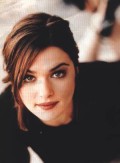 Rachel
Weisz (b. 3/7/71, London), Actress and Model Rachel
Weisz (b. 3/7/71, London), Actress and ModelFilm credits include: The Mummy, The Mummy II, Enemy at the Gates, Stealing Beauty, Chain Reaction, Swept from the Sea, Sunshine, Beautiful Creatures. Rachel studied English at Trinity Hall, Cambridge. She formed the Talking Tongues theater company and at 1991's Edinburgh Festival won a student drama award for a play she wrote and acted in. Her mother, Edith, is a Viennese-born psychotherapist (wanted to act herself, encouraged Rachel to try theatre). Her father, George, is a Hungarian-born inventor credited with inventing life-saving respiratory medical equipment. - Biography at Heavenly
Celebrities, |
||||||
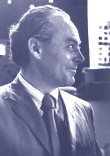 Gyorgy
Kepes (b. Selyp, Hungary in 1906, d. 1/16/2002) Gyorgy
Kepes (b. Selyp, Hungary in 1906, d. 1/16/2002)Painter, designer, author and educator who founded and directed the Center for Advanced Visual Studies at MIT “Gyorgy Kepes was the greatest pioneer in the marriage of art and technology in America, if not the world. He was a visionary, a towering intellect and a breathtaking artist. He single-handedly created the Center for Advanced Visual Studies at MIT and turned it into an internationally acclaimed program for the development of the finest in late 20th-century art. His work will endure for many centuries to come,” said Alan Brody, associate provost for the arts. Kepes studied painting at the School of Arts in Budapest. The horrors of World War I convinced him that “only film could bring into a single focus my joy in the visual world and the social goals to be realized in this world,” he wrote. In 1930 he went to Berlin, collaborating on film, stage and exhibitions, and graphic design with Laszlo Moholy-Nagy, one of the principals in the Bauhaus movement. Kepes came to the United States in 1937 as head of the Light and Color Department of the Institute of Design in Chicago, then known as the New Bauhaus. He joined MIT in 1946 as associate professor of visual design, becoming a full professor in 1949. He was appointed Institute Professor in 1970. Kepes founded the Center for Advanced Visual Studies (CAVS) in 1967 and served as its director until 1972. In addition to his career as an artist and an educator, Kepes was a prolific author. He published “The Language of Vision,” a summary of educational ideals and methods, in 1944; “The New Landscape in Art and Science” in 1956, and the seven-volume “Vision and Value” series in 1965 and 1966. Throughout his career, Kepes continued working as a designer, producing both small and large-scale works. The First and Second Church in Boston commissioned him to make stained glass windows, and he designed a window and all sculpture for a church in Japan. His paintings are included in 30 permanent collections including the Brooklyn Museum, the Corcoran Gallery of Art in Washington and the Whitney Museum in New York City. In 1995 the Hungarian government endowed a museum in Eger, Hungary, devoted to housing a major collection of Kepes’ paintings, drawings and photographs as well as his archives. A permanent collection of his photographs is in Hungary’s National Photography Museum. The Kepes Prize is presented annually at MIT. Among many tributes, Kepes was awarded the Fine Arts Medal of the American Institute of Arts and Letters. He was a Fellow of the American Academy of Arts and Letters and a member of the National Institute of Arts and Letters. In 1996, he received both the Medal of Honor and the Middle Cross of the Republic of Hungary. See MIT Tech Talk or Gyorgy Kepes, Exemplar of the Visual Arts (includes a gallery) |
||||||
Some call him "One of the Most Controversial Men of Modern Times," Uri is undoubtedly the most famous psychic in the world, first known for his spoon bending. His "powers" have been under scientific scrutiny for years. Visit "Uri Geller," for biographical information, a picture gallery, paranormal research, Uri's paintings, and more. Uri's own home page at www.urigeller.com is also a great resource on his activities. |
||||||
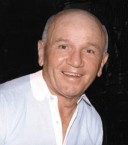 Stefan
Hatos (b. Aurora, Illinois, on 8/ 20/1920, d. Lakeside Golf Club
in Toluca Lake, California 1999) Stefan
Hatos (b. Aurora, Illinois, on 8/ 20/1920, d. Lakeside Golf Club
in Toluca Lake, California 1999)Television producer of "Let's Make a Deal" fame Stefan Hatos was a first generation American with Hungarian parents. His father was an iron peddler by trade. Stefan was the second of three sons and a daughter. He began playing piano and oboe at age eight. While attending college on a music (and basketball) scholarship, he played Oboe and English Horn with the Detroit Civic Symphony and also played Tenor & Bass Saxophone in dance bands to work his way through school. He got his start in media when he became staff announcer at a Detroit radio station and later on the NBC radio network. He was always more interested in writing and production than in performing. While an announcer, he wrote episodes of The Lone Ranger (1940), The Green Hornet, and a psycho-thriller Hermit’s Cave. After serving 37 months as commanding officer of PT 328 during WWII, and surviving being wounded twice, he returned to CBS Radio as a Staff Director and Writer in New York and Chicago. He next joined ad agency Foote, Cone & Belding as staff Producer-Director for radio shows Readers Digest with big name stars and The Wayne King Show (CBS Radio). He directed Lucky Strike Hit Parade for NBC Radio.
Trivia:
Read more on the Official Let's Make a Deal Website (thanks for the above information!) |
||||||
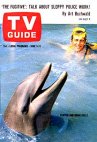 Iván
Tôrs - (b. 6/12/1916 d. 6/4/1983) Iván
Tôrs - (b. 6/12/1916 d. 6/4/1983) Producer/Director, Underwater Film Pioneer Although Ivan Tors died in 1983, his impact on conservation, wildlife awareness, and even recreational scuba has been huge. By means of his work as a filmmaker and producer, Ivan brought the underwater world home to millions via television and movies. He is the man who created Sea Hunt in the 1960s, but even back in 1958 he was innovating underwater cinematography with features like "Underwater Warrior." Another milestone in Tors' career was the 1960s TV series "Flipper," forever endearing the Atlantic bottlenose dolphin to Homo sapiens. Other Ivan Tors productions included "Namu, the Killer Whale," "Around the World Under the Sea," and "Hello Down There." Other television series created by Ivan Tors during the 1970s included "The Aquarians," "Primus," and "Salty." By means of his creative cinematography and innovative narrative, Ivan Tors communicated his vision of the sea to so many when so few knew what wonders lie beneath the sea. Tors also handled underwater sequences for the early Bond films such as "Thunderball." Inducted into the International Scuba Diving Hall of Fame. Though he worked extensively with captive dolphins and other animals, he spent much of his later years campaigning against dolphin captivity... - See his filmography here |
||||||
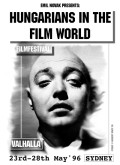 Peter
Lorre - (born Lászlo Loewenstein, 6/26/1904 Rozsahegy
[Rosenberg], Hungary, d. 3/23/1964) Peter
Lorre - (born Lászlo Loewenstein, 6/26/1904 Rozsahegy
[Rosenberg], Hungary, d. 3/23/1964) Actor: Chaplin called him "the greatest actor alive"
Vincent Price said of him, "His voice. . . face . . . the way he moved . . . laughed. He was the most identifiable actor I have ever known." Trivia:
- See Walking the Shark: a Peter Lorre Page for more; Peter Lorre by Michael Ferguson; The Peter Lorre Story, with numerous pictures and anecdotes; more biographical info, filmography, and more at IMDB; or his filmography |
||||||
Houdini fascinated audiences with his great escapes and illusions for decades. To this day he is the one magicians aspire to. He was honored as first to fly a plane in Australia and also has a star on the Hollywood Walk of Fame for his film career.
Trivia: "Genius of Escape Who Will Startle and Amaze"
- See Houdini Biography or The Houdini Tribute for more. |
||||||
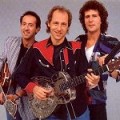 Mark (b. 8/12/1949, Glasgow) and David Knopfler (b. 12/27/1951) Mark (b. 8/12/1949, Glasgow) and David Knopfler (b. 12/27/1951)Legendary, Grammy Award-winning Rock Musicians of Dire Straits: "The Sultans of Rock" and "the finest British band of all time." Mark Freuder Knopfler was born to Erwin Knopfler and Louisa Mary Knopfler. Erwin Knopfler, an architect, was a Hungarian Jew who had fled from the Nazis in 1939, and settled in Glasgow. A daughter, Ruth had been born in 1947. Later, in 1952, Mrs. Knopfler gave birth to a second son, David. When Mark was seven or eight, the Knopflers moved from Glasgow to Newcastle. Dire Straits was formed in London by Mark Knopfler (lead vocals and lead guitar) and his brother David (guitar), with John Illsley (bass), and Pick Withers (drums). In the late 70s, the band emerged with a refreshing rock sound mixed with blues, jazz and even country. The band's sound was strengthened by the meshing of players and Knopfler's lyrics. Mark Knopfler is and always has been the face and force of Dire Straits. Their first demo gets airtime thanks to a chance friendship with London Radio DJ Charlie Gillent. Dire Straits (named after their financial condition) then is born. A record company deal and the first album, the self-titled Dire Straits, follow the next year. Thus began the meteoric rise of the one of the finest British band of all time. The first single of their album Brothers In Arms, "Money For Nothing," went to Number 1 on pop and rock charts. Follow-up hits included the Top 10 "Walk Of Life" and "So Far Away." The band used the popularity of the "new" CD format to give listeners longer versions of their songs. Tracks such as "Your Latest Trick" and "Brothers In Arms" became even more of a treat to listeners with the longer format. The LP sold over 9 million copies in the U.S. and many more millions around the world. The LP went #1 in Canada, Brazil, Austria, Belgium, Denmark, Ireland, Finland, Iceland, Norway, Portugal, France, German, Greece, Spain, Sweden, Switzerland, Turkey, Yugoslavia, Australia, New Zealand, Hong Kong and Israel. 1986 Grammy Awards: Best Rock Performance by a Duo or Group with Vocal ("Money For Nothing") and Best Country Instrumental Performance ("Cosmic Square Dance" awared to Mark Knopfler and Chet Atkins). Trivia:
- See discography and more on neck-and-neck.com |
||||||
Louis CK uses his peculiar last name because his "Hungarian name has too many letters." It is funny too, and tells you a lot about this comic genius. Though his first foray into comedy in 1984 was unsuccessful, by 1989 he was appearing on virtually all the popular comedy shows of the time from Evening at the Improv, MTV Half Hour Comedy Hour, Comic Strip Live, and Comedy on the Road. He was even on Star Search but lost to a fellow named Steve Mc'grew. Besides writing and doing standup comedy, Louis has directed over half a dozen crowd-pleasing short films which have aired on Bravo and the Independent Film Channel. His feature debut, "Tomorrow Night," received popular acclaim after being screened at the Sundance Film Festival. His film, "Ceasar's Salad," in 1990, earned a Silver Plaque Award from the Chicago Film Festival. The New Orleans Film and Video Festival gave it the "Best Comedy" award. Louis was on his way! The next phase of Louis' career was in Television comedy writing, something which has earned him Four Emmy Nominations and one EMMY AWARD WIN! In 1993, The Conan O'brien Show hired Louis as a writer. He was a member of the original writing staff that launched the show. Louis also made his network television debut as a stand up on Conan; he was the first stand up comedian to appear on Conan's show! In 1996, Louis made his own HBO Half Hour stand up comedy Special. And he got hired as a Producer and writer on the Chris Rock Show on HBO, where in 1999, he won an Emmy for his work. He also Created and starred in a show for comedy Central called "Louis C.K.'s Filthy Stupid Talent Show." In 2000 Louis directed and wrote his first studio movie, called "Pootie Tang" starring a character Louis created on the Chris Rock show. In 2001, he made his very first appearence on the Tonight Show on NBC. He also co-wrote Down To Earth, starring Chris Rock. In 2003 - 2004, Louis was a big hit at the Montreal Comedy Festival and the Aspen Comedy Festival and he signed with CBS and Warner Brothers to do another sitcom pilot. This one was called "Saint Louie." This year, 2005, has been an incredible year for Louis. especially April. In that one month, he wrote, Executive Produced and starred in a sitcom pilot for HBO, shot his second HBO half hour standup special in New York, and his wife gave birth to his second daughter, all within two weeks of each other! The standup special turned out great and premiered on August 19th of 2005. The pilot was picked up by HBO for series and Louis is currently in production, writing, producing and starring in 12 episodes of the show which will begin airing in 2006. This show will mark HBO's first multi-camera sitcom(in front of an audience) ever. Awards - Won Emmy Award for best writing on a variety show
1999 - See his wonderful debut on the Tonight
Show with Jay Leno! |
||||||
Best known as a composer of operettas, he studied with his father, a military bandmaster, and at the age of 15, from 1882 to 1888 he was a pupil at the Prague Conservatory, studying violin and music theory. On the advice of Dvorak, he concentrated on composition. After graduation, he played violin in the opera orchestra at Elberfeld. Later, he joined his father's band, the Fiftieth Infantry, in Vienna, as assistant bandmaster. In Vienna, he also free-lanced as a conductor, and in the Spring of 1902, became conductor at the Theater an der Wien in Vienna. His opera Wiener Frauen was produced there in November, 1902. From that time, he lived in Vienna, and devoted his time to composition.
Franz Lehar wrote nearly forty operettas. His greatest success was The Merry Widow, which was first produced at Theater an der Wien on December 30, 1905. which had more than five thousand performances. At one time, it ran simultaneously in five different languages in five different theaters, all in Buenos Aires. Other major successes include The Count of Luxemburg (1911) and Land of Smiles (1923), Gypsy Love, Eva and other sonatas, symphonic poems, marches, and dances. In February 1935 Lehár decided to found his own publishing house in order to have the greatest possible control over the performance and availability of his works. He incorporated Glocken Verlag Vienna on 15 February 1935. He reacquired most of his oeuvre from other publishers to whom he had previously sold various rights and devoted much time to the publication of definitive editions. He died in Bad Ischl on 24 October 1948. - Read more Here or at this great biography "Franz
Lehár Considered from the Objectivist Point of View" |
||||||
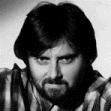 Gábor Csupó -
(b. 1952, Budapest) Gábor Csupó -
(b. 1952, Budapest)Co-founder of Klasky-Csupo, one of the world's leading independent animation studios, Founder of Tone Casualties, Musician. 5 EMMYS and 2 CABLE ACE Awards - produced Rugrats and the Simpsons
- Visit KlaskyCsupo.com for more info on the company and background on Gábor. |
||||||
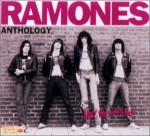 Tommy
Ramone (b. 1/29/1952, Budapest, Hungary) Tommy
Ramone (b. 1/29/1952, Budapest, Hungary)Drummer and Producer of the Legendary, Pioneering Punk Rockers, the Ramones! Born Thomas Erdelyi, he emigrated from Hungary at the age of four. The Ramones formed in 1974, after the foursome graduated or left high school in Forest Hills, New York. The original lineup featured Joey on drums, Dee Dee sharing guitar with Johnny, and Tommy as manager, but soon became the band's drummer. In the mid-'70s, the Ramones shaped the sound of punk rock in New York with simple, fast songs, deadpan lyrics, no solos, and an impenetrable wall of guitar chords. Each band member changed his name to Ramone. "All the better-known punk groups that followed - The Sex Pistols, The Clash, whoever - they would be the first ones to say that without the Ramones the whole punk movement never would have happened," Spin magazine editor-in-chief Alan Light. The Ramones have released 14 studio albums of "arguably the greatest American Rock-n-Roll ever," contributor Fred Mintz. Tommy's last show was May 4, 1978, at CBGB in New York. Tommy left under amiable terms, citing a dislike of touring and desire to be a producer. He returned to produce the albums Road to Ruin and Too Tough To Die. Trivia:
- See RollingStone.com or |
||||||
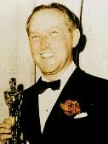 George
Pál (b. 1/2/1908, Cegléd, Hungary, d. 5/2/1980, Beverly Hills, California)
- George
Pál (b. 1/2/1908, Cegléd, Hungary, d. 5/2/1980, Beverly Hills, California)
- Cartoonist - Winner of SIX Oscars, and pioneer of stop-action animation! "Before Spielberg... Before Lucas... There was...George Pal, The original Wizard of Sci-Fi & Fantasy!"
In the '50s Pal turned to live-action films as a producer (as did his friend Walt Disney seen with Pal and Lantz on the right). His first film. "Destination Moon," (Oscar) was a 'futuristic documentary' chronicling man's exploration of Earth's nearest neighbor. As veteran director Robert Wise observes in the documentary, "’Destination Moon’" was a major turning point in film history." He later brought to the screen such classics as H.G. Wells' "The War of the Worlds" (Oscar) and "The Time Machine" (Oscar), and "When World Collide" (Oscar).. But there was a warm and gentle side to this artist as well. Today Pal is also honored for the beautiful and charming fantasies "Tom Thumb," (Oscar) "The Wonderful World Of The Brothers Grimm" (his son David was also an animator), and "7 Faces of Dr. Lao." Pal's cinematic legacy can be traced today in the works of George Lucas, Steven Spielberg, and Gene Roddenberry. Trivia:
- For more biographical information, see IMDB, The
Legacy Of George Pal, A
Brief Biography of George Pal, The
Time Machine, or Sci-fi
station.com |
||||||
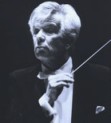 Kristof
(Christoph) von Dohnányi - (b. 9/28/1929, Berlin) Kristof
(Christoph) von Dohnányi - (b. 9/28/1929, Berlin) Conductor (Cleveland) of the "Country's Greatest Orchestra" Time Magazine, 1994 Born in Berlin, Christoph von Dohnanyi began the study of the piano as a 5-year-old, and although he studied law in Munich after the war, he decided to devote himself exclusively to music. His most important teacher was his grandfather, the composer Ernst von Dohnanyi, with whom he studied at the Florida State Universitry. Dohnanyi also took conducting courses in Tanglewood under Leonard Bernstein. His career began when Sir Georg Solti called him to the Frankfurt Opera in 1953, where he was choral conductor and later orchestral conductor. He then took posts in various German cities before serving as principal conductor and general manager of the Hamburg State Opera from 1978 to 1984. As a regular guest at the Salzburg Festival, Christoph von Dohnányi has led the Vienna Philharmonic in several new productions. He has conducted such orchestras as the Berlin Philharmonic, Vienna Philharmonic, Concertgebouw Amsterdam, New York Philharmonic, Israel Philharmonic and Chicago Symphony Orchestra. He has appeared in major international opera houses such as the Metropolitan Opera, New York, Lyric Opera of Chicago, Royal Opera House, Covent Garden, La Scala, Milan and Vienna State Opera. Dohnanyi was appointed music director of the Cleveland Orchestra in 1984. "They don't have to love you, but respect is essential," he says of his relationship with the players. Today, Dohnanyi and the Cleveland Orchestra are considered as one of the great musical teams of our time, both in the U.S. and internationally. His programs in Cleveland have drawn widespread admiration and won him the ASCAP Prize for progressive concert programs in 1989. From Case Western Reserve University: "Under your direction, the Cleveland Orchestra has become the most recorded American orchestra, and has brought insight and enjoyment to millions of listeners and fame to this community through your performances here and throughout the world. Christoph von Dohnanyi, musician, leader, adventurer, world citizen, and our close partner in this extraordinary neighborhood known as University Circle. On the recommendation of the University Faculty and the vote of the Board of Trustees, it is a privilege to admit you to the degree of Doctor of Humane Letters, honoris causa, with all the rights and privileges pertaining thereto. In token of this act, we bestow upon you the hood of this University and grant you this diploma." Trivia:
- See Honoring
conductor Christoph von Dohnanyi on his 70th birthday |
||||||
|
||||||
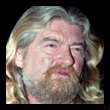 Joe
(Joszef) Eszterhás - (b. 11/23/1944, Csákánydoroszló, Hungary) Joe
(Joszef) Eszterhás - (b. 11/23/1944, Csákánydoroszló, Hungary) Prolific Screenwriter (Basic Instinct, Sliver, Flashdance) "Highest-paid writer in Hollywood" Writing must run in his genes. His father, Istvan Eszterhas, was a renowned novelist and author of more than 30 Hungarian historical novels. His mother, Maria Biro, diagnosed as a schizophrenic, died when Eszterhas was 23. Joe Eszterhas began his journalistic career as a reporter for Rolling Stone. Prior to that, Joe worked as a reporter for the Cleveland Plain Dealer. In 1974, Eszterhas authored the popular, award-winning novel Charlie Simpson's Apocalypse. The book was optioned by Hollywood, and though it has not as yet been filmed, it served as the key for Eszterhas' entree into scriptwriting. He is best known for his vicious, sexy, highly literate crime and mystery scripts: The Jagged Edge (1985), Betrayed (1988), and the Sharon Stone starmaker Basic Instinct (1989). At one point Eszterhas was the highest-paid writer in Hollywood, receiving $3 million up-front money for Basic Instinct alone. Other credits include: Burn Hollywood Burn: An Alan Smithee Film (1998); Telling Lies in America (1997); Jade (1995); Showgirls (1995); Sliver (1993); Checking Out (1989); Music Box (1989); Big Shots (1987); Hearts of Fire (1987); Flashdance (1983); and F.I.S.T. (1978) - Read more at E! Online or IMDB! |
||||||
 Claude-Michel
Schönberg (b. 7/6/1944, Vannes, France) Claude-Michel
Schönberg (b. 7/6/1944, Vannes, France)Acclaimed Grammy and Tony Award-winning Writer, Composer, and Producer of Les Miserables and Miss Saigon
Schonberg and Boublil's next project, Miss Saigon, was acclaimed both in London (1989) and New York (1991), and has been successfully presented in many countries throughout the world. He lives in Paris with his wife and two children. - Go to Amazon.com for his recordings |
||||||
Ilona Staller's father was an official in the Ministry of the Interior, her mother an obstetrician. She began modeling at the age of 13 and later entered medicine with plans to become a gynecologist before an interest in archaelogy sidetracked her. She then joined M.T.I. Modeling Agency which handled 50 of Hungary's most beautiful models. Staller moved to Italy in 1976 where she hosted a radio show on Radio Luna, and for the first time used the name Cicciolina. In 1979 she helped start Italy's first Green Party while making pornography on the side. She would be world renowned for her haunted girlish beauty and willingness to do any filthy thing imaginable. Ilona was elected to the Italian parliament in 1987 on a platform of "make love, not war." She vowed to fight nuclear energy, experimentation on animals, drug prohibition, capital punishment, cars, unchecked capitalism and censorship. She married American artist Jeff Koons who has exhibited vivid sculptures showing the two engaged in intercourse. Ilona alleged physical abuse and their marriage bitterly broke up in 1992. Their son Ludwig was born shortly afterwards. Staller left the US with the child, and a lengthy custody battle ensued. Koons won custody in 1998 but the son remains with Staller in Italy. Cicciolina continues to be active in politics, advocating a safe future without nuclear energy and with absolute sexual freedom including the right to sex in prisons. She is against all forms of violence including the death penalty and the use of animals for fur or scientific experimentation. She is for the decriminalization of drugs, against censorship of any kind, in favour of sex education in schools, and for objective information about AIDS. She has proposed a tax on automobiles to reduce the damages of smog and fund the defence of nature. In 2002, she made an unsuccessful bid in Hungary to represent Budapest's Kobanya district in the Hungarian parliament. - See Cicciolina Online (Warning: some nudity) |
||||||
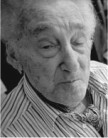 Stefan
Lorant (b. 2/22/1901, Budapest, d. 11/14/1997, USA) Stefan
Lorant (b. 2/22/1901, Budapest, d. 11/14/1997, USA)Photographer / Editor / Filmmaker / Pioneering Journalist - Widely regarded as the first major editor of modern photojournalism and "the Godfather of Photojournalism" Stefan was born Lóránt István. His father was director of Erdélyi, the largest photographic studio in Budapest. Lorant attended the Lutheran Evangelical Gymnasium and the Academy of Economics, where his classmates included John von Neumann and Nobel laureates Eugene Wigner, Dennis Gábor, and George von Bekesy. Lorant began taking photographs with a postcard camera, progressed to portrait photos, and in 1914 started publishing photos in Budapest newspapers and magazines. At the collapse of the Hungarian government after WWI, Lorant left for Czechoslovakia. There he was helped by none other than Franz Kafka to find a job playing the violin in a movie house orchestra. Before long, he moved to Vienna and began work as a still photographer for a Hungarian filmmaker. "During the day I made photographs in the studio; at night I studied the intricacies of the movie camera." At 19 years of age, Lorant became known as a leading cameraman in Europe with his first film, The Life of Mozart. Over the next few years, he developed skills as a scriptwriter and director as well, and made a total of 14 films between Vienna and Berlin. While working in Berlin in 1921, a young woman approached Lorant and asked for a screen test. It turned out badly, and Lorant told her that he "did not believe she should try a career in the movies, that she had no gifts for that." Well, the twenty-year old woman turned out to be Marlene Dietrich and, despite the snub, the two later became friends. Appointed chief editor of a Munich weekly in 1928, he was responsible for making the Muncher Illustrierte Presse the first modern photojournalistic paper in Europe. With the Nazi invasion of Bavaria in 1933, Lorant's political commentaries enraged Hitler who ordered him taken into "protective custody." Never charged with a crime or taken before a court, he was imprisoned for nearly a year. The Hungarian government came to his rescue, and Lorant was released and began editing a paper in Budapest. Based on his prison experience, Lorant wrote I Was Hitler's Prisoner and took the manuscript to London in 1934, where it was published a year later. Stefan began the movement of photojournalism in England. Barely literate in the English language when he first arrived in Britain, Lorant shortly became editor of Odham's Weekly Illustrated. This was the first popular illustrated paper in England and a model for American picture magazines such as Life and Look. In 1937, Lorant founded Pocket Publications in London and published the successful pocket magazine, Lilliput. In October 1938, Edward Hulton, owner of the Hulton Press, purchased Lilliput from Lorant and offered him the chance to start what was to be the most successful and influential illustrated British news magazine, Picture Post. - See more at the Carnegie Library of Pittsburgh |
||||||
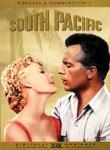 Mitzi
Gaynor (9/4/1931, Chicago) Mitzi
Gaynor (9/4/1931, Chicago)Legendary Actress / Singer / Dancer: Star of "South Pacific" Mitzi Gaynor has claimed to be descended from Hungarian nobility; on these occasions, she has stated that her real name is Francesca Mitzi von Gerber. The daughter of a ballerina, Gaynor made her own terpsichorean debut when she was barely a toddler; by age 12, she had joined the dancing chorus of the Los Angeles Civic Light Opera. In 1950, Gaynor was signed by 20th Century Fox as yet another potential Betty Grable replacement. She sang and danced her way quite prettily through such Technicolor confections as Golden Girl (1951, as Lotta Crabtree), Bloodhounds of Broadway (1952), and There's No Business Like Show Business (1954). Unfortunately, her films were not sufficiently successful to warrant renewal of her contract after 1954. After being dropped by Fox, Gaynor married talent agent Jack Bean, who wisely perceived that his new bride was a far more effective performer on a live stage rather than a cold movie set. Gaynor co-starred with Bing Crosby and Donald O'Connor in Anything Goes (1956), with George Gobel and David Niven in The Birds and the Bees (1956), and with Frank Sinatra in The Joker Is Wild (1957). Her best work during this period was while on loan to MGM for George Cukor's Les Girls (1957), in which she shared star billing with Gene Kelly, Kay Kendall, and Taina Elg. In 1957, Gaynor was tapped for the plum role of Nellie Forbush in Joshua Logan's film version of Rodgers and Hammerstein's South Pacific (1958). Mitzi Gaynor continued to be a major draw through the 80's on the nightclub and summer-musical circuit, and for several years she headlined a top-rated annual TV special. - Read more and buy her films on Yahoo! or Daily Celebrations |
||||||
 Alanis
Morrisette - (b. 6/1/1974) Alanis
Morrisette - (b. 6/1/1974)Multi-Platinum-selling Singer, Songwriter - Won 7 Grammy and 16 Juno Awards! Her album, "Jagged Little Pill" is the biggest-selling female debut LP of all-time! One of the VH1's: 100 Greatest Women of Rock & Roll. One of the most successful singer/songwriters in Rock-n-Roll history, Alanis Nadine Morissette and her two brothers were raised in Ottawa, Canada by a French-Canadian father and Hungarian Mother. In her early youth, Alanis's family moved around a lot, including a stay in West Germany and attending a Roman Catholic school. Alanis learned ballet, jazz dancing, and the piano by the age of 7 and was writing songs for the fun of it by age 9. By the age of 10, the precocious Morissette had landed a role on the Nickelodean TV show "You Can't Do That on Television" and recorded her first single, "Fate Stay With Me." She spent most of her pre-pubescent years performing throughout Canada, singing "O' Canada" at sporting events and even making the de rigueur appearance on "Star Search." Her foray into teeny bopper music was fortunately
short lived. She began to pursue darker, edgier themes and found
representation. The resulting demo tape was shopped around to the
major labels and Madonna's Maverick imprint eventually signed Morissette. Jagged Little Pill, was released in the summer of 1995. On
the strength of the break-out single "You Oughta Know,"
the album reached platinum status and the Top 10. Follow-up singles
"Hand in My Pocket," "All I Really Want" and "Ironic"
went #1 for 12 weeks and kept Jagged Little Pill on the album
charts the next two years, hitting 16x Platinum in the US and ultimately
selling over 30 million copies worldwide. Her 1999 Alanis Unplugged went US Gold and featured the #1 hit "Uninvited," and she performs an incredible arrangement of it live as she did at the Grammy's. In February, 2002, she released Under Rug Swept which went US Platinum and # 1. Trivia / Other:
|
||||||
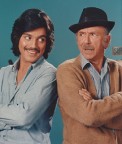 Freddie
Prinze Sr. (b. 1/28/1954, NY, d. 1/29/1977 (self-inflicted gunshot) Freddie
Prinze Sr. (b. 1/28/1954, NY, d. 1/29/1977 (self-inflicted gunshot)Actor, Comedian The son of a Puerto Rican mother
and a Hungarian father (A Hungarican as Freddie would say), Freddie
Prinze was a 20 year-old stand-up comedian when he earned a spot on
the TV sitcom, Chico and the Man. The show made its debut in
1974, was a ratings success, and by 1977 Prinze was one of the biggest
stars on TV. At the height of his popularity, despondent over personal
problems and apparently under the influence of drugs, he shot himself
in the head and died several hours later. - See Who2.com, The
Freddie Prinze Sr. "Chico" Homepage, or his filmography
at IMDB |
||||||
 Freddie
Prinze, Jr. (b. 3/8/1976, Albuquerque, New Mexico, USA) Freddie
Prinze, Jr. (b. 3/8/1976, Albuquerque, New Mexico, USA)Actor and Heart-Throb! "Young Hollywood's Leading Man" After starting out in television, Freddie Prinze, Jr. made his big screen debut opposite Claire Danes in 1996's To Gillian On Her 37th Birthday. In 1997 he starred in the horror film I Know What You Did Last Summer, and its success made Prinze a star. (He also appeared in the 1998 sequel.) By 2001 he had made more than a dozen movies, including the hit teen romance She's All That and Head Over Heels (2001). In April of 2001 Prinze became engaged to actress Sarah Michelle Gellar; the two co-star in the 2002 live-action film of the cartoon Scooby Doo He enjoys Martial arts and was listed on On People's 'Best-Dressed' and '50 Most Beautiful People' lists. See the very well-designed I Love Freddie.com (or directly to their Photo Gallery), Who2.com or more at IMDB |
||||||
 Jules
White (b. 1900 Budapest, d. 1985) Jules
White (b. 1900 Budapest, d. 1985)Four-time Oscar-Nominated Producer / Director of "The Three Stooges" and More!
- See his production
credits or |
||||||
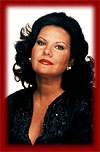 Éva
Márton - (b. 1943, Budapest) Éva
Márton - (b. 1943, Budapest) Heavenly Soprano Internationally celebrated as one of opera's greatest singers today. Eva began singing in the children's choir of the government's radio station, which she eventually left to begin serious training as a soloist. She entered the Franz Liszt Academy and finished with a diploma in both opera and vocal teaching. She made her professional debut as Kate Pinkerton in Madame Butterfly at the Summer Festival of Margaret Island, and this, in turn, led to a scholarship at the Hungarian State Opera. In 1972, after her phenomenal success in Hungary, she was invited by fellow Hungarian listee Christoph von Dohnanyi to make her debut as the Countess in Le Nozze di Figaro at the Frankfurt Opera. Her international fame was now assured. From 1981 to 1986 she was selected three times among the best artists of the year by the New York Times. Eva has also become one of the most recorded artists. She has more than 20 complete operas to her credit, as well as solo recital programs, aria albums, and symphonic works. - Special thanks to EvaMarton.com for her picture and biographical information (this great site includes
contact information, music clips, and much more). |
||||||
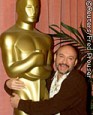 Frank
Darabont (b. 1/28/1959, Montbeliard, France) Frank
Darabont (b. 1/28/1959, Montbeliard, France)Director/Writer - Two Oscar Nominations for The Green Mile, "One of the best writer/directors of his generation" Frank Darabont's parents fled Hungary during the 1956 revolution and settled in a French refugee camp, where he was born. He came to the US while still an infant and settled in Chicago. From IMDB.com: The two-time writer Academy Award nominee made his debut in the movie industries beginning first in writing horror movies including The Blob (1988), Nightmare On Elm Street 3: Dream Warriors, A (1987), & The Fly II (1989), and one episode of "Tales from the Crypt" (1989). Frank is a close friend of two of the biggest directors of the movie industries, George Lucas & Steven Spielberg both of whom he worked for at some time. Frank wrote some episodes of Lucas's TV-series "Young Indiana Jones Chronicles, The" (1992). He worked on the Frankenstein (1994) script. His adaptation of Stephen King's serialized novel The Green Mile (1999), starring Tom Hanks, was nominated for four Academy Awards including Best Picture. The death row drama follows his powerful Shawshank Redemption. His latest success was "The Majestic." He is busy on upcoming blockbusters. - See more on IMDB,
including filmography and photo gallery |
||||||
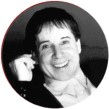 Paul
Frederic Simon (b. October 13, 1941 in Newark, New Jersey) Paul
Frederic Simon (b. October 13, 1941 in Newark, New Jersey)Musician, Singer, Songwriter - American Legend of "Simon & Garfunkel" fame! 12 Grammys and Rock-n-Roll Hall of Famer.
Paul's parents were Hungarian Jews, Louis and Belle Simon. His father was a bass player bandleader who appeared on CBS-TV's Arthur Godfrey, Jackie Gleason and Gary Moore shows, sometimes under the name Lee Sims. He later went back to school to earn his master's degree in teaching, and taught at New York Community College. His mother was a high school English teacher before her children were born. Paul Simon grew up in Queens, New York City, and attended Forest Hills High School alongside Art Garfunkel. The friends together sang Paul's first song, "The Girls for Me," when they were both 15. Billed as Tom and Jerry, the two had their first hit record at 16: "Hey Schoolgirl," a disarmingly romantic rocker that got the boys their first gig on "American Bandstand" as well as their first appearance on the Billboard charts. Tom and Jerry went their separate ways after high school, but Simon and Garfunkel soon got together again and American music would never be the same. - See the Kennedy Center Honors |
||||||
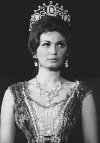 Sylvia
Sass - (b. Near Budapest, 1951) Sylvia
Sass - (b. Near Budapest, 1951)Another Heavenly Soprano, "the New Callas" Sylvia Sass (pronounced shush) was born into a very musical family. Her mother was a coloratura soprano and her father was a high school music teacher. At the age of 14, Sass made her stage debut with the school orchestra in Adam's operetta Nurnberger Puppe. Soon after, she studied music at Hungary's Liszt Academy, where she completed a five-year program in just two years. She then began her seven-year stay with the Hungarian State Opera. This led to her professional debut as Frasquita in Carmen in 1971. By the age of 25 was already being heralded as the new Callas, who she met many times. She has been honored with many awards, her first in 1972 when she won first prize at the Kodály Voice Competition in Budapest. In 1973, she won the Grand Prix as Violetta in La Traviata at the International Opera Competition for Young Singers. In 1974. she won the Silver Medal (there was no First Prize) at the International Tchaikovsky Competition in Moscow. She was also made an Honored Artist of Hungary in 1977. Someone once said to her, "I hear that you're the new Maria Callas." Sass replied by saying, "No, I am the first Sylvia Sass." - See Sylvia
Sass for more details |
||||||
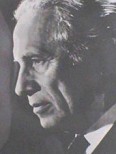 Antal
Doráti - (b. 4/9/1906, Budapest, d. 11/13/1988, Gerzensee,
Switzerland) Antal
Doráti - (b. 4/9/1906, Budapest, d. 11/13/1988, Gerzensee,
Switzerland) Acclaimed Conductor and Composer Antal Dorati rose to become the youngest ever conductor of the Royal Opera House in his native city soon after graduating at age 18. In 1928 he went to Dresden as assistant to Fritz Busch and subsequently was engaged as conductor at the opera house in Münster / Westfalia, where he stayed until 1933. From 1934-1941 he was first second conductor, later music director of the Ballet Russe de Monte Carlo and, subsequently, of the American Ballet Theater in New York. His American debut as a symphony conductor came in 1937, when he guest-conducted the National Symphony in Washington, D.C. He became an American citizen in 1947. From 1945-1949 Doráti directed and greatly revitalized the Dallas Symphony. He became music director of the Minneapolis Symphony in 1949, where he stayed for 11 years. In 1963 he was appointed Chief conductor of the BBC Orchestra, a post he held for 4 years. This was followed by a similar position with the Stockholm Philharmonic Orchestra (from 1965-1972). Parallel to his European activities he became music director of the National Symphony in Washington in 1970, followed by the same position 1977 in Detroit. At the same time (since 1975) Antal Doráti accepted the Royal Philharmonic's invitation to become their chief conductor. From 1981 he became "Conductor Laureate" for life of 3 orchestras (RPO London, Stockholm Philharmonic and Detroit Symphony). He was also a prolific and quite individual composer; he studied with Kodaly and Leo Weiner. - Visit his International Homepage |
||||||
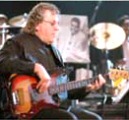 Bob
Babbitt (b. Pittsburgh, PA) Bob
Babbitt (b. Pittsburgh, PA)Legendary, Two-time Grammy-award winning Electric Bass Player earning 25 Gold and platinum records playing on over 200 top 40 hits. An "Icon of the Groove" helping to "define the era of the 1960's." Part of the Funk Brothers: "the Greatest Hit Machine in Modern Music."
Bob was the bass groove behind some of my favorite tunes including Marvin Gaye's "Mercy, Mercy, Me," Gladys Knight's "Midnight Train to Georgia," Smokey Robinson's "Tears of a Clown," Robert Palmer's "Every Kind of People," and the Spinners' "Rubber Band Man."
Bob studied at the Detroit Institute Of Arts, majoring in Harmony & Theory for Bass. - Bob appeared as himself in the critically acclaimed
documentary "Standing
in the Shadows of Motown." Watch the movie trailer and see
him play! The film won Best Documentary at the National Society of
Film Critics in 2002. It also won the New York Film Critics Circle
in 2002. |
||||||
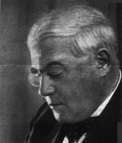 Ferenc
Molnár - (1/12/1878, Budapest - 4/2/1952, New York) Ferenc
Molnár - (1/12/1878, Budapest - 4/2/1952, New York) Playwright Ferenc Molnar studied criminal law in Budapest and Geneva and became a journalist for the Budapest newspaper Budapesti Napló as the full-time Paris correspondent. In 1901, after writing a number of short stories, he published his first book, The Hungry City, a story of dirty politics, corruption, social inequality and anti-semitism and became the the darling of Budapest café society. Molnár was the ringleader of a circle of artists and musicians in Budapest. They were called "The Elastics," because they wore a new kind of laceless shoe with elastic on the side. The group comprised of young playwrights, writers of farce and light comedy, as well as some musicians, operetta composers and conductors from operetta and musical theatres. A friend commissioned him to write a play for the National Theatre, a farce. Although this play, The Lawyer, was never performed at the National Theatre, it played in 1902 at the new Comedy Theatre and audiences demanded more from Molnár. But he wanted to write something more serious, so he wrote The Devil, which was very modern, slightly Freudian and very titillating (in fact, it was banned in London) and brought him international acclaim. His most famous work, Liliom, was translated to English and performed in 1926 in London with Charles Laughton. He moved to New York in 1939, one of the many talented immigrants that were part of the "Hungarian Invasion" of New York Theatre, and Liliom was revived to rave reviews. Liliom provided the plot for Rodgers' and Hammerstein's famed musical, "Carousel" which debuted in 1945. Some of his plays were adapted for the Big Screen, including The Swan, starring Grace Kelly, Charles Vidor, Alec Guiness, and Louis Jourdan. - Read more at The
Play's the Thing |
||||||
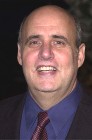 Jeffrey
Tambor (b. 7/8/1944, San Franciso, CA) Jeffrey
Tambor (b. 7/8/1944, San Franciso, CA)Actor Large-framed and prematurely bald, American actor Jeffrey Tambor excelled in character parts from the time he was draft age. Tambor spent nearly two decades in regional theatre, appearing in the classic comedy roles (his favorite was Aguecheek from Twelfth Night: "One hundred lines, one hundred laughs"). While his propensity for scene-stealing did not always endear him to his fellow actors, Tambor was able to matriculate to films and television by the end of the '70s. He was occasionally seen on the early-'80s police drama Hill Street Blues as cross-dressing attorney (and later judge) Alan Wachtel. He was in his mid-thirties when he made his film debut in the Al Pacino courtroom vehicle, …And Jutice for All (1979). His film roles usually consisted of corporate blowhards and backstabbing CEOS (e.g. 1983's Mister Mom). In 1986, Tambor starred in the situation comedy Mister Sunshine, playing a blind English professor (the series' gratuitous slapstick, which Tambor invariably performed brilliantly, incurred the wrath of several professional advocates for the sightless). Some of Tambor's more notable subsequent films include City Slickers (1991), Life Stinks (1991) (as Mel Brooks's villainous rival), Dr. Dolittle (1998), and Dr. Seuss' How The Grinch Stole Christmas (2000) and Pollock (2000). More recently, Jeffrey Tambor has been seen as the Uriah Heep-ish sidekick of scabrous talk show host Garry Shandling in cable TV's The Larry Sanders Show. A quote: - See this article from the LA
Times or |
||||||
 Drew Barrymore - (b. 2/22/1975, Culver
City, California) Drew Barrymore - (b. 2/22/1975, Culver
City, California) Actress, Model, Producer, Philanthropist, America's Sweetheart Her mother is actress and "wild child" Ildiko Jaid Mako. While waitressing at the Troubadour, a music club on Santa Monica Blvd., Ildiko met John Barrymore Jr. They dated for 5 years (from 1970-1975) when they gave birth to their child, Drew Blythe Barrymore. John was abusive and Jaid left him before Drew was born. Normalcy for Drew would be hard to come by... This international superstar of the legendary Barrymore family appeared in her first TV commercial for Puppy Choice dog food before her first birthday. At the ripe old age of 11 months she made her first TV appearance when she appeared in a dog food commercial. At the age of two she made her first TV movie, playing a boy in Suddenly, Love. Her first feature film happened at age five when the young Barrymore apeared in Altered States. Two years later Drew landed her most famous role playing Gertie in the hugely popular E.T. The Extra-Terrestrial. Appearing in one of the top films of all time helps to put an actress on the map. In 1984, Drew appeared in Firestarter and earned a Golden Globe nomination for her role in Irreconcilable Differences. That's when things started to go bad for Drew. At age 9, she was drunk at a party thrown for Rob Lowe. At age 10, she was smoking pot and by her thirteenth year she had escalated to cocaine. At an age when most teens are getting ready for high school, Drew was checking in to rehab. Drew felt she had finally beaten her demons and that same year she also legally declared herself free of her mother's control; the two had shared a rocky relationship for years. Clean and sixteen, Drew co-authored a book, Little Girl Lost, that chronicled her life so far. Drew now started working on getting her career back on track. In 1992, she turned in an incredible performance in the steamy thriller Poison Ivy. In October 1993, it was Drew Barrymore that surprised the world as the new "GUESS Girl." In 1995 she appeared in movies like Mad Love, Batman Forever, and Boys on the Side. In 1996 she appeared in the teen horror parody Scream and worked opposite Edward Norton in Woody Allen's Everyone Says I Love You. She teamed up with Adam Sandler in 1998 to appear in the wildly popular hit The Wedding Singer and ended the year with a strong performance in Ever After. The now hard-working actress turned her hand to producing as well. In 1999 she produced and starred in both Never Been Kissed and in 2000 Charlie's Angels which co-starred Cameron Diaz and Lucy Liu. In 2001 she produced Donnie Darko and starred in Riding in Cars with Boys. Flower Films is her sown production company, . Trivia:
- See filmography, details, pictures and more at IMDB |
||||||
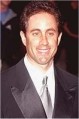 Jerry
Seinfeld (b. 4/29/1954, Brooklyn, NY) Jerry
Seinfeld (b. 4/29/1954, Brooklyn, NY)Actor / Comedian: American Icon! The most successful and influential comedian of his generation! Critically acclaimed and successful as a stand-up comic, television actor, best-selling author and advertising pitchman, Jerry was born to Hungarian Kalman Seinfeld, a signmaker, and his wife, Betty. Jerry was the second of the couple's two children. The Seinfeld family moved to Long Island when Jerry was a child, and he spent most of his youth there. After graduating from high school, Seinfeld went on to college, first attending the State University of New York at Oswego, and then moving on to Queens College of the City University of New York, where he received a Bachelor's Degree in 1976. Seinfeld developed a keen interest in performing while in college (his degree from Queens was in communications and theater), and after graduation he began working New York comedy clubs, often without pay, while holding down a number of odd jobs. Seinfeld's first big break came when his bright but understated observational humor caught the eye of standup legend Rodney Dangerfield, who featured Seinfeld on a special for HBO. The exposure helped establish Seinfeld on the comedy club circuit, and won him a recurring role on the situation comedy Benson. In 1981, Seinfeld appeared for the first time on The Tonight Show, then hosted by Johnny Carson, and made a strong impression on both the audience and the host; he became a frequent guest on the Carson show, as well as David Letterman's late-night talk show. As Seinfeld's fame began to rise, he starred in several cable TV specials, and was approached to star in several TV series. Seinfeld and his good friend Larry David began working up an idea for a situation comedy to be called The Seinfeld Chronicles. In 1989, NBC took the bait, and a year later the show premiered under the streamlined name Seinfeld. Concerning standup comic Jerry Seinfeld and the often odd everyday occurrences of his circle of friends (many of whom were based on people Seinfeld and David knew in real life), Seinfeld got off to a slow start, but began to win a healthy audience in its second season, and in time became one of NBC's biggest hits. - See his filmography and more photos on Yahoo Movies or IMDB |
||||||
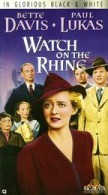 Paul
Lukas (b. Pál Lukács 5/26/1824, Budapest, d. 8/15/1971, Tangier,
Morocco) - Paul
Lukas (b. Pál Lukács 5/26/1824, Budapest, d. 8/15/1971, Tangier,
Morocco) - Actor, Oscar Winner for "Watch on the Rhine" Lukas trained for the stage at the Hungarian Actors Academy, and in 1916 he went to Kassa (now Kosice after Czech annexation) to become an actor, In 1918 he entered into engagement with the Theatre for Comedy and later debuted on the Budapest stage in Ferenc Molnár's "Liliom." He soon became Star of the Hungarian Stage and appeared in a number of Max Reinhardt productions before arriving in the US in 1927 and establishing himself as one of Hollywood's favorite suave European types. For a time in the early 1930s, the dapper Lukas was a romantic lead of films including "Strictly Dishonorable" (1931), "Little Women" (1933), "By Candlelight" (1933), and "The Fountain" (1934). The most notably exception to Lukas's roles during this period was his fine Oscar-winning lead performance (recreating his stage role) as a heroic resistance fighter in the well-intentioned but stodgy "Watch on the Rhine" (1943). During his later years Lukas played a number of gentler roles, keeping busy in "Twenty Thousand Leagues Under the Sea" (1954, as Prof. Aronnax) and "Tender Is the Night" (1962), but the gentlemanly if sometimes deceptive Continental suavity which was always his trademark never left him. - Buy Paul Lukas movies at Barnes
and Noble |
||||||
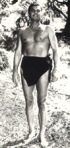 Johnny
Weissmuller (b. 6/2/1904, Szabadfalu (Freisdorf), Hungary, [awarded
to Rumania after WWI], d. 1/20/1984, Acapulco, Mexico) Johnny
Weissmuller (b. 6/2/1904, Szabadfalu (Freisdorf), Hungary, [awarded
to Rumania after WWI], d. 1/20/1984, Acapulco, Mexico)The one and only Tarzan and FIVE-time Gold Olympic swimming legend! "The greatest swimmer of all time" Johnny was born Janos Weiszmueller in Szabadfulu (Freetown or in German, Freidorf), near Temesvar [now Timisoara after Rumanian annexation] in the Banat region of Hungary where many "Schwabians" / "Donauschwaben" / "Danube Swabians" or ethnic Germans had settled after the pullout of the Ottoman Turks in the 17th century. His parents were Peter Weiszmueller, a day worker from Varjas, and Erzsebet Kersch, of Szabadfalu (the name for Freidorf at the time). His Godparents were Janos Borstner and Katharina Erbesz. The Weissmuller family arrived in New York on the S.S. Rotterdam on Jan 26, 1905 when Johnny was three. Johnny often claimed he was born in Windber, PA because of Olympic eligibility issues. Weissmuller was the winner of the 100m freestyle in 1924 and 1928 and a member of the winning 4x200m relay team in both years. He also won a bronze medal in the 1924 water polo competition at the Olympics. He broke three records at the 1924 Olympics in Paris. Weissmuller set 28 world records and such was his margin of superiority over his contemporaries that many authorities still rate him ahead of Mark Spitz as the greatest swimmer of all time. Because of the limited number of events available to Weissmuller, his Olympic record cannot be fairly compared with that of Spitz but the longevity of his records is a testament to his greatness. His 1927 world record for the 100 yard freestyle was unbeaten for 17 years, a remarkable length of time during a period of rapid development in the sport. From 1921-29 he won every free style race he entered. In addition to his Olympic Triumph, he won 18 Gold Medals at the USA National Championships (1921 - 1923,1925 -1928). Much of his success was due to his revolutionary high-riding stroke, flutter kick and head-turning breathing. After modeling BVD's and successfully playing a fig-leafed Adonis, MGM took notice and invited for a screen test for the role of Tarzan. Weissmuller was chosen over 150 other applicants and went on to become the most famous screen Tarzan of all, playing the role in 12 movies between 1932 and 1948. After 1942 MGM had used up its options; it dropped Tarzan and Weissmuller who then moved to RKO and made six more Tarzans. After that he made sixteen programmed Jungle Jim (1948) movies for Columbia, finally retiring from movies to private businesses in Fort Lauderdale FL. Weissmuller died in Acapulco, Mexico after a series of strokes. Trivia:
- See the International
Olympic Committee |
||||||
 András
Schiff - (b. 12/21/1953, Budapest) András
Schiff - (b. 12/21/1953, Budapest)Acclaimed Classical Pianist Andras Schiff occupies a prominent position among the world's leading musicians. Born in Budapest, Hungary in 1953, he began piano lessons at age five with Elisabeth Vadász and continued his musical studies at the Ferenc Liszt Academy with Professor Pál Kadosa, György Kurtág and Ferenc Rados. He also worked with George Malcolm in London. Among other honors, András Schiff was awarded the Bartók Prize in 1991 and the "Claudio Arrau Memorial Medal" from the Robert Schumann Society in Dusseldorf in 1994. In March 1996, Mr. Schiff received the highest Hungarian distinction, the "Kossuth Prize" and in May 1997, he received the "Leonie Sonnings Music Prize" in Copenhagen. He makes his home in Florence, Italy. - Read more |
||||||
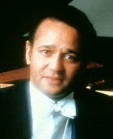 Andre
Watts - (b. 6/20/1946, Nürnberg, Germany) Andre
Watts - (b. 6/20/1946, Nürnberg, Germany) Acclaimed Classical Pianist - one of the "Great Pianists of the 20th Century" The first African-American concert pianist to achieve international superstardom. Critics have called Watts electrifying, sensational, daring, colorful, imaginative, powerful, and a supervirtuoso. André Watts is the son of an American career soldier stationed in Germany and a Hungarian refugee. Watts began studying the violin at age four. By the time he was six he made it known that his preference was for the piano, so his mother, a pianist herself, gave him his first lessons. As is frequently the case, he loved to play but hated to practice. When his habit persisted, his mother began relaying stories of her countryman, pianist and composer Franz Liszt, emphasizing the fact that he practiced faithfully. Liszt soon became Watts's hero, and he even adopted Liszt's bravura playing style. At 10 he performed a Haydn concerto with the Philadelphia Orchestra. He burst upon the music world at the age of 16, when Leonard Bernstein chose him to make his debut with the New York Philharmonic in their Young People’s Concerts, broadcast nationwide on CBS-TV. He became an overnight sensation. More than 30 years later, André Watts remains one of today’s most celebrated and beloved superstars. His performances each year with the world’s great orchestras and conductors and his sold-out recitals and appearances at the most prestigious international festivals bring him to every corner of the globe. A much-honored artist who has played before royalty in Europe and heads of government in nations all over the world, André Watts was selected to receive the Avery Fisher Prize in 1988. At age 26, he was the youngest person ever to receive an Honorary Doctorate from Yale University. - Read more at Cramer/Marder
Artists Agency or |
||||||
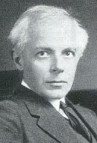 Béla
Bartók - (3/25/1881, Nagyszentmiklós, Hungary,
d. 9/26/1945, New York) Béla
Bartók - (3/25/1881, Nagyszentmiklós, Hungary,
d. 9/26/1945, New York) Composer, ethnomusicologist Bela Bartok was one of the most significant musicians of the twentieth century. He shared with his friend Zoltán Kodály, another leading Hungarian composer, a passion for ethnomusicology. His music was invigorated by the themes, modes, and rhythmic patterns of the Hungarian and other folk music traditions he studied, which he synthesized with influences from his contemporaries into his own distinctive style. Bartók grew up in that part of Hungary annexed by Rumania at the Treaty of Trianon after World War I. His birthplace, Nagyszentmiklós (Great St Nicholas), in Transylvania, became Sînnicolau Mare, Romania. In 1894, Pozsony (now called Bratislava after Slovakia was created out of Northern Hungary) the former Hungarian Capital, became their new home. He attended school, studied the piano with Laszlo Erkel and Anton Hyrtl, and composed sonatas and quartets. In 1898 he was accepted by the Vienna Conservatory, but decided rather to attend the Budapest Academy, where he studied the piano as a pupil of Franz Liszt as well as studying composition. He deepened his acquaintance with Richard Wagner during these times, though it was the music of Richard Strauss, who he met at the Budapest premiere, that had most influence. He wrote a symphonic poem, Kossuth, using Strauss's methods combined with Hungarian elements in Liszt's manner. Trivia: Béla showed precocious musical ability and began to compose dances at the age of nine. - See Thinkquest |
||||||
Along with Bartók and
Ligeti, Zoltan Kodaly is one of the three major figures in Hungarian
music this century. Kodály's many compositions show a strong affinity
with the folk traditions of his country and include ballad operas,
orchestral works, chamber music, choral works, songs, folk song arrangements
and music for children.
Kodály was born in Kecskemét, a small town in central Hungary. Much of his childhood was spent in the Hungarian villages. It was here that Kodály developed a great love for the Hungarian countryside and for the folk traditions of his culture.From a young age Kodály showed great aptitude and interest in music. His father, an amateur musician, encouraged this interest, particularly the young boy's interest in composition. By the time Kodály reached secondary school he was composing his own music. After completing his school education, Kodály studied at The Franz List Academy (Hungary's most prestigious music institution) where he met Bela Bartok with whom they collected Magyar folk music, elements of which they would eventually use in their compositions. He later attended the University of Hungary where he earned a degree in Hungarian, German and then, later, a Doctor of Philosophy in linguistics. As a composer, Kodály did much to bridge the gap between Hungarian folk music and the European art music tradition. In later years Kodály was president of the Hungarian Academy of Sciences, president of The International Folk Music Council, and honorary president of the International Society for Music Education. Trivia: His hand
signals teaching method was seen in the movie Close Encounters
of the Third Kind
- Read more at Emory
University |
||||||
 Edward
James Olmos (b. 2/24/1947, East Lost Angeles, California, USA) Edward
James Olmos (b. 2/24/1947, East Lost Angeles, California, USA)Oscar and Tony Nominated and Emmy Award Winning Actor, Producer, Director, and Activist. The "Olivier of the Latino World" and People's 2000 Sexiest Man Alive
Olmos spent nine years trying to establish himself
as an actor, making his film debut (billing himself as Eddie Olmos)
as an extra in Aloha, Bobby and Rose in 1975. Prior to that, Olmos
had worked as a bit player and extra in several early '70s television
shows ranging from Medical Center to Hawaii Five-O.
In 1979, he made a splash on Broadway playing Pachuco in Luis Valdez's Zoot
Suit. The play was originally staged in L.A. and represented the
first time in which Olmos was paid to act on-stage. During the show's
New York run, Olmos earned a Tony Nomination and a Drama Critics Circle
Award. In 1982, he played a creepy police detective in Blade
Runner. Olmos became a star when he played the super-pragmatic
Lieutenant Castillo on the hip police drama Miami
Vice (1984-1989) and in 1985 won an Emmy for his efforts. He earned
an Oscar nomination for his inspirational performance as a determined
teacher who helps a troubled group of urban kids excel in math and
science in Stand
and Deliver (1986). He made his Olmos' humanitarian activities include acting as a United States Goodwill Ambassador for UNICEF, being the national spokesman for the Juvenile Diabetes Foundation, serving a place on the boards of the Miami and Los Angeles Children's Hospitals, serving as the executive director of the Hazard Education Project, and contributing to the foundation for the Advancement of Silence and Education. For his many good works, Olmos has received Honorary Doctorates from five educational institutions including the University of Colorado, California State University at Fresno, and the American Film Institute in Hollywood. - Visit the Edward
James Olmos Page |
||||||
 Robert
Capa - Robert
Capa - Acclaimed Photojournalist (b. Endre Erno Friedmann, Budapest, 1913, d. May 25, 1954 (Thai Binh, Vietnam). "One of the greatest photojournalists of the 20th century" - Brittanica "The Greatest War Photographer in the World: Robert Capa"- Picture Post
His most famous photo is of the "Falling Soldier, " from the Spanish Civil War in 1936 published in Life magazine in 1937. He was one of the co-founders of the Magnum photo agency. His brother, Cornell Capa, is current director of the International Photography Centre in New York. Trivia: Famous love affair with Ingrid Bergman -1945 Pierce Brosnan will soon portray Robert Capa in "Blood and Champagne" |
||||||
 Éva
Gárdos Éva
GárdosAcclaimed Screenwriter, Director, and Editor Eva Gardos grew up in rural communist Hungary in the 1950s, away from film and television. She began her film career as an editor on 1983’s Valley Girl and later worked on films such as Mask, Barfly, Valleygirl, Tales from the Crypt, and Time of the Butterflies. An American Rhapsody marked Eva’s debut as both a screenwriter and director. Her screenplay, a semi-biographical tale depicting the personal odyssey of a family's escape from Communist Hungary on which she worked for seven years, won the prestigious Hartley-Merrill International Screenwriting Prize. The award led production company Seven Arts International (now Fireworks Pictures) to greenlight her as director. An American Rhapsody won both the Audience Award for Best Feature, and the Perrier Bubbling Under Award for promising first-time directors at the 2001 Nantucket Film Festival. Buy her videos at Barnes & Noble |
||||||
 Leslie
Howard - (b. 4/3/1893, London, d. 6/1/1943, Bay of Biscay ,casualty
of war) Leslie
Howard - (b. 4/3/1893, London, d. 6/1/1943, Bay of Biscay ,casualty
of war) Actor (born Lászlo Steiner). See on the left in 'Gone With the Wind." He was born to Hungarian parents, Lilian and Frank Steiner, in London. Frank worked as a stockbroker. Leslie's younger years were spent in Vienna. After school, Leslie worked as a bank clerk until the outbreak of World War I. In 1917, diagnosed as shell shocked, he was mustered out and advised to take up acting as therapy. In a few years, his name was known on the stages of London and New York. He became known as the perfect Englishman, slim, tall, intellectual and sensitive, a part that he would play in many movies and a part women would dream about. He made his first movie in 1930, 'Outward Bound', a film adaptation of his stage performance of the same name. In 'Never the Twain Shall Meet (1931)' and 'Smilin Through (1932)', he was playing the Englishman role to the hilt. His screen persona could perhaps be best summed up by his role as Sir Percy Blakeney in 'The Scarlet Pimpernel (1934)', a foppish member of society. It was Leslie who insisted that Humphrey Bogart get the role of Duke Mantee, in 'The Petrified Forest (1936), the character that Bogart played in the stage production. With success, he became quite picky about which roles he would do and usually did but two films per year. In 1939, he would play the character that would always be associated with him - that of Ashley Wilkes, the honor bound disillusioned intellectual southern gentleman in 'Gone with the Wind'. But war clouds were gathering over England and Leslie devoted all his energy on behalf of the war effort. He directed films, wrote articles and made radio broadcasts. Howard returned to his native England after World War 2 began, and was shot down by Nazi fighter planes while flying from Portugal in 1943. Trivia:
See above and much more at the IMDB |
||||||
| Goldie Hawn - Very Cute Actress and Academy Award Nominee for Private Benjamin. Tentative honoree - NEED ADDITIONAL VERIFICATION RESOURCES. |
||||||
 André
Kertész (b. Budapest, 1894 - d. New York, 1985) André
Kertész (b. Budapest, 1894 - d. New York, 1985)Acclaimed photographer One of the pioneers of "street photography." He said, "technique is unimportant," "it is important to think." With a small camera he captured the poetic and absurdity of ordinary life. A major force, he made his mark on different kinds of photography, making documentary an art form. Kertesz began taking pictures when he was sixteen. He was called to arms in World War I and took his camera with him. These early war photos set him apart as he captured images not of blood and war, but often the tender side of the lives of ordinary soldiers. In 1925 he moved to Paris, where he met and photographed painters and writers. In 1927 he presented the first one-man photographic exhibition ever held. From About.com: The photographs of Andre Kertesz can be found in several collections: the Detroit Institute of Arts, Museum of Modern Art, Harvard University, University of Kansas Museum of Art, Mint Museum of Art, the Smithsonian Institution, Wellesley College Museum and Pompidou Center to name a few. - Read the full About.com article or |
||||||
 Debra
Winger - (b. 5/16/1955, Cleveland) Debra
Winger - (b. 5/16/1955, Cleveland) Actress - 2 Oscar Nominations! In 1961, her family left Cleveland for sunny California when she was 6 years old. As a teenager, she emigrated to Israel, where she worked for two years on a collective farm and served in the Army. Upon returning to the States, she was involved in a serious accident that left her in a coma. Partially paralyzed and blinded in one eye for several months, Winger thought long and hard about where her life was going, and decided that upon recuperating she would become an actress. She did, making several commercials before being cast as Lynda Carter's little sister Drusilla on the popular "Wonder Woman" TV series. Her determination has paid off with a successful career that includes starring roles in "Urban Cowboy," "Legal Eagles," "Betrayed," "Black Widow," and Oscar Nominated performances in "An Officer and a Gentleman" and "Shadowlands." See more at IMDB or at Debra Winger |
||||||
 Jamie
Lee Curtis (b. 11/22/1958) Jamie
Lee Curtis (b. 11/22/1958)Actress...Best Legs in Hollywood? Jamie Lee Curtis was born to legendary parents Janet Leigh and Tony Curtis. She got her big break at acting in 1978 when she won the role of Laurie Strode in Halloween (1978) and rose to cult stardom playing the straightlaced teenage baby sitter imperiled by an unknown slasher. After that she became very famous for roles in movies like Trading Places (1983), Perfect (1985), and A Fish Called Wanda (1988). She soon starred in one of the biggest action films ever, True Lies (1994) in which she won a Golden Globe for her performance. In 1998 she starred in Halloween H20: Twenty Years Later (1998) in which she reprised her role that made her famous back in 1978. She then appeared in Virus in 1991 and Tailor of Panama in 2001. Trivia:
- For more biographical info., visit Mr.Showbiz or |
||||||
 Kelly
Curtis (b. 61/17/1956, Santa Monica, CA) Kelly
Curtis (b. 61/17/1956, Santa Monica, CA)Actress Sister of Jamie Lee, and first child of Tony Curtis and Janet Leigh, Kelly Lee Curtis appeared with her sister in Trading Places as Muffy. She as appeared in screen and television films, including "The Sentinel" as Lieutenant Carolyn Plummer, "The Devil's Daughter (AKA The Sect)," "Search and Rescue," "Thanksgiving Day," and "Almost Famous." She also appeared in "Star Trek: deep Space Nine" and "Silk Stalkings." - See her full filmography and TV appearances at IMDB |
||||||
 Eugene
(Jenö) Ormándy - (b.11/18/1899, Budapest, Hungary, d. 3/12/1985,
Philadelphia) Eugene
(Jenö) Ormándy - (b.11/18/1899, Budapest, Hungary, d. 3/12/1985,
Philadelphia) Renowned Conductor (Philadelphia) One of the most famous conductors in musical history, Ormandy graduated from the Budapest Royal Academy, where he studied violin with Jenö Hubay, an eminent Hungarian violinist. By the time he was 17, Ormandy was a professor of violin himself and performed in concerts throughout Central Europe. In 1921, Ormandy traveled to the United States for a concert tour. Once in America, however, he cancelled the tour and became a violinist in the orchestra of the Capitol Theater in New York City. During his tenure with this orchestra, Ormandy began his career as a conductor. He performed light classics for radio, as well as summer concerts. This led to a position as deputy for Arturo Toscanini during a major concert series of the Philadelphia Orchestra. From 1931 to 1936 Ormandy conducted the Minneapolis Symphony Orchestra, achieving national recognition with a series of recordings. In 1936, he returned to the Philadelphia Orchestra where he shared the conductorship with Leopold Stokowski. Two years later, Ormandy became principal conductor of the Philadelphia Orchestra, a position he held until his retirement in 1980. Acclaimed for his interpretations of 19th-century music, he was known to conduct all scores from memory. He emphasized rich orchestral tones and developed fine, velvety string playing that became his trademark. Under his direction, the Philadelphia Orchestra became known for its warm, textured romantic "Philadelphia Sound." - See the Eugene Ormandy Pages for CD's and much more. |
||||||
 Lászlo
Kovács ASC - (b. May 14, 1933, Hungary) Lászlo
Kovács ASC - (b. May 14, 1933, Hungary) Legendary Cinematographer.
International Film Festivals have celebrated "the extraordinary impact Kovacs has made in advancing the art of filmmaking." They also cited his influence on young filmmakers in every part of the world. Laszlo Kovacs has compiled more than 60 narrative films credits, including Easy Rider, Five Easy Pieces, Paper Moon, Close Encounters of the Third Kind, Shampoo, The Rose, New York, New York, What’s Up Doc?, The Last Waltz, The Runner Stumbles, Ghostbusters, The Mask, Little Nikita, F.I.S.T., Blow Out, Legal Eagles, My Best Friend’s Wedding, Return to Me, Copycat, Multiplicity, Sliver, and Miss Congeniality. Kovacs was born and raised in Hungary during the World War II Nazi occupation of his native land. His parents were farmers, who lived in a small village some 60 miles from Budapest. Despite his penchant for skipping school to go to the movies and a less-than-perfect academic record, Kovacs, on his second try, was accepted at the Academy of Drama and Film Art in Budapest, where George Illes, a legendary Hungarian filmmaker and head of the cinema department, took him under his wing. Kovacs was in his final year at school in 1956, when a spontaneous revolt that began on the streets of Budapest seemed to be on the verge of moderating the communist regime. Kovacs and Vilmos Zsigmond, ASC, a recent graduate, borrowed a 35mm camera from the school, along with a generous supply of film. They used the camera to document incredible acts of bravery as citizens armed only with homemade weapons tried to stop Soviet tanks and soldiers when they poured into the city en masse and brutally crushed the revolt. Kovacs and Zsigmond were forced to flee or face severe reprisals at the hands of the invading Russians. They arrived together in the U.S. as political refugees in 1957. Kovacs worked his way up from prints to documentaries and a low budget Western. His talents were noticed and he was introduced to Robert Altman and Peter Bogdanovich with whom he worked on a number of their earliest films. In 1969, Lewis introduced Kovacs to Dennis Hopper who was getting ready to shoot a film with Peter Fonda and Jack Nicholson. The reluctant Kovacs agreed to film "Easy Rider" and the rest is history! Trivia: Wears a T-Shirt that says "I am not Vilmos" (Acclaimed Cinematographer friend and colleague, Vilmos Zsigmond that is!) - Read above excerpt in more detail at The
International Cinematographer's Guild |
||||||
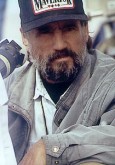 Vilmos
Zsigmond (ASC) - (b. June 16, 1930, Szeged, Hungary) Vilmos
Zsigmond (ASC) - (b. June 16, 1930, Szeged, Hungary) Legendary Cinematographer - Oscar Winner and Multiple Oscar Nominations! First cinematographer to use the Panaflex camera on a movie -- "The Sugarland Express." From Cinequest.org - "...Son of a celebrated soccer player and coach, Zsigmond developed an interest in photography while in high school. After his graduation from the State University of Motion Picture and Theater Arts in Budapest (with friend Laszlo Kovacs), the Hungarian Revolution hit. [Along with Laszlo Kovacs, he filmed footage of the 1956 Hungarian revolution, supposedly with a camera concealed in a shopping bag.] His escape from the country and pilgrimage to the United States were underway. Eventually making connections with U.S. filmmakers, Zsigmond had the chance to develop his new style of lighting-a combination of the "old" classical style and the "new" flexible soft lighting. Zsigmond's evocative look and "altering eye" found outlets in such masterpieces as John Boorman's Deliverance (1972), Mark Rydell's The Rose (1979), Richard Donner's Maverick (1994), Sean Penn's The Crossing Guard (1994) and Steven Hopkins' The Ghost and the Darkness (1996). His long-overdue Academy Award came in 1977, with his powerful achievements on Steven Spielberg's Close Encounters of the Third Kind. The following year found Zsigmond's dark and disturbing work on Michael Cimino's The Deer Hunter (1978) receiving an Oscar nomination, and another nomination appeared for the daring and powerful look he brought to Mark Rydell's The River (1983)." Trivia: Wears a T-Shirt that says "I am not Laszlo" (Acclaimed Cinematographer friend and colleague, Laszlo Kovacs that is!) - See his Filmography and more at IMDB.com |
||||||
 István
Szabó (b. 2/18/1938, Budapest) István
Szabó (b. 2/18/1938, Budapest)Director, Writer, Producer - Academy Award in 1981 Though he stayed home in Hungary, he won an Academy Award in 1981 for his acclaimed film "Mephisto." Other recent credits include "Sunshine," "Meeting Venus," and "Oberst Redl." See his filmography and more at IMDB |
||||||
| Beatrix Aruna Pasztor - (b. Budapest,
Hungary) Costume Designer Beatrix (Beáta) studied at the Academy of Applied Arts, graduating in 1984. While finishing her diploma, she designed couture shoes and costumes for theatrical productions and constructed Bauhaus costumes for Carlos Godzi's 15th century play The Deer King. These costumes became part of the first Hungarian theatre exhibition to travel throughout Eastern Europe. She moved to New York in 1984 to pursue her career, and earned a living as a hat designer and a window display dresser at Bloomingdale's and Henry Bendel's before landing jobs on low-budget films in New York. In 1988 she relocated to Los Angeles and soon found great success. Altogether, Pasztor has designed costumes for 20 feature films including Psycho, Indecent Proposal, An American Rhapsody, John Q, Monkeybone, She's So Lovely, Drugstore Cowboy, U-Turn, Excess Baggage, Bad Company, The Fisher King, My Own Private Idaho, A Dog of Flanders, Even Cowgirls Get the Blues, To Die For, and Good Will Hunting. - See Psycho:
The Production |
||||||
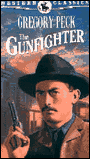 Andre
de Toth (a.k.a. Tóth Endre, b. May 15, Mako, Hungary, 1913) Andre
de Toth (a.k.a. Tóth Endre, b. May 15, Mako, Hungary, 1913)Director - Oscar Nomination, "The Gunfighter" The son of a Hungarian military officer, Andre De Toth studied law at the Royal Hungarian University in Budapest. His academic career was shelved when De Toth became involved with the Hungarian film industry, where he served in several artistic and technical capacities before graduating to director in 1938. After completing five features in the space of one year, he was brought to England by fellow Hungarian Alexander Korda, who hired De Toth as second unit director on The Thief of Baghdad (1940). Then he moved to Hollywood and worked again for Korda shooting second-unit for Jungle Book (1942). A full-fledged Hollywood director by 1943, De Toth specialized in westerns and adventure films; one of these, Slattery's Hurricane (1949), co-starred the director's then-wife Veronica Lake, whose fame was diminishing even as her husband's was descending. Andre de Toth's second American production, None Shall Escape in 1944, was a remarkable achievement, an intense, at times almost harrowing, experience that deals with the issue of what to do with Nazi war criminals-not on an impersonal level, as did Judgment at Nuremberg a few years later, but on a one-to-one basis. De Toth is also well known for his embrace of 3-D films of the 1950s, House of Wax (1953) and The Stranger Wore a Gun (1953); the fact that De Toth had lost one eye did not diminish his lifelong fascination with stereoscopic photography, nor his expertise in this field. In 1950, De Toth was nominated for an Oscar for his work on the screenplay of The Gunfighter (1950). Though his last official directorial credit was for 1970's El Condor, De Toth made several significant (and uncredited) contributions to the 1978 big-budgeter Superman: The Movie. Arguably de Toth's greatest American films are two of his last, Day of the Outlaw and Play Dirty. In 1994, Andre De Toth published Fragments a memoir. - See his Filmography and more at IMDB.com |
||||||
| Dezsö Magyar (b. Hungary) Director / Screenwriter: Chair, American Film Institute Conservatory, Master Filmmaker-in-Residence: Directing From
The American Film Institute: Magyar was Director of the AFI Conservatory between 1989 and 1994. In 1994, he left to become Artistic Director of the Canadian Film Centre (chaired by Norman Jewison) where he oversaw curriculum, faculty and production of short dramatic films. He was also Executive Producer of the Canadian Feature Film Project, the producer of such acclaimed films as Cube, Rude, Klutch, and Uncles. Magyar returned and was named chair of the AFI Conservatory in June of 2000. See AFI |
||||||
 Lajos
Koltai, HSC, ASC (b. 4/2/1946, Budapest) Lajos
Koltai, HSC, ASC (b. 4/2/1946, Budapest)Cinematographer - Oscar Nomination for "Malèna" and worked on numerous Oscar-Nominated Films Lajos shot his first Super 8 film during a family vacation when he was 14 years old. After that experience, Koltai began writing, directing and shooting "little films" starring his friends and family. One year, he won first and second prize at an amateur film festival where a promising young director named Istvan Szabo headed the jury. Koltai graduated from the School of Drama and Film in Budapest, which also nurtured Vilmos Zsigmond, ASC and Laszlo Kovacs, ASC. Koltai subsequently shot many films with Szabo including the Oscar-winning Mephisto, the Oscar-nominated Confidence, Colonel Redl, and most recently the epic multi-generational family story Sunshine that earned cinematography prizes in Europe. His body of work also includes Time Stands Still, Taking Sides, White Palace, Wrestling Ernest Hemingway, Born Yesterday, When a Man Loves a Woman, Home for the Holidays and Just Cause, among an eclectic blend of more than 60 European and United States-made films. Current projects are "Max" with John Cusack, and "The Palace Thief" with Kevin Kline. See his filmography at IMDB |
||||||
 Sir
Alexander Korda - (b. Sandor Laszlo Kellner, Turkeve, Hungary,
9/16/1893, d. January, 1956) Sir
Alexander Korda - (b. Sandor Laszlo Kellner, Turkeve, Hungary,
9/16/1893, d. January, 1956) Legendary, Oscar Nominated Producer / Director: A "Hollywood Renegade" & Founding Member of The Society of Independent Motion Picture Producers. Founder and guiding force behind the British film industry: the only "British Movie Mogul" and "Savior of the British film industry." He was the oldest of three sons to a Hungarian Jewish family. As a young boy, Sandor's sight was damaged by the improper treatment of an eye condition. Throughout his life he always wore thick glasses. Despite this detriment, he was a voracious reader, and acquired a near-photographic memory. Throughout his life he also mastered about a half-dozen languages, and was known to be a brilliant (some say "hypnotic") conversationalist. Age age thirteen Sandor suffered the death of his father, and shortly thereafter Sandor left the capital Budapest. There he became a short story writer for a daily newspaper. Here he adopted the pseudonym "Korda," and became a full-time reporter at age sixteen. Sandor Korda also contributed crime stories and wrote reviews, and became the paper's night editor. In 1911 he set out to start a career in films and spent several months in Paris, doing odd jobs in the Pathé studio -- at the time, the most advanced film factory in the world. He returned to Hungary and joined a film company in Budapest. Though the Hungarian film industry was in its infancy, the country would produce a surprisingly rich heritage of film. Influential filmmakers like Alexander Korda, Michael Curtiz, and George Cukor were Hungarian. The country also boasted the world's first film journal. Korda helped found the Hungarian film industry. He soon called himself Alexander Korda and worked in the studios of Vienna, Berlin and Hollywood before becoming a naturalized and, in 1943, a knighted Englishman. Together with his brothers Vincent (a production / art designer) and Zoltan (a director), Korda settled in London, and made the Oscar nominated film, The Private Life of Henry VIII, perhaps the most influential British film of all time. The movie was an international blockbuster and is credited with single-handedly creating a boom film market in England. Alexander Korda became the first member of the film industry to be knighted. Korda helped define the cinematic image of the British Empire. The vast Denham Studios were built by Korda on money borrowed from the Prudential Insurance company. Among the films he produced in the pre-war period were The Scarlet Pimpernel, Sanders of the River, Things to Come, The Ghost Goes West, Rembrandt, Knight Without Armour, Elephant Boy, The Drum, The Thief of Bagdad and many more. The bubble burst and the studios were sold up, but after the war Korda renewed his energies, producing such post-war successes as The Fallen Idol, The Third Man, Seven Days to Noon, The Sound Barrier and Richard III. Trivia
- More on Hollywood.com or |
||||||
| Zoltan Korda - (b. Zoltan
Kellner, Turkeve, Hungary, 1895) Acclaimed Director The brother of Alexander Korda, Zoltan Korda achieved recognition in his own right as a director of action films. A one-time cavalry officer, Korda entered films as a cameraman and later became an editor before moving into the director's chair in the '30s at his brother's London Films. It was as a director that his military background proved invaluable -- Zoltan Korda knew how to deploy men and horses to maximum effect, and the battle scenes in the films he directed, including The Four Feathers and Drums, as well as parts of The Thief of Baghdad, helped make those movies among the most exciting in history. During World War II, Korda also directed Sahara for Columbia Pictures, which remains one of the most enduring and impressive of World War II action films and one of Humphrey Bogart's best pictures as well. One of the ironies of the relationship between Zoltan Korda and his older brother was their politics. Zoltan was a liberal with leftist leanings, where Alexander was a proud British imperialist -- all the funnier, because they were Hungarian-born -- and the two frequently clashed over the content of their films. Zoltan would shoot a picture like Sanders of the River as a sympathetic portrait of oppressed peoples under an imperialist system, and Alexander would recut the material to reflect the pro-British position. In later years, they reached an accomodation of sorts, with Zoltan directing and Alexander distributing a film adaptation of Alan Paton's anti-apartheid book Cry The Beloved Country. - More on Hollywood.com |
||||||
 Vincent
Korda - (b. Vincent Kellner, Turkeve, Hungary, 1897, d. 1979) Vincent
Korda - (b. Vincent Kellner, Turkeve, Hungary, 1897, d. 1979)Oscar Winning Film Art Director Distinguished art director with multiple Oscar Nominations. Vincent Korda trained as a painter at Budapest Academy of Art, and at the Academies of several other cities. Most often associated with his brothers Alexander and Zoltán Korda, he became famous in his own right as designer of such London Films productions as "The Private Life of Henry VIII," "The Thief of Baghdad" for which he won an Oscar, and for the futuristic vision of the ambitious science fiction tale, "Things to Come," a landmark in feature film production design and Britain's biggest sci-fi film of the 1930s, adapted from H.G.Wells. He received Oscar nominations for "The Longest Day," "Lady Hamilton," and "The Jungle Book." - Read more on Hollywood.com or |
||||||
 Michael
Korda (b. 1933, London, England) Michael
Korda (b. 1933, London, England)Best-Selling Author and Superstar Publisher and over 40 years as Editor-In-Chief of Simon & Schuster The talented nephew of Hungarian-born film magnate Sir Alexander Korda, he was born to an English mother, baptized in the Anglican church, and grew up in England surrounded by brilliant and famous people. But he was unsure about his future when he left Oxford. After an international education (England, America, Switzerland, France) Korda wound up in New York in the late '50s. There, with the aid of family connections, he got a job doing research for playwright Sidney Kingsley and later worked as a script reader for CBS. Drifting into publishing in New York in the 1950s, he joined Simon & Schuster in 1958. Korda is known for writing with style and wit. His novels "Charmed Lives," in which he tells the story of his celebrated show-business family in his 1979, "The Fortune," "Power!," and "Queenie" a fictional biography of his aunt Merle Oberon, were all best-sellers. He has also written a memoir of his years in publishing, "Another Life," that makes his arcane industry as entertaining and dramatic as any of the novels he published. The editors of Publishers Weekly chose "Another Life" for inclusion in their "100 Best Books for 1999." Most recently, Man to Man, provides a helpful and timely account of his bout with prostate cancer. His cast of clients is amazing -- Ronald Reagan, Richard Nixon, Mafia boss Joe Bonanno, faded movie legend Joan Crawford, super-agent 'Swifty' Lazar, noted writers Graham Greene (whom he had known since adolescence) and Tenessee Williams, schlockmasters Harold Robbins and Jacqueline Susann. Using his inside knowledge of many of his clients, he was the screenwriter for "Isn't She Great," with Bette Midler, the real-life story depicting the vibrant, flamboyant and sometimes outrageous life of author and celebrity Jacqueline Susann and her husband and manager Irving Mansfield. - A review of his book Another Life |
||||||
 Fritz
Reiner - (b. 12/19/1888, Budapest, d. 11/25/1963, New York
City) Fritz
Reiner - (b. 12/19/1888, Budapest, d. 11/25/1963, New York
City) Legendary Conductor: A "Foremost Conductor of his Time" and "Genius Orchestra Builder" Fritz Reiner was a legend among conductors. Universally admired for his music making, widely disliked for his aggressive and exacting temperament, and survived by a legacy of definitive recorded performances, he was largely responsible for the artistic ascendancy of the Chicago Symphony Orchestra, and exerted considerable influence on generations of musicians. Reiner studied piano with his mother. At 15, he studied with Bela Bartok at the renowned Franz Liszt Academy that has produced many outstanding conductors and musicians including Reiner, Bartok, Kodaly, Dohnanyi, Szell, Ormandy, Solti and Dorati. He also graduated in law from the University in Budapest. At the age of twenty one he became the Chorusmaster of the Budapest Opera and two years later the conductor of the Budapest Volksoper. From 1914 to 1922 he was principal conductor of the Royal Opera in Dresden. At Dresden he worked with Richard Strauss on productions of his early operas and conducted the German premiere of Die Frau Ohne Schatten. Reiner left Europe to become the appointed director of the Cincinnati Symphony Orchestra a post he held until 1930. In 1928 he became an American citizen. He married his second wife Cincinatti actress Carlotta Irwin in 1930. From 1931-1941 Reiner served as head of the orchestra and opera departments at the Curtis Institute of Music where Leonard Bernstein was his student supervised activities of the Philadelphia Academy of Music and was a frequent guest conductor at the Philadelphia Grand Opera. During that time he also participated in opera festivities at Covent Garden in honor of King Edward VIII's coronation and Wagner performances at the San Francisco Opera from 1936-1938. In 1938 Reiner was appointed conductor and music director of the Pittsburgh Symphony resigning in 1948 over financial disputes. He became conductor at the Metropolitan Opera in New York City where he debuted with a historic performance of Strauss' Salome on February 4, 1949. From 1953-1962 Reiner conducted the Chicago Symphony which he raised to international stardom. - Buy his CD's on Yahoo! shopping or |
||||||
 László
Moholy - Nagy, (b. Bácsborsod, Hungary 7/20/1895, d. 1946) László
Moholy - Nagy, (b. Bácsborsod, Hungary 7/20/1895, d. 1946) Avant-Garde Painter, designer, and experimental photographer: A Founder of Constructivism, Professor and Director at the Bauhaus School of Design, Chicago, and Founder and head of the Chicago Institute of Design Laszlo Moholy-Nagy first expressed his creative interests through writing. He contributed short stories to the Hungarian periodical Jelenkor (Our Age), published by the aesthetician Iván Hevesy. While training to be a lawyer at the University of Budapest, Moholy-Nagy was drafted into the Austro-Hungarian Army and called to the Russian front during World War I. It was during this period that Moholy-Nagy began to experiment with visual art, making over 400 drawings on military-issued postcards. After World War I, Moholy-Nagy returned to Budapest where he became active in the Hungarian avant garde, aligning himself with the circle of intellectuals and artists led by Lajos Kassák. A founder of CONSTRUCTIVISM, and a professor at the BAUHAUS (1923-28), he directed the Bauhaus School of Design, Chicago, until 1938, and then opened and headed the Chicago Institute of Design. His teaching influenced American commercial and industrial design, and he wrote The New Vision (1928) and Vision in Motion (1947). For more, visit: - László
Moholy-Nagy: From Budapest to Berlin, 1914-1923 |
||||||
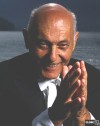 Sir
Georg Solti - (b. 10/21/1912, Budapest, Hungary, d. 9/5/1997,
Antibes, France) Sir
Georg Solti - (b. 10/21/1912, Budapest, Hungary, d. 9/5/1997,
Antibes, France) Legendary Conductor: Record number of Grammys Born György Stein, Solti studied piano and composition with Ernst von Dohnanyi, Zoltan Kodaly and Béla Bartók at the Franz Liszt Academy in Budapest, giving his first concert at the age of twelve. He began working as assistant at the Budapest Opera in 1930 and was director of music there from 1934 to 1939. In the summers of 1936 and 1937 he was assistant to Arturo Toscanini at the Salzburg Festival, an encounter that left a deep impression on the young musician. After the outbreak of the Second World War, he emigrated to Zurich, resuming his career as a pianist. He won first prize at the Geneva International Competition in 1942. His career really began after the end of the Second World War. For almost twenty-five years, he concentrated entirely on conducting operas. He was chief musical director of the Munich Opera from 1947 to 1951 and of the Frankfurt Opera from 1952 to 1961. Covent Garden excelled during his tenure as musical director (1961-71). In 1961 he was appointed as musical director of the Los Angeles Philharmonic Orchestra, but hardly ever worked in this position since the orchestra's management had appointed an assistant without asking him (the assistant was none other than Zubin Mehta!). In 1969 he took over as director of the Chicago Symphony Orchestra and his second career as a conductor of orchestral music began. He remained in this post until 1991. From 1972 to 1975 he was also director of the Orchestre de Paris. In 1973, Rolf Liebermann appointed him as musical adviser to the Paris Opera. From 1979 to 1983 he was director of the London Philharmonic Orchestra. In 1992 he took over from Herbert von Karajan as artistic director of the Salzburg Easter Festival (until 1994). In 1995 he was artistic adviser to the festival that replaced the Schleswig-Holstein Music Festival.
- Buy his CD's and read more at iClassics.com or |
||||||
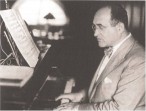 Friedrich
Schorr - (b. 09/02/1888, Nagyvárad, Hungary, d. 8/14/1953,
Farmington, CT) Friedrich
Schorr - (b. 09/02/1888, Nagyvárad, Hungary, d. 8/14/1953,
Farmington, CT) Renowned "mahogany-colored" Bass-Baritone
His fame as a Wagner singer spread rapidly. From 1916 until 1923 he appeared at the opera houses of Prague and Cologne and became a guest star of the Berlin Staatsoper, Covent Garden and Bayreuth. He also sang roles like Amonasro, Escamillo, Barak, Borromeo, Dr. Faust (Busoni), Scarpia, Michele and Pizarro. The main part of his career, however, he spent in the U.S.A. Impresario Gatti-Casazza heard him as Hans Sachs and engaged him in 1923. Friedrich Schorr appeared at the Met until 1943 and made guest appearances all over the world. In March 1943 he gave his farewell performance at the Met in Siegfried. He continued to appear in concerts and became director of the Manhattan School of Music in New York. He also directed productions at the City Centre Opera in New York. He was also a very successful vocal coach. Trivia:
- Buy CD's and see more at Yahoo! Shopping |
||||||
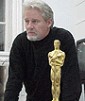 Ferenc
Rofusz - Ferenc
Rofusz - Animator: Oscar in 1981 for his animated film, "The Fly" (A Légy) - the first Hungarian Oscar for a cartoon. The film is a simple story about a day in the life of a housefly. The short is a perfect example of how a simple plot can be very compelling when the animation is solid. The fact that the film is totally from the point of view of the fly, along with the building tension provided by the sound, the viewer truly feels for the insect and his situation. And for students, THE FLY is an amazing example of perspective and foreground-to-background movement. - See an interview in Hungarian here |
||||||
 Viktor
Vasarely - (b. 4/9/06, Pécs, Hungary, d. 1997) Viktor
Vasarely - (b. 4/9/06, Pécs, Hungary, d. 1997) Famed painter known for his geometrical forms, he is the father of Op-Art His motto is "Art for all" and the Paris subway is full of his modern works. - See the beautiful official website, Vasarely.org |
||||||
 Pierre
Székely (b.Budapest, Hungary, 6/11/1923, d. 4/3/2001, Paris) Pierre
Székely (b.Budapest, Hungary, 6/11/1923, d. 4/3/2001, Paris)Renowned Sculptor and Architect - the "Incessant Adventurer"
He is founder of the European Institute of Technology of Granite. Some of his noteworthy works of sculptural architecture are the "Chapelle du Carmel" in Valenci-ennes, France; his rose granite sculpture in Budapest entitled "Monument to Peace"; and for "Impossible Bird" which French President Mitterand presented to Israeli President Menachem Begin. Pierre Szekely was decorated with the French National Order of Merit in 1980 and was inducted into the French Legion of Honor - Read more and see and hear Pierre in a video (In French) |
||||||
 Arthur
Koestler - (b. 1905, Budapest, d. 3/3/1983) Arthur
Koestler - (b. 1905, Budapest, d. 3/3/1983)Influential Journalist and Author of "Darkness at Noon," among the 20th century's most influential novels
Though he studied science and psychology in Vienna, at the age of twenty he became a foreign correspondent and worked foe various European newspapers in the Middle East, Paris, Berlin, Russia and Spain. During the Spanish Civil War, which he covered from the Republican side, he was captured and imprisoned for several months by the Nationalists, but was exchanged after international protest. In 1939-1940 he was interned in a French detention camp. After his release, due to British government intervention, he joined the French Foreign Legion, subsequently escaped to England, and joined the British Army. Like many other intellectuals in the thirties, Koestler saw in the Soviet experiment the only hope and alternative to fascism. He became a member of the Communist Parry in 1931, but left it in disillusionment during the Moscow purges in 1938. His earlier books were mainly concerned with these experiences, either in autobiographical form or in essays or political novels. Among the latter, Darkness At Noon has been translated into thirty-three languages. After World War II, Mr. Koestler became a British citizen, and all his books since 1940 have been written in English. He now lives in London, but he frequently lectures at American universities, and was a fellow at the Center for Advanced Study in the Behavioral Sciences at Stanford in 1964-65. In 1968 Mr. Koestler received the Sonning Prize at the University of Copenhagen for his contributions to European culture. He is also a Commander of the Order of the British Empire, as well as one of the ten Companions of Literature, elected by the Royal Society of Literature. His works are now being republished in collected editions of twenty volumes. He established The Koestler Foundation, which exists to promote research in parapsychology and other fields. In his will Koestler left his entire property to found a Chair of Parapsychology at the Edinburgh University. In the 1970s Koestler was made a Commander of the Order of the British Empire and a Companion of Literature. Facing incurable illness - Parkinson's disease and terminal leukemia - and as a lifelong advocate of euthanasia, Koestler took his own life with his wife, who, however, was perfectly healthy. Koestler died of a drug overdose - death was reported on March 3, 1983. In her suicide note Cynthia Koestler wrote, "I cannot live without Arthur, despite certain inner resources." - See more and read some Koestler quotes here or |
||||||
Although he died at the age of sixty, his creative period was very short. He started his art studies in 1894; he painted his major pictures between 1903 and 1909. His oeuvre consists of about one hundred paintings and twenty drawings - not too many, but his paintings were the first great summary of modern art in Hungary. Csontváry's decision to become a painter was influenced by his schizophrenia. He worked for fourteen years in order to become financially independent, and started to study painting at the age of forty-one: first in Munich under Simon Hollósy, then in Karlsruhe under Kallmorgen.
Csontváry first showed his works in Paris in 1907, then travelled to Lebanon. His symbolic paintings of mysterious atmosphere were painted there: "Lonely Cedar", "Pilgrimage to the Cedars in Lebanon" and "Mary's Journey in Nazareth". His next exhibitions were in 1908 an in 1910, but they did not bring him the recognition he had so earnestly hoped for. The last major canvas. "Riding along the Beach" was painted in Naples in 1909. After this year he hardly painted, loneliness and the lack of understanding caused in him such a severe mental condition, that he was able to create nothing else, but sketches of surrealistic visions. - Visit the following Hungarian site:
The Csontváry Múzeum (great site) in Pécs for images and link to his own Autobiography. |
||||||
 Christina
Kiss - (b. Budapest, Hungary) Christina
Kiss - (b. Budapest, Hungary) Renowned Pianist: one of the foremost Liszt interpreters of our time Internationally acclaimed as an artist of world class statue, Christina Kiss is recognized as one of the foremost Liszt interpreters of our time. She is performing the entire Liszt cycle at Carnegie Hall (over a thousand works) from memory performed over several years. Presently in its ninth New York season, she will complete the cycle of over 60 recitals in the year 2010. Critics have said, her Liszt Cycle is akin to climbing Mount Everest. Ms. Kiss has already played more Liszt works in concert than any other pianist, thus making this series one of the truly important and historic piano cycles of all time. Concert tours have taken her to Italy, Spain, Greece, Austria, Hungary, France, Belgium, Israel and the U.S. She is a frequent soloist with the world's leading orchestras including the Barcelona, Cincinnati and Budapest Philharmonic. Born in Budapest, Miss Kiss completed her studies at the Franz Liszt Academy and Juilliard with Gyorgy Sandor and Kornel Zempleni. She received First Prize at Barcelona's 1979 Maria Canals International Piano Competition, First Prize at Cincinnati's International American Music Competition, and two dozen additional prizes at international competitions on three continents including the Athens, Dino Ciani, Van Cliburn, Gina Bachauer and the Liszt-Bartok Watch an excerpt from one of Christina's like performances |
||||||
 George
Széll - (b. Budapest 6/7/1897, d. Cleveland, Ohio 1970) George
Széll - (b. Budapest 6/7/1897, d. Cleveland, Ohio 1970)Legendary Conductor: "One of the greatest conductors of symphony and opera of the twentieth century" Part of the wave of great Hungarian conductors who took over American musical life just before and after World War II (the others included Fritz Reiner, Antal Dorati, and Eugene Ormandy), George Szell quickly transformed a middling Midwestern orchestra into one of the nation's Big Five. His cultivation of the Cleveland Orchestra set an example of discipline and hard work that gradually helped raise the standards of orchestras across America. Considered a child prodigy, he first performed in a public concert at the age of eleven. At age sixteen he conducted the Vienna Philharmonic Orchestra. The next year he appeared with the Berlin Philharmonic Orchestra as conductor, pianist, and composer. During this time, Richard Strauss heard Szell perform his transcription of the composer's symphonic poem TILL EULENSPIEGEL. Upon hearing Szell's arrangement, Strauss appointed Szell to the conducting staff of the Berlin State Opera. Szell stayed as Strauss's assistant for two years, at which time Strauss recommended Szell as principal conductor of the Strassburg Municipal Theater to succeed Otto Klemperer. A few years later, Szell left the Strassburg Municipal Theater to become conductor of the Court Theater at Darmstadt. Between the years of 1921 and 1929, he was conductor of the Berlin Broadcasting Company and was also a member of the faculty at the renowned Hochschule für Musik. In 1929, Szell went to Prague to become the general music director of the German Opera House and the Philharmonic. At this time he started to appear as guest conductor with many of the leading orchestra's of Europe. From 1930 to 1931 he conducted the St. Louis Symphony Orchestra. He was so well received as a guest conductor in England that he soon became the conductor of the Scottish Orchestra in Glasgow, England and the Residentie Orchestra at The Hague in Holland. The start of World War II in 1939 found Szell in Australia. Making his way to the United States Szell was invited by Toscanini to guest conduct the famous NBC Symphony Orchestra in New York City. His debut attracted such wide attention that other conducting engagements soon followed including the Cleveland Orchestra. From 1942 to 1946 Szell was one of the regular conductors of the Metropolitan Opera House. In 1946 Szell become the conductor and music director of the Cleveland Orchestra. Szell had, at one time or another, conducted just about every major symphony orchestra in the world. He also appeared as guest conductor at the leading European summer music festivals, including Vienna, Salsburg, Milan, Paris, Florence and Lucerne. His compositions include; Variations for Orchestra, Symphony in B Minor, Lyric Overture, and several chamber music works. It goes without saying that Szell has been the recipient of many honors and awards. These include and honorary degree of Doctor of Music from Case Western Reserve University (1951) and a similar degree from Oberlin College. In 1949 he received an Award of Honor by the National Music Council, the Chevalier of the National Order of the Legion of Honor in France (1957), Commanders' Cross, Order of Merit in Germany (1959), Laurel Leaf Award for performing more American contemporary works than any other conductor (1954). - See Sony
Classical.com |
||||||
Fleeing Hitler in the late '30s, Sakall settled in Hollywood, where from 1939 through 1955 he played an endless succession of excitable theatrical impresarios, lovable European uncles, and befuddled shopkeepers. His rotund cuteness earned Sakall the nickname "Cuddles," and he was often billed as S.Z. "Cuddles" Sakall in his later films. Nearly always featured in the supporting cast (notably as Karl the waiter in 1942's Casablanca), S.Z. Sakall was given the principal role of songwriter Fred Fisher in 1949's Oh, You Beautiful Doll, though top billing went to June Haver. S.Z. Sakall's final performances were seen in the 1954 film The Student Prince and the like-vintage TV series Ford Theatre.In Hollywood, became popular comic support and was nicknamed "Cuddles." Some other movies: It's a Date (1940), Ball of Fire ('41), Casablanca (Nick's waiter, '42), Tea for Two ('50), Lullaby of Broadway ('51). He wrote an autobiography in 1953: The Story of Cuddles. AKA: Eugene Gerõ Szakáll, Szõke Szakáll. - For more visit: S.Z. Sakall or |
||||||
The glamorous, Hungarian-born actress, is the middle child of the celebrated Gabor sisters. Though officially an actress, Zsa Zsa Gabor is more famous as a whimsical celebrity sex symbol. Married nine times, Gabor made a career of joking about her man-hungry ways and her love of jewelry and furs. Among her husbands was hotel millionaire Conrad Hilton and Oscar-winning actor George Sanders. Among her more prominent films: John Huston's Toulouse-Lautrec biopic, "Moulin Rouge," 1952; "The Story of Three Loves," 1953; "The Girl in the Kremlin," 1957; and Orson Welles' classic "Touch of Evil," 1958. In 1989, ZsaZsa gained fresh notoriety as she was sentenced to 72 hours in jail for slapping a Beverly Hills police officer. She also was ordered to perform 120 hours of community service at a women's shelter. Another traffic accident, in November of 2002, left her in a coma.
Zsa Zsa quotes:
- See and buy her films on Amazon |
||||||
Best known as the Gabor sister with talent,
actress Eva Gabor began her career as a cabaret singer and ice skater
in her native Hungary. Forced to emigrate to the United States at
the outbreak of World War II, Gabor was able to secure film work in
mystery-woman parts in such films as Forced Landing (1941) and Pacific
Blackout (1942). The actress didn't truly achieve star stature until
her Broadway appearance in The Happy Time (1950), though curiously
she wasn't called upon to appear in the 1952 film version of this
play. Gabor's movie career in fact remained rooted in supporting roles,
such as one of Vincent
Price's victims in The Mad Magician (1953) and as Liane d'Exelmans
in the Oscar-winning Gigi (1958). In 1958 she was nominated for a Golden Laurel Award - Top
Female Comedy Performance for: "Don't
Go Near the Water" (1957). Like her sister Zsa
Zsa Gabor, Eva has accrued plenty of press coverage thanks to
her multiple marriages, but unlike Zsa Zsa, Gabor has managed to stay
off the police blotter - except for a 1964 incident in which she was
nearly killed fighting off a couple of vicious diamond robbers. |
||||||
Born Gábor István Szabó and Inspired by a Roy Rogers cowboy movie, Szabo began playing guitar when he was 14 and often played in dinner clubs and covert jam sessions while still living in Budapest. He escaped from his country at age 20 on the eve of the anti-Communist uprising and eventually made his way to America, settling with his family in California. He attended Berklee College (1958-60) and in 1961 joined jazz legend Chico Hamilton’s innovative quintet featuring Charles Lloyd. Urged by Hamilton, Szabo crafted a most distinctive sound; agile on intricate, nearly-free runs as he was able to sound inspired during melodic passages. Szabo left the Hamilton group in 1965 to leave his mark on the pop-jazz with another jazz legend, Gary McFarland. Szabo initiated a solo career in 1966, recording the exceptional album, SPELLBINDER, which yielded many inspired moments and "Gypsy Queen," the song the rock group, Santana, turned into a huge hit in 1970. During the 1970s, Szabo regularly performed along the West Coast; hypnotizing audiences with his enchanting, spellbinding style. But from 1970, he was locked into a commercial groove – even though records like MIZRAB occasionally revealed the success of his jazz, pop, Gypsy, Indian and Asian fusions. Szabo had revisited his homeland several times during the 1970s, finding opportunities to perform brilliantly with native talents. He was hospitalized during his final visit and died in 1982 – just short of his 46th birthday and five years after his final American album was released. Dougls Payne writes, "He was one
of the most original jazz guitarists to emerge in the 1960s; mixing
his hungarian folk music heritage with a deep love of jazz and crafting
a distinctive, largely self-taught sound." |
||||||
Tragedy, Torture, Triumph, and Tragedy... He was born in a shanty-town called Angels Court on the outskirts of Budapest to a family of gypsy musicians. He said he was born in the family bathtub because they could not afford a hospital. The family was desperately poor and ultimately both his father (an accomplished piano and cimbalom player) and a sister died of starvation. He began to play piano by watching an older sister's lessons. By the age of five he was appearing in a circus, improvising variations on request of the audience. At ten, even he was sent to the Conservatory in Budapest. He was able to stay there only briefly, taking piano lessons from Gyorgy Ferenczi and composition with Ernst von Dohnanyi. He supported himself playing in nightclubs and began to establish a recital career in Hungary, Holland, and Sweden. He married his wife, Zuleika, shortly before he was drafted into the Hungarian army in 1941. After the war he was imprisoned for a year in 1946. Returning to his wife and small son, and with his mother and surviving sisters dependent on him, he worked hours each day to recover his piano technique, making a living on tips from playing jazz in bars and cabarets each night. After the Communists gained full power in Hungary, Cziffra was imprisoned again, for political reasons, which meant that his captors also took his wife and son, Gyorgy Cziffra, Jr. The boy nearly died from the inhuman conditions. Cziffra's Communist captors tortured him; knowing he was a pianist, they went after his hands, beating on them and making him carry heavy pieces of stone in each hand. When he was released, the ligaments were so loose that he could not transmit the power of his arms through his wrists, but found a certain type of wristbands gave him the needed support. After six months of exhaustive work he recovered his top form. His records on the Hungarian label, Qualiton, and the Czechoslovak Supraphon label began to circulate in Western Europe, raising him to legendary status. When Russian troops poured into Hungary he and his family was forced to flee. After ten days on foot, they reached Vienna where he debuted on November 17, 1956, with outstanding success. Debuts elsewhere in Europe followed. After one recital in London, the Daily Telegraph said the audience "witnessed feats of piano playing probably never to be equalled, certainly never surpassed in their lifetime." Cziffra eventually settled in France with his family and took citizenship there. He undertook three major projects: One was the establishment of a piano competition in his name. The second was the purchase of the Royal Chapel of St. Frambourg near Senlis, which he made a non-sectarian shrine to spirituality and the arts. It is now known as the Foundation Cziffra. He also restored the organ at the Abbey of La Chaise Dieu and started a summer festival there, on the suggestion of his son, who became a conductor. It is known as the Salle Cziffra. Gyorgy, Junior died tragically in an accident in 1981, shortly after making his first commercial recordings. Cziffra refused to perform with an orchestra thereafter. He retired from recording in 1986 and left the stage in 1988. In the same year France named him a cultural ambassador to a newly liberalized Hungary. He was diagnosed with cancer in the early 1990s, but died in 1994 of a heart attack. He is buried in the cemetery of Senlis near the remains of his son. Mme Cziffra continued to direct the Foundation Cziffra. - See The
Inkpot for CD reviews and more! or |
||||||
The pianist, composer, and conductor awarded with the Kossuth and Liszt prizes, was born in 1952 in Budapest. His extraordinary gift for music became evident at a very early age. He commenced his musical studies when he was 5 years old and continued them at the Béla Bartók Conservatory from 1963, specializing in piano and composing. In 1968 he was admitted to the Ferenc Liszt Academy of Music. From the start, reviews referred to him as a prodigy and a lion of the piano, who rose above his contemporaries with his virtuosity and his personality of elemental strength. (1981 Le Figaro writes about the genius, 1987 the Kölner Stadt-Anzeiger mentions the miracle of the keyboard, 1990 the Frankfurter Allgemeine Zeitung writes about the pianist above all criticism etc). Zoltán Kocsis is also an acknowleged composer. He is one of the founders of the New Musical Studio of Budapest. His works, written for the Ensemble Modern and performed together with the ensemble at concerts, along with his Bartók and Schönberg transcriptions, have won him considerable appreciation in the profession. When in 1983 conductor Ivan Fischer and pianist Zoltan Kocsis decided to establish a new orchestra, no one guessed that this was beginning of one of the most successful and exciting musical ventures on the Hungarian and international music scene. After nine successful years of a few concerts every season in 1992 it become the permanent orchestra of Budapest. Today, the Budapest Festival Orchestra is one of the most successful musical ensembles internationally. Currently, he is Music Director of the Hungarian National Philharmonic Orchestra. - See klassik.com for more. You can order CD's or even send questions to him from the Website! |
||||||
 Joseph
Pasternak - (b. 9/19/1901, Szilagy-Somylo, Hungary (Transylvania),
d. 9/13/1991, Hollywood, California) Joseph
Pasternak - (b. 9/19/1901, Szilagy-Somylo, Hungary (Transylvania),
d. 9/13/1991, Hollywood, California) Prolific Film Producer/Director: Multiple Oscar Nominations. Rescued Universal Studios Joe Pasternak came to the US as a teenager. He was fascinated by show business and worked several menial jobs at the Paramount Studios commissary, learning the trade talk of the stars, technicians and executives. Pasternak worked his way into a job as second assistant director at Paramount in 1923, and, within three years, he was manager of Universal Studio's Berlin operations. In the early '30s, Pasternak made a name for himself producing German, Austrian and Hungarian musicals. He returned to the US at the request of the new Universal Studios management, which was hoping to reorganize the near-bankrupt company. Joe carefully nurtured a screen image for 13-year-old soprano Deanna Durbin as a down-to-earth tomboy with a beautiful singing voice and produced her first vehicle, Three Smart Girls in 1936 for which he received an Oscar nomination for. The film was an enormous hit, literally rescuing Universal. Pasternak received another Oscar nomination for One Hundred Men and a Girl in 1937. He would later rescue the film career of Marlene Dietrich in the 1939 film Destry Rides Again. Pasternak moved to MGM, which was filming lavish escapist musicals for wartime audiences. Again he met with great success receiving an Oscar nomination for Anchors Aweigh. Joe retired in 1968 after producing three of Elvis Presley's best musicals (including the immortal Girl Happy). Suffering from Parkinson's disease, Joe died just six days shy of his 90th birthday. Trivia:
- See his filmography and more, and buy his films on Yahoo! Movies |
||||||
 László
Benedek - (b.1905 Budapest - d. 3/11/1992, Bronx, NY) László
Benedek - (b.1905 Budapest - d. 3/11/1992, Bronx, NY) Producer/Director/Writer of "The Wild One" fame He was brought to the US by MGM. Laszlo gained acclaim and won a Golden Globe and Director's Guild Award in 1951 with his 5-Oscar nominated film, "Death of a Salesman," adapted from Arthur Miller's Pulitzer Prize-winning social drama of a middle-aged man at the end of his emotional rope featuring Fredric March. In 1954, he directed the classic motorcycle rebel movie, "The Wild One" with Marlon Brando. On television, he was prolific, responsible for such hits as "The Outer Limits," "Mannix," "The Untouchables," "Voyage to the Bottom of the Sea," "Perry Mason," and the "Alfred Hitchcock Hour." He is sometimes credited as Laslo Benedek. - See his filmography and more on IMBD |
||||||
 Lawrence
Dorr Lawrence
DorrPulitzer Prize Nominated Author / Professor - The "Christian Hemingway" As a child stricken with polio in Hungary and unable to play traditional games with other children, Lawrence Dorr turned to reading and writing at an early age. By the age of 16, he was writing what he calls "trashy" stories which he sold to earn a few cents. He also experienced war first hand as his country was occupied by the Nazis and later the Soviets. Dorr writes, "I escaped from Hungary (then under communist rule) in 1946 and went to England in 1948 as a European Voluntary Worker (indentured servant), where I worked in coal mines, cotton mills, and (my last most significant job) as a kitchen porter in Shenley Mental Hospital, Hartfordshire. There I met Clare, a psychiatric occupational therapist, who would become my wife. Clare is the daughter of an English Anglican priest (he was also a missionary); her mother hailed from St. Helena's Island, South Carolina. I was allowed into the U.S. as a ‘war bride’ in 1950. His experiences, including those on the Russian front and later as a political exile, compose much of the material for Dorr's short stories. Collections of these stories include "A Slow, Soft River" (1973), "The Immigrant" (1976), and "A Slight Momentary Affliction" (1987) which was nominated for a Pulitzer Prize. He has also written a novel entitled "The Open Face of Heaven," and has most recently had published "A Bearer of Divine Revelation." Dorr currently teaches creative writing at Santa Fe Community College. Dorr has presented at the Festival of Faith and Writing numerous times. - Buy his books on Amazon |
||||||
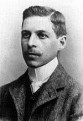 Emmerich (Imre) Kálmán - (10/24/1882, Siofok, Hungary, d. 10/30/1953, Paris) Emmerich (Imre) Kálmán - (10/24/1882, Siofok, Hungary, d. 10/30/1953, Paris) Composer - The last Grand Master of the Viennese Operetta Emmerich (Imre) Kálmán was admitted to the Budapest Academy of Music in 1900, together with Zoltán Kodály, to János Koessler’s composition class. Béla Bartók had already been studying with Koessler for a year and Leó Weiner joined them somewhat later. After his years at the Academy a few of his works were performed, including Saturnalia and a symphonic poem titled Endre and Johanna. In 1907 he won a Franz Joseph Prize for his songs. As a result he was able to continue his studies in Bayreuth, Munich and Berlin. However his career in classical music that began so promisingly was redirected towards lighter genres following a few brilliant cabaret songs and the success of his operetta Herbstmanöver composed in 1908. We now know that this decision was a decisive one. The praise expressed by his fellow composers, Bartók and Kodály, shows that Emmerich Kálmán was exceptionally talented. His early chamber and orchestral works were eclipsed by his later world famous operettas and remained practically unknown. These works quite clearly demonstrate that without his sound classical training, Emmerich Kálmán would not have been able to achieve his later successes in the “light” genre. For two decades, from 1909 to 1930, Imre Kalman's compositions dominated the Viennese entertainment theaters and all small and big stages of the German speech area. In a bizarre turn of events, Hitler was so impressed with Kálmán's music that he offered the composer honorary Aryan status. He refused; his music was banned by the Nazis; and he fled Vienna, traveling first to Paris in 1939 and then to the United States when the Germans occupied Paris. He became an American citizen in 1942 but returned to Europe in 1949, eventually settling in Paris. - See Imre
Kálmán |
||||||
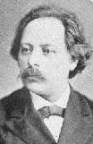 Goldmark,
Karl (b. 5/18/1830, Keszthely, Hungary – 1/2/1915, Vienna) Goldmark,
Karl (b. 5/18/1830, Keszthely, Hungary – 1/2/1915, Vienna)Composer Goldmark's father, a poor cantor in the local Jewish synagogue, was unable to assist to any extent financially in the development of his son's, one of twenty children, talents. Yet in the household much music was made, and on a cheap violin and home-made flute, constructed by Goldmark himself from reeds cut from the riverbank, the future composer gave rein to his musical ideas. His talent was fostered by the village schoolmaster, by whose aid he was able to enter the music-school of the Oedenburger Verein. Here he remained but a short time, his success at a school concert finally determining his parents to allow him to devote himself entirely to music. In 1844, then, he went to Vienna, where Jansa took up his cause and eventually obtained for him admission to the Conservatorium. For two years Goldmark worked under Jansa at the violin, and on the outbreak of the anti-Habsburg revolution, after studying all the orchestral instruments, he obtained an engagement in the orchestra at Raab. There, on the capitulation of Raab, he was to have been shot for a Hungarian spy, and was only saved at the eleventh hour by the happy arrival of a former colleague. In 1850 Goldmark left Raab for Vienna, where from his friend Mittrich he obtained his first real knowledge of the classics. Highly gifted in lyrical melody, he was influenced by Wagner and had his first success with his String Quartet, Op. 8, in 1860. He joined in the establishment of a Wagner Society in Vienna and gradually assumed a position of great importance in the musical life of the city. His concert overture Sakuntala (1865), his symphony A Rustic Wedding (1870), and an opera, The Queen of Sheba (1875), were all very popular. In addition to two symphonies and two violin concertos, Goldmark wrote a series of concert overtures. His popular Rustic Wedding Symphony was later championed by the great Leonard Bernstein. A third opera, a version of Dickenss Cricket on the Hearth, was given by the Royal Carl Rosa Company in London in 1900. Encylopedia.org adds, "In opera he is most certainly at his best, and as an orchestral colorist he ranks among the very highest." Trivia:
- Read about him at the American
Symphony Orchestra |
||||||
 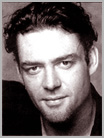 Marton
Csokas (b. 6/30/1966, New Zealand) Marton
Csokas (b. 6/30/1966, New Zealand)Acclaimed Actor - "The Kiwi who Infiltrated Hollywood" After WW II, Marton's
father (whom he was named for) emigrated from Hungary to New Zealand,
where he met and married Marton's mother, a New Zealander of Irish/Danish
descent. A graduate of the New Zealand Drama School in 1989, he landed
his first movie role in Jack Brown, Genius in 1994. Talent,
elvish good-looks, and a muscular 6'3" frame helped him land
the roles of the assassin Jarda in The Bourne Supremacy; that of Russian bad guy Yorgi, opposite Vin Diesel in XXX; and
one of the most sought after roles, that of King of the Elves in the Lord
of the Rings,husband to Galdadriel (played by the stunning
Australian Cate Blanchett). Other credits include Swimming with
Sharks, The Monkey’s Mask, Timeline, Kangaroo Jack, Broken English,
Down and Under, Rain, and as the voice of Poggle in Star Wars
Episode II: Attack of the Clones. For television, Csokas has performed
in a range of dramas including "The Three Stooges," "G.P."
(AFI Nomination), "Farscape," "Halifax f.p" and
"Wildside." Marton is known to most in the US as Khrafstar
and Borias in the 1997-1998 seasons of "Xena:
Warrior Princess" (1995). - See his filmography and more at IMDB |
||||||
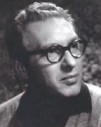 Géza
Anda (b. 11/19/1921,Budapest, d. 6/14/1976) Géza
Anda (b. 11/19/1921,Budapest, d. 6/14/1976)Acclaimed Pianist: The "Troubador of the Piano" One of Europe's leading pianists in the 1950s and 1960s, Furtwängler once called him the "troubadour of the piano," and indeed, though Anda joked about his "box of wires," what mattered to him more than anything was making the piano sing. Taught by Ernö Dohnányi and others in Budapest, the pianist won the Franz Liszt Prize at nineteen and débuted under Willem Mengelberg's baton with Brahms's Second Piano Concerto. 1941 saw Anda continuing his studies in wartime Berlin as a protégé of Furtwängler; but when Hungary mobilized in 1942, Anda moved to Switzerland. In 1960, he took over Edwin Fischer's master classes in Lucerne; starting his own in Zurich in 1969, he ran them with missionary zeal as a symbolic corrective to state education, responsible across central Europe - in his view - for promoting mediocrity and systematically suppressing creative talent. At the height of his career, Anda contracted cancer in 1974, dying two years later. Anda brought heartfelt devotion to the music of his fellow-countryman Béla Bartók. His Bartók readings, particularly his recordings or the three concertos under Ferenc Fricsay, are timeless classics. But for Anda, Bartók was where music ended. He believed that a suitably talented composer should still be capable of writing a good piece in C major. Anda accused 20th-century composers of having no feeling for the piano, lacking the pianistic skills (which Bartók possessed) of their classical forebears. Mozart was the other important composer in Anda's repertoire. Directing the Camerata Academica of the Salzburg Mozarteum from the keyboard, Anda recorded all Mozart's piano concertos with the chamber orchestra - the first pianist to do so - and composed and published cadenzas of his own wherever no original cadenzas existed. Anda's Mozart was deliberately unromantic; still, it was typical "post-war Mozart," not period performance, and Anda accused the new historical-performance movement of musicological pedantry. True to his time, Anda shunned fireworks, sentimentality and fevered emotionalism; his ideal was the true synthesis of temperament and intellect. He cared about phrasing; when pupils had problems with it, he sometimes made them sing out the tunes during lessons. - But his CD's and see more at iClassics.com |
||||||
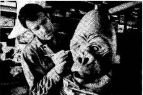 Janos
Prohaska (b. 10/10/1919, Budapest, Hungary, d. 3/13/1974 in Airplane
crash (Bishop, CA)) Janos
Prohaska (b. 10/10/1919, Budapest, Hungary, d. 3/13/1974 in Airplane
crash (Bishop, CA))Actor/Stuntman  Best
known for playing "animal" roles, typically gorillas and bears.
He played Cookie Bear on The Andy Williams Show (1969). His thick Hungarian
accent forced producers to dub his voice. Besides sculpting highly-detailed
ape and bear masks, Prohaska designed a wide variety of non-anthromorphic
costumes to avoid the "man in a suit" concept. His work included
the Horta for the original Trek episode "Devil in the Dark",
"Mugatu," and for The Outer Limits (original series) he designed
a reverse-jointed Thetan alien (accomplished with the aid of stilts)
and an amoeba (the "Mikie"). He is the father of stuntman
Robert Prohaska who died with him in the airplane crash in 1974. Best
known for playing "animal" roles, typically gorillas and bears.
He played Cookie Bear on The Andy Williams Show (1969). His thick Hungarian
accent forced producers to dub his voice. Besides sculpting highly-detailed
ape and bear masks, Prohaska designed a wide variety of non-anthromorphic
costumes to avoid the "man in a suit" concept. His work included
the Horta for the original Trek episode "Devil in the Dark",
"Mugatu," and for The Outer Limits (original series) he designed
a reverse-jointed Thetan alien (accomplished with the aid of stilts)
and an amoeba (the "Mikie"). He is the father of stuntman
Robert Prohaska who died with him in the airplane crash in 1974. Byron Haskin, director of the Outer Limits episode "The Architects of Fear", claimed, "When I first met Janos, he came into my office, put a beer bottle on the table, and then stood on his head with his finger in the bottle, supporting himself. He could defy the law of gravity." (Outer Limits Companion, pg. 81). Prohaska maintained a workshop in Santa Monica up to the time of his death from which he did most of his greatest work. -
See all his roles at TV
Tome or |
||||||
 Anna
Sandor Anna
SandorEmmy Award-Winning screenwriter Anna Sandor was born in Budapest, Hungary to Holocaust survivors. Her childhood was uprooted when her family immigrated to Canada following the Hungarian Revolution. Ms. Sandor began acting professionally while still a teenager. She worked on Canadian stage and television before shifting to writing in the mid-seventies. After a distinguished writing career in Canada (for which she was awarded a Lifetime Achievement Award by the Canadian Academy of Cinema & Television) she moved to the U.S. in 1989. Ms. Sandor has written everything from sitcoms to mysteries, and over twenty movies for television on a wide variety of topics, ranging from Amelia Earhart's last years (Amelia Earhart, the Final Flight) to a Holocaust survivor's moving search for her identity (Miss Rose White) to a young girl's discovery of the true meaning of family (My Louisiana Sky). Her screenplays have twice been nominated for the Emmy and have been honored with numerous awards, including the Humanitas (1993 & 2002), the Gemini (Canadian Emmy), and the WGA Award. Two of her films, Miss Rose White and My Louisiana Sky, have won the Emmy. Her latest TV-movie (co-written), Tiger Cruise, premiered 8/6/2004 on the Disney Channel to great reviews. Ms. Sandor is the proud mother of one daughter, Rachel. - See IMDB |
||||||
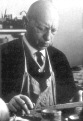 Imre
Reiner (b. Versec, Hungary, 8/18/1900 - d. Lugano, Switzerland,
1987) Imre
Reiner (b. Versec, Hungary, 8/18/1900 - d. Lugano, Switzerland,
1987)Painter, Sculptor, Illustrator, and Renowned Type Designer of "Reiner Script" fame! Reiner attended the
Zalatua State Sculpture School, the Frankfurt School of Arts and Crafts
and the School of Arts and Crafts in Stuttgart under Prof. F. H. Ernst
Schneidler. From 1923 to 1925, he worked as a graphic designer in
London, Paris, New York and Chicago. Reiner left for Switzerland in
1926. From 1931 he worked in Ruvigliana near Lugano as painter, graphic
designer and illustrator. - See more fonts at linotype.com |
||||||
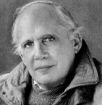 J.
Anthony Lukas (b. 4/25/1933, New York, d. 6/5/1997, New York) J.
Anthony Lukas (b. 4/25/1933, New York, d. 6/5/1997, New York)Acclaimed Author and Journalist - Winner of TWO Pulitzer Prizes! "One of America's most brilliant writers." Lukas was known for the "excrutiating, almost obsessive precision of his research." After graduating from Harvard he worked as a reporter for the Baltimore Sun, then the New York Times. He won his first Pulitzer in 1967 for an account of a wealthy teenager found beaten to death in Greenwich Village by her counter-culture boyfriend. His second Pulitzer was for "Common Ground," a 1985 book about race relations in Boston. Lukas also wrote in 1971 a book about another famous trial, "The Barnyard Epithet and Other Obscenities: Notes on the Chicago Conspiracy Trial." J. Anthony Lucas, two-time winner of Pulitzers, spent the last seven years of his life researching and writing his 754-page opus "Big Trouble," which will remain without question the seminal study of one of America's most fascinating trials. On the morning of June 5, 1997, Lukas met with his editor to discuss final revisions to Big Trouble. He returned in the afternoon to his Upper West Side apartment and hanged himself with a bathrobe sash. He was 64 when he died. Lukas, who had been diagnosed with depression ten years earlier, wrote a 1987 book "Silent Grief: Living in the Wake of Suicide," inspired by his own pain of living with the suicide of his mother, who had slashed her throat at age 33. Many adjectives have been used to describe one of America's most brilliant writers: decent, erudite, insightful, dedicated, intense, energetic, inventive, sensitive, tender, self-righteous, brooding, restless. A friend described Lukas as "the happiest and the saddest man I know." Apart from his love of writing, Lukas found happiness in gardening, baseball, and pinball (Lukas bought his own machine: "The ball flies into the ellipse, into the playing field -- full of opportunities.") "Big Trouble" was Lukas's first attempt at pure history, and the project left him full of self-doubt. He worried that his book was too ambitious, that he wouldn't be able to get his point across, that it didn't show his talents as well as "Common Ground." As the Big Trouble neared completion in the spring of 1997, friends worried that he seemed mentally and physically exhausted. On the Monday before he died, Lukas called an editor at Life who had assigned him the task of writing a piece on Caldwell, Idaho's changes since the Steunenberg assassination and told him "he didn't know what to write." Friends who knew Lukas said such a thing had never happened before. Trivia
- Read about the Lukas
Prize at Columbia University or |
||||||
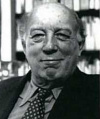 John
Lukacs (1/31/1924, Budapest) John
Lukacs (1/31/1924, Budapest)Eminent Historian: Pulitzer Prize Nominated, Ingersoll Prize Winner - "one of America’s most respected historians - Yale" Praised by critics as a historian who has the literary talents of a novelist, John Lukacs is the author of more than 20 books, including The Hitler of History (1997), in which Lukacs studies German Chancellor Adolf Hitler's life by examining the more than one hundred biographies written about him. A recipient of the Ingersoll Prize, his other books include The Great Powers and Eastern Europe (1954); A History of the Cold War (1961); Outgrowing Democracy: A Historical Interpretation of the U.S. in the 20th Century (1984); and The Duel (Hitler vs. Churchill (1991); Churchill: Visionary. Statesman. Historian; The End of the Twentieth Century; the End of the Modern Age (nominated for the Pulitzer Prize); and A New Republic, a major statement on the nature of our political system and a critical look at the underpinnings of our society: American democracy, says John Lukacs, has been transformed from an exercise in individual freedom and opportunity to a bureaucratic system created by and for the dominance of special groups.. Lukacs served from 1947–94 as professor of history at Chestnut Hill College, and as its department chair from 1947–74. He also served as a visiting professor at many universities, including Columbia, Princeton, Johns Hopkins University, and at the University of Budapest in his native Hungary. - Purchase his books at Yale
University Press |
||||||
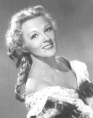 Ilona
Massey (Hajmássy) - (b. 6/16/1910, Budapest, d. 8/20/1974,
Bethesda. MD) Ilona
Massey (Hajmássy) - (b. 6/16/1910, Budapest, d. 8/20/1974,
Bethesda. MD) "Breathtakingly beautiful" Actress, Star of MGM Musical "Balalaika" and more! Hal Erickson, All Movie Guide, writes, "Ilona Massey was born into poverty in Budapest; her father, a typesetter was left an invalid in WW I. With her meager earnings as a dressmaker's apprentice, Massey studied singing. She went on to perform at the Vienna Stratsoper then made her screen bow in two Austrian musical films. Conflicting reports state that either Massey wasn't interested in films until she was spotted by MGM executive Louis B. Mayer while she was appearing in a Stratsoper production of Aida, or that she eagerly submitted her publicity photos to MGM in the hopes of meeting her "idol" Nelson Eddy. Another variation of the legend has her meeting a producer at a party, then being invited to audition for Mayer. Whatever the case, Massey was cast opposite Nelson Eddy and Eleanor Powell in the MGM musical Rosalie in 1937. At first, she spoke no English and had to learn her lines phonetically. By the early 1940s, she was conversant enough in her second language to star on the network radio series Top Secret. Massey made only 11 films during her Hollywood career; her favorite was Balalaika (1939), while her least characteristic were Frankenstein Meets the Wolfman (1943) and the Marx Brothers' Love Happy (1950). On Broadway, she co-starred with Milton Berle and Arthur Treacher in the 1943-44 revival of The Ziegfeld Follies. On TV, she starred in the 1952 adventure weekly Rendezvous and hosted the 1953 variety series The Ilona Massey Show. Off camera, she was extremely active in anti-communist causes, especially after the 1956 Hungarian uprising; at one point, she picketed the United Nations, demanding the expulsion of visiting Soviet premiere Nikita Khrushchev. Among her many husbands was film actor Alan Curtis. Ilona Massey's last husband was retired Air Force general Donald S. Lawson, a union that entitled her to treatment at Bethesda Naval Hospital, where she died in 1974 after a three-month illness." - See Yahoo! to buy her movies and read more! |
||||||
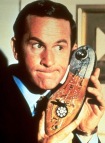 Don
Adams (b. 4/13/1926, New York City) Don
Adams (b. 4/13/1926, New York City)Record setting Triple Emmy and Clio Award Winning Actor, Director, Screenwriter - Get Smart! Born Donald James Yarmy, Don Adams was born to an Irish Catholic Mother and Hungarian Jewish Father. He jokes, "God Knows Why I am a Catholic and a Jew..." But when he enlisted in the marines, he lied about his age (he was only 16) and listed "none" as his religion. When his parents married, "both families disowned them -- hers because she'd married a Jew, his because he'd married a Catholic." After nearly dying of blackwater fever (malaria) contracted while fighting at Guadalcanal in WWII, Don had a religious awakening and became a devout Catholic.
His success directing Get Smart led to a post-Smart career as a director of commercials. He won the Clio Award for outstanding commercial direction in advertising in 1971. It was for his Aurora Skittle Pool commercial, in which he was also the performer. In 1993, he made his screenwriting and directing debut with the direct-to-video release Shreck, a thriller about teenagers who resurrect a serial killer. Trivia
- Read about Get Smart on TV
Land where you can actually see videos
|
||||||
 Robert
Halmi, Sr. - (b. 1924, Budapest) Robert
Halmi, Sr. - (b. 1924, Budapest)Producer, "Tele-Visionary," Chairman of Hallmark Entertainment, the most prolific producer in TV history: multiple Emmy Award winner and 1999 Peabody Award winner Book
Magazine writes: Halmi was the son of a playwright mother and a father
who was the official photographer to the Vatican and the Hapsburg
empire. After the war, he worked in Hungary for the U.S. precursor
of the Central Intelligence Agency. In 1947, he was put on trial by
the Communists for blowing up bridges and was sentenced to death.
He says he was saved only after his father arranged to have him kidnapped:
He was given a bicycle to get to the Austrian border, and escaped
from Hungary by hiding in a potato truck. For a time, he continued
his intelligence work in Salzburg, helping to spread American propaganda
in Eastern Europe. His travails were chronicled in a seven-part series
in the Saturday Evening Post called "Trial by Terror," which
was later made into a movie for 20th Century Fox. Halmi's TV movies, miniseries and films include Gypsy, The Odyssey, Moby Dick, Jason and the Argonauts, Arabian Nights, Gulliver's Travels, Lonesome Dove, Animal Farm and Dinotopia. - See filmography and more on Hollywood.com |
||||||
 Sylvia
Plachy - (b. 1943, Budapest) Sylvia
Plachy - (b. 1943, Budapest)Acclaimed Photographer, Mother of Actor Adrien Brody A refugee from Hungary in 1956, the year the Russians invaded, Plachy hid under the corn in a farmer's cart to make it through the checkpoint at the border. She eventually ended up as a staff photographer for the Village Voice. Her regular photo column, "Unguided Tour," was for many readers something highly anticipated and won the prize of the International Center of Photography in 1990. Her pictures can be found in the Guggenheim Museum, the Museum of Modern Art, the Metropolitan Museum and the San Francisco Museum of Modern Art. In 1977 she received a Guggenheim-scholarship. As a Hungarian, Plachy has an interesting pedigree. Some of the world’s most famous photographers — Brassai, Laszlo Moholy-Nagy, Robert and Cornell Capa and Andre Kertesz — were also Hungarian. When they emigrated, they tended to stick together. Robert Capa, who died during the French Indochina War, was helped in his career by Kertesz, as was Plachy, who describes the famous Kertesz as a friend and mentor. - Read the article, "Her Way" |
||||||
 Adrien
Brody - (b. 4/13/1973, New York City) Adrien
Brody - (b. 4/13/1973, New York City)Actor - Oscar for "The Pianist." The youngest actor to win the Academy Award for Best Actor in a Leading Role, at 29 years old. Despite a strong performance in The Thin Red Line, the film's time constraints forced the director to edit out much of Adrien's parts and despite his later work with Spike Lee and Barry Levinson, he never became the star many expected he would become...until Roman Polanski called on him to play a celebrated Jewish pianist in the Nazi-occupied Warsaw. He pulled off a brilliant performance in "The Pianist" drawing on the heritage (and rare dialect) of his Polish grandmother. His mother is the Hungarian-born photojournalist Sylvia Plachy. He attended the Joseph Pulitzer (another Hungarian) Middle School (I.S.145) and New York's Fiorello H. LaGuardia High School of Music & Art and Performing Arts (famous as the inspiration for television's Fame). Adrien grew up an only child in Woodhaven, Queens, where he would accompany his mother on assignments for the Village Voice. "I remember going with her to photograph Timothy Leary at his house," he says. "I realize now that that was a fairly unusual thing for a 6-year-old to do." He credits his mother with making him feel comfortable in front of the camera. "Not only was her work everywhere, but I was the subject of it," he says. "It wasn't like when your uncle comes around every once in a while and says, `Smile, smile, smile,' and you become repulsed by the camera." - See more pictures and his full filmography at the IMDB |
||||||
 Menyhert
Lengyel (b. Lebovics Menyhért, Jan 12, 1880 Balmazújváros,
Hungary - d. Oct 23, 1974 Budapest, Hungary) Oscar Nominated Writer, Producer,
and Broadway and Film Director Menyhert
Lengyel (b. Lebovics Menyhért, Jan 12, 1880 Balmazújváros,
Hungary - d. Oct 23, 1974 Budapest, Hungary) Oscar Nominated Writer, Producer,
and Broadway and Film Director
Also known
as Melchior or Menyhard. Lengyel started out as a correspondent for
Hungarian newspapers in Switzerland and became a well-known journalist,
author, and critic in Germany and Austria where he published numerous
plays and established friendships with Ernst Lubitcsh and other German
theatre greats with whom he would later work in Hollywood. He visited
the US twice in 1921 and 1924, where he maintained a diary of American
theatre life and met Eugene O'Neill whose work he would later produce
in Germany. He moved to England in 1933 as a correspondent for the
Budapest "Pesti Naplo" and then followed Lubitsch to America
in 1935. He moved to Italy in 1960 and then returned to Hungary in
1970 where he died at 94. His credits include Typhoon, Silk Stockings, the Czarina, Angel (which he directed and produced), Antonia (which he-co-directed with George Cukor) and quadruple Oscar nominated Ninotshka in which he was nominated for an Oscar for Best Original Screenplay. He lost to none other than "Gone With the Wind." Other spin-offs of the Ninotchka theme include MGM's Comrade X (1940) with Clark Gable and Hedy Lamarr (in the Soviet Union), and The Iron Petticoat (1956) with Katharine Hepburn and Bob Hope (in London). The storyline also became the foundation for the Broadway (Cole Porter) stage musical Silk Stockings - that was later filmed by director Rouben Mamoulian in a 1957 film version with Cyd Charisse in Garbo's role opposite Fred Astaire. Less known is that he wrote the libretto for Bartók's The Miraculous Mandarin and To Be or Not to Be which Lubitsch turned into a classic film comedy. - See this GREAT
site and even listed to a Lengyel speech (in Hungarian) |
||||||
 Deszö
Ránki (b. 1951, Hungary) Deszö
Ránki (b. 1951, Hungary)Renowned Concert Pianist - with Kocsis, the "Golden Boys of the Magyar Keyboard" Considered one of the top Hungarian pianists, Ranki graduated from the famed Liszt Academy under Pal Kadosa and won the Robert Schumann Prize. He quickly embarked on an acclaimed international career performing with all the world's most prestigious orchestras. He is renowned for his classical and romantic repertoire of Mozart, Beethoven, Liszt, Schubert and Schumann and his incomparable interpretations of Bartok and Kurtag. His interpretation of Chopin won him the Grand Prix de l’Académie Charles-Cros. - See Amazon.com for more |
||||||
 Robert
Hegyes (b. 5/7/1951, Metuchen, NJ) Robert
Hegyes (b. 5/7/1951, Metuchen, NJ)Actor, Director - immortalized as "Juan Epstein" on Welcome Back Kotter!
He became Asssociate Professor & Artist-in-Residence
of Theater and Communications in Rowan University, N.J. and is currently
Adjunct Professor, Brooks College of Long Beach, CA.
Trivia:
- See IMDB or |
||||||
 Miklós
Perényi: Cello Great and former Child Prodigy! Miklós
Perényi: Cello Great and former Child Prodigy!
Perenyi was born in Budapest into a musical family. At the age of five he received his first cello lessons and at the age of seven he was admitted to the Ferenc Liszt Music Academy Budapest. He made his official debut in Budapest at the age of nine. He had further studies at the Accademia Santa Cecilia Roma with Professor Enrico Mainardi. In 1962 he won the International Casals Competition held in Budapest. In 1965 and 1966 Pablo Casals invited him to join his master classes in Zermatt and Puerto Rico and this was followed by an invitation to perform at the Marlboro Festival for four consecutive years. In 1974 he was appointed a teacher at the Ferenc Liszt Music Academy Budapest, where he is now Professor of the cello department. As an acknowledgement of his musical activites he was awarded the Kossuth Prize in 1980, and the Bartok-Pasztory Prize in 1987. As a soloist and a chamber musician he has appeared in many musical centres and festivals in Europe as well as in America, Japan and China. He has a very extensive repertoire, including pieces from the 17th and 18th centuries to the present day. Miklos Perenyi is also involved in composing and his compositions include pieces for cello and works for small and large chamber ensembles. - See this site in English or German |
||||||
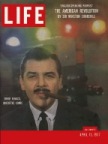 Ernie
Kovács - (b. 1/23/1919, Trenton, New Jersey d. 1962) Ernie
Kovács - (b. 1/23/1919, Trenton, New Jersey d. 1962) Actor, Broadcast Pioneer, and Legendary Comedian and T.V. Personality Three Emmy Awards in the 1956-57 TV season. "Ernie Kovacs was the first person to make television as television." He invented much of the visual vocabulary of television that we take for granted today. Kovacs pioneered the use of blackouts and trick photography in TV comedy. His first show was Pick Your Ideal, a weekly fashion show. Ernie showed up for the audition dressed in his shorts and a barrel. He got the job. Ernie appeared in some well-produced high school theatrics. At 16, he became a singer in a local stock company performing Gilbert & Sullivan. He said, "whenever they needed a man that worked cheap, they got me." He later attended the New York School of the Theater. During WWII he worked in radio in Trenton and wrote his own column, "Kovacs" in The Trentonian, the local paper. His first TV job was as host of "Deadline For Dinner", a cooking show on WPTZ in Philadelphia. Ernie called it Dead Lion for Breakfast, and had lots of fun with it. As a result, the world got Eggs Scavok and Kovacs got his own show. In fact, he got one show after another and did no less than seven different shows in Philly between 1950 and 1952. Among the titles: Three To Get Ready (wherein the E.E.F.M.S. had its genesis); Ernie In Kovacsland, and Kovacs On the Corner. These shows involved lots of experiments, born not only of the incredibly cheap budgets but of Ernie's rather bizarre imagination. No known recordings (either Video or Audio) exist of the early Channel 3 local broadcasts. However, one morning in March of 1952 (Ernie's last month at WPTZ), Andy McKay brought his new 8mm home movie camera to the station and shot some home movies. In the shots are Ernie Kovacs, Edie Adams, Joe Earley and Pete Boyle, who were part of the network show. There is no sound as this footage was shot silent and it was filmed in black & white. For Ernie Kovacs fans, this is, indeed, a rare treat. Watch the footage. The success of these shows got Ernie to New York in 1952. For five years he did his thing and then some. He was even a sometime host of NBC's Tonight show, pre-Carson. But mainly he hosted his own show, starting out from behind a desk, and rarely staying there. When the Jerry Lewis show was on hiatus, Ernie was given the opportunity to fill a half hour doing something special on network primetime. The result which aired January 19th, 1957, "The Silent Show," was a sensation, garnering Ernie the cover of Life magazine and a movie contract with Columbia pictures, prompting a move to Los Angeles. In L.A., while working on such films as "Operation Mad Ball" and "Bell, Book and Candle," Kovacs continued to do TV. His great career was cut short when, at age 42, he died in a car accident in 1961 driving a new Corvair station wagon (the car later dubbed "unsafe at any speed" by Ralph Nader). - See this Ernie Kovacs page with a great photo gallery and much more |
||||||
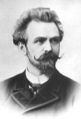 Jeno
Hubay (b. Jeno Huber b. 9/15/1858 Pest, d.
3/12/1937, Budapest) Jeno
Hubay (b. Jeno Huber b. 9/15/1858 Pest, d.
3/12/1937, Budapest)Violin Virtuoso, Romantic Composer - The "Prince of the Violin" and Founder of the legendary modern Hungarian Violin School Hubay studied violin first with his father, Karoly Huber (1828-1885) leader and conductor of the orchestra at the National Theatre, and violin professor of the National Conservatorium. From the autumn of 1873 Hubay continued his studies in Berlin, with the greatest Hungarian violinist of the time and most distinguished violin teacher of the period, Joseph Joachim. In the spring of 1876 he completed his studies and returned to Hungary. Here became friendly with Franz Liszt, and gave together many performances. In May 1878, Hubay travelled to Paris on Liszt’s advice and was soon to be a favorite guest in the musical salons of the city. In the next years he made successful concert tours in France, England, Belgium, the Netherlands and Hungary. In his mid 20s was appointed violin professor at the Brussels Conservatory. In February 1882, the Belgian King appointed Hubay to one of Europe’s most important musical posts. Hubay returned to Hungary in 1886 at the request of the Minister of Education to teach and eventually became head of The Royal Academy at Budapest from 1919 until 1934 in succession to his father. Here he created one of the world’s leading violin schools that turned out (many under his own tutelage) many greats such as Stefi Geyer, Ferenc Vecsey and Jozsef Szigeti, to be followed by Emil Telmanyi, Eddy Brown, Jelly Aranyi, Eugene (Jeno) Ormandy, Janos Koncz, Istvan Partos, Erna Rubinstein, Zoltan Szekely, Ede Zathureczky, Endre Gertler and Wanda Luzzato. Jeno Hubay represented the last of the old school of composers in Hungary. In addition to his teaching many of the world's great violin players, Hubay was a formidable defender of the establishment, a conservative by nature, was very well respected in all areas of musical life. Hubay was knighted in 1907. He dressed the part and lived lavishly. Hubay married the Countess Rosa Cebrian in 1894 they lived in a palace that was to become their permanent home. The Palace was the scene of many glittering musical soirees attended by the cream of Hungarian and European musical society, and as you would expect there would be any number of private concerts held there. - Read a lecture about Hubay
and the Hungarian Violin School |
||||||
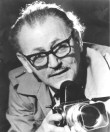 Dezo
(Dezso) Hoffmann / Hofmann / Hoffman (b. 1912, Selmecbánya (today
Banska Stiavnica, Slovakia) d. 1986) Acclaimed Photographer - the Beatles' photographer! "One of the Greatest Photographers in Entertainment" Dezo
(Dezso) Hoffmann / Hofmann / Hoffman (b. 1912, Selmecbánya (today
Banska Stiavnica, Slovakia) d. 1986) Acclaimed Photographer - the Beatles' photographer! "One of the Greatest Photographers in Entertainment"
Dezo Hoffmann began his career as a clapper boy in A-B Studios in Prague. He joined Twentieth Century Fox, in Paris and was sent to photograph Mussolini's invasion of Ethiopia. He covered the 1936 Olympics and witnessed the Spanish Civil War working alongside Ernest Hemingway and fellow-Hungarian Robert Capa for the International Brigade Press Corps in Barcelona. Hoffmann was one of the first photo journalists to send images back from the front. Arriving in England in 1940, he covered virtually all European theatres of World War II. To this day, the entire library of Dezo Hoffmann's wartime experiences is maintained by the Imperial War Museum in London. At the war's end he photographed more lighthearted show business images such as Charlie Chaplin, Marilyn Monroe, Frank Sinatra, Louis Armstrong, and Marlene Dietrich. Hoffmann joined the Record Mirror, a weekly music paper in 1955. Applying techniques from the battlefield, he captured the exploding world of rock music like no other photographer ever had, using only small format cameras and always only available light. At the urging of a young fan, he had the opportunity to first shoot The Beatles in 1962. Through this early session Dezo Hoffmann and The Beatles were to develop a deep, personal and professional relationship that would last throughout the years of "Beatlemania." The success arising from this unique relationship gave Dezo great access to many rising stars such as: The Rolling Stones, Jimi Hendrix, Eric Clapton and The Yardbirds, David Bowie, Rod Stewart. Dezo's photographs of the Beatles are as much part of the visual vocabulary that we now think of as comprising the 20th Century as any other single photographic work of that time. Dezo Hoffmann took more pictures of The Beatles than any other photographer. Photos of the Beatles are hard to view as simply "images" of a certain aspect of our culture. They are an endless capture of a time that itself changed so fast that perhaps only the quick-witted shutter of a properly placed camera could catch it. Whether the image is of the Fab Four caught jumping in mid-air or a set of pensively postured Mount Rushmore-like heads about to release their opus Sergeant Pepper's album, Dezo Hoffman's photography did apprehend and create much more than a PR and pop phenomenon. He helped create an unforgettably shared moment of time within the very personal view that his eye had captured. The book With the Beatles: The Historic Photographs of Dezo Hoffman, by Pearce Marchbank, captures the intimate pictorial biography of one of that world's greatest acts. - Buy the book on Amazon |
||||||
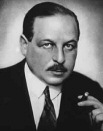 Imre
(Emmerich) Kalman (b. 10/24/1882 Siofok, Hungary, d. 10/30/1953,
Paris) Imre
(Emmerich) Kalman (b. 10/24/1882 Siofok, Hungary, d. 10/30/1953,
Paris)Composer - "One of the Greatest Composers of Operetta" Also known by his Hungarian name Imre Kálmán, he was a prolific composer of Operettas that brought him success in both the US and Europe. From a poor family, he first moved to Budapest in 1897. A highly gifted young man, he began giving lessons in Latin and Greek and was able to save enough to take piano lessons and even buy a piano. He developed rheumatism in his hands so he turned to composition. His talents led to an opportunity to study at the famed Budapest Academy of Music under the master Hans Koesller. Béla Bartók and Zoltan Kodály are his fellow students. In 1907, Kalman was awarded the coveted Franz Josef Prize of Budapest for a song cycle. From 1904 to 1908 he worked as a music critic for the Pesti Naplo paper. He achieved great success with the Budapest premier of his operetta "Tatárjárás" (Tatar Maneuvers or "The Gay Hussars") in 1908. This met with enormous success throughout Europe and the USA before World War I. In particular, it was very well received in Vienna, the capital of operetta, and this led him to settle there where he would compose another 8 successful Operettas. Though the music of Kálmán finds its sources in Hungarian popular folklore, Kalman was also inspired by the Viennese style while making concessions to the new rates and rhythms that crossed the ocean during the Twenties. His operettas are of a high musical quality; moreover, their librettos were carefully chosen, sometimes after years of searching by the composer, to appeal to contemporary taste (as a result the texts normally have to be extensively modified for revival). The unusually high standard of the music can be attributed to Kalman's having undergone a thorough training under Koessler. When the Nazis came to power and banned his Operettas, Kalman left Vienna for Paris in 1939. With the Nazi takeover of Paris he left for the United States in 1940. He later returned to Paris and did not live long enough to see the production of his final operetta "Arizona Lady" which debuted in Bern under his son Charles Emmerich Kalman (b. Vienna, 17 Nov. 1929), himself the composer of several finely written and enjoyable light pieces and musicals. - See Classic
Music Dictionary |
||||||
Elia Kazan later wrote in his autobiography, "Joe Bromberg was one of the Group company I most admired. I thought he was an immensely talented actor when I joined that organization, a man who could play a great variety of character parts. It has been said that the House Committee on Un-American Activities (HUAC) killed Joe. Certainly the pressure he was subjected to shoved him over the brink." - Read more and buy J. Edward Bromberg Films on Yahoo! Shopping |
||||||
 Elemer
Ragalyi (b. 1939, Budapest) Elemer
Ragalyi (b. 1939, Budapest)Acclaimed, Emmy Award Winning Cinematographer of Oscar Winning "Journey of Hope" Elemér
Ragályi is a pre-eminent Hungarian cinematographer who has worked
extensively in the United States, Elemer Ragalyi has received the
Critic's Prize for Best Cinematography six times at the Hungarian
Film Festival. He has also shot 95 feature films, mini-series, telefilms
and documentaries all over the world. Ragályi graduated from Budapest's
College of Dramatic and Cinematic Art in 1968 as Cinematographer.
Between 1957 and 1968 works as spotlight operator, laboratory assistant,
location manager at Mafilm Studios. He has been Professor at the College
of Dramatic and Cinematic Art since 1979. - See his filmography on IMDB Jump to:
|
||||||
© Bryan Dawson, All Rights Reserved. DISCLAIMER: The American Hungarian Federation® does not necessarily
endorse the content or opinions
expressed by its individual members
and member organizations.


 Producer and Founder of the Paramount Pictures Empire and Loew's
Theatres. Produced the first full-length motion picture,
"The Prisoner of Zenda." Received a special Academy Award
in 1948 for his "contribution to the industry." One of the
original studio "moguls." Zukor arrived in the US at 16,
got one of his first jobs as a furrier's apprentice. Zukor worked
his way up to become a well-heeled Chicago furrier and, in 1903, teamed
with Marcus Loew to open the first of a series of penny arcades. Two
years later the team formed Loew's Consolidated, with Zukor as treasurer
of the far-flung empire of theaters. 80 years later, he was still
going to work every day at Paramount Pictures. Adolph Zukor ruled
Paramount Studios with an iron hand for decades, forming alliances
with such other powerful and influential figures like these, shown
left to Right: Jesse L. Lasky,
Producer and Founder of the Paramount Pictures Empire and Loew's
Theatres. Produced the first full-length motion picture,
"The Prisoner of Zenda." Received a special Academy Award
in 1948 for his "contribution to the industry." One of the
original studio "moguls." Zukor arrived in the US at 16,
got one of his first jobs as a furrier's apprentice. Zukor worked
his way up to become a well-heeled Chicago furrier and, in 1903, teamed
with Marcus Loew to open the first of a series of penny arcades. Two
years later the team formed Loew's Consolidated, with Zukor as treasurer
of the far-flung empire of theaters. 80 years later, he was still
going to work every day at Paramount Pictures. Adolph Zukor ruled
Paramount Studios with an iron hand for decades, forming alliances
with such other powerful and influential figures like these, shown
left to Right: Jesse L. Lasky, 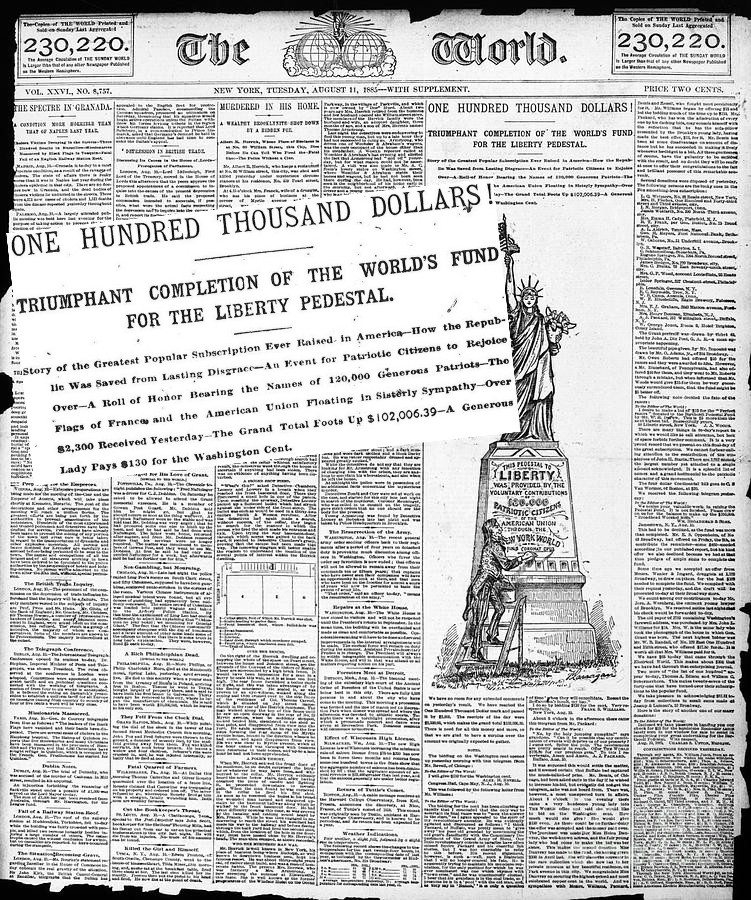
 "In the latter years of the 19th century, Joseph
Pulitzer stood out as the very embodiment of American journalism.
Hungarian-born, an intense indomitable figure, Pulitzer was the most
skillful of newspaper publishers, a passionate crusader against dishonest
government, a fierce, hawk-like competitor who did not shrink from
sensationalism in circulation struggles, and a visionary who richly
endowed his profession. His innovative New York World and St. Louis
Post-Dispatch reshaped newspaper journalism. Pulitzer was the first
to call for the training of journalists at the university level in
a school of journalism. And certainly, the lasting influence of the
Pulitzer Prizes on journalism, literature, music, and drama is to
be attributed to his visionary acumen. In writing his 1904 will, which
made provision for the establishment of the Pulitzer Prizes as an
incentive to excellence, Pulitzer specified solely four awards in
journalism, four in letters and drama, one for education, and four
traveling scholarships."
"In the latter years of the 19th century, Joseph
Pulitzer stood out as the very embodiment of American journalism.
Hungarian-born, an intense indomitable figure, Pulitzer was the most
skillful of newspaper publishers, a passionate crusader against dishonest
government, a fierce, hawk-like competitor who did not shrink from
sensationalism in circulation struggles, and a visionary who richly
endowed his profession. His innovative New York World and St. Louis
Post-Dispatch reshaped newspaper journalism. Pulitzer was the first
to call for the training of journalists at the university level in
a school of journalism. And certainly, the lasting influence of the
Pulitzer Prizes on journalism, literature, music, and drama is to
be attributed to his visionary acumen. In writing his 1904 will, which
made provision for the establishment of the Pulitzer Prizes as an
incentive to excellence, Pulitzer specified solely four awards in
journalism, four in letters and drama, one for education, and four
traveling scholarships."
 Fox
invented the global media newsgathering organization emulated today
by CNN, BBC, ITN, DW and others. Fox secured his place in history
by commercializing talking pictures and then introducing a larger
movie screen. Read about his patent fights for Talking Pictures
and more at
Fox
invented the global media newsgathering organization emulated today
by CNN, BBC, ITN, DW and others. Fox secured his place in history
by commercializing talking pictures and then introducing a larger
movie screen. Read about his patent fights for Talking Pictures
and more at 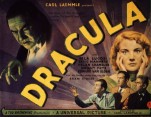 His
first American film was 1923's The Silent Command,
a suspenseful spy movie in which Bela played the bad guy. He officially
became a US citizen on June 26, 1931. He took on the role of Count
Dracula in Horace Liveright's play in place of actor Raymond Huntley
in 1929. It played for 33 weeks on Broadway, and also toured the
entire West Coast. Soon after, the rights to play were picked up
by Universal Studios. Universal wanted Lon Chaney, Sr. to play the
lead role, but Chaney died of throat cancer in 1930. It wasn't until
after Chaney's death that Bela was even considered for the part
of Count Dracula. The rest is history!
His
first American film was 1923's The Silent Command,
a suspenseful spy movie in which Bela played the bad guy. He officially
became a US citizen on June 26, 1931. He took on the role of Count
Dracula in Horace Liveright's play in place of actor Raymond Huntley
in 1929. It played for 33 weeks on Broadway, and also toured the
entire West Coast. Soon after, the rights to play were picked up
by Universal Studios. Universal wanted Lon Chaney, Sr. to play the
lead role, but Chaney died of throat cancer in 1930. It wasn't until
after Chaney's death that Bela was even considered for the part
of Count Dracula. The rest is history! Click
Click  Tony
writes about his painting on the right:
Tony
writes about his painting on the right: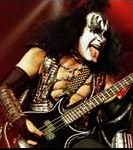 Gene Simmons of KISS
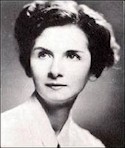 Kate Seredy (b. 11/10/1899 Budapest, d. 3/7/1975 Middletown, New York)
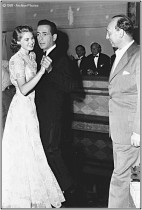 After
WWI he continued his filmmaking career in Austria and Germany and
into the early 1920's when he directed films in other countries in
Europe. Moving to the US in 1926, he started making films in Hollywood
for Warner Bros. and became thoroughly entrenched in the studio system.
His films during the 30's and 40's encompassed nearly every genre
imaginable and some, including
After
WWI he continued his filmmaking career in Austria and Germany and
into the early 1920's when he directed films in other countries in
Europe. Moving to the US in 1926, he started making films in Hollywood
for Warner Bros. and became thoroughly entrenched in the studio system.
His films during the 30's and 40's encompassed nearly every genre
imaginable and some, including 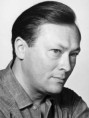 Gerard
Schurmann: World-renowned Double Oscar Winning Composer:
Orchestrated "Lawrence of Arabia" and "Exodus"
Gerard
Schurmann: World-renowned Double Oscar Winning Composer:
Orchestrated "Lawrence of Arabia" and "Exodus"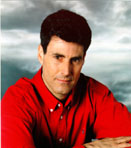 Uri Geller - (b. 1946, Israel)
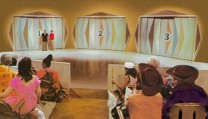 He
moved into television in 1949, and created and produced one of the
first nighttime game shows on the first inter-connected network of
seventeen TV stations on ABC-TV. The name of the show was Fun for
the Money. He produced numerous radio and television shows
and hit it big with "Let's Make a Deal" with Monty Hall
which debuted in 1963 and ran for over 4,600 shows and continues today
in syndication!
He
moved into television in 1949, and created and produced one of the
first nighttime game shows on the first inter-connected network of
seventeen TV stations on ABC-TV. The name of the show was Fun for
the Money. He produced numerous radio and television shows
and hit it big with "Let's Make a Deal" with Monty Hall
which debuted in 1963 and ran for over 4,600 shows and continues today
in syndication!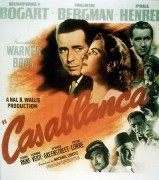 Superstar
of Horror film classics, some with countryman Bela Lugosi, as well
as acclaimed supporting roles in "Casablanca," the
"Maltese Falcon," and "20,000 Leagues Under
the Sea." Born in Rozsahegy, Hungary (now Ruzomberok, Slovakia
after the
Superstar
of Horror film classics, some with countryman Bela Lugosi, as well
as acclaimed supporting roles in "Casablanca," the
"Maltese Falcon," and "20,000 Leagues Under
the Sea." Born in Rozsahegy, Hungary (now Ruzomberok, Slovakia
after the 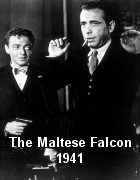 Almost
as quickly as he achieved world-wide fame, Lorre became typecast.
In spite of his diminuitive size, Lorre became synonymous with dread.
Fleeing the Nazi machine, Lorre left Germany in 1933, landing in England,
where Alfred Hitchcock exploited his image by casting him in is first
English-speaking role as the head of a ring of kidnappers who menace
young Nova Pilbeam in The Man Who Knew Too Much (1934). He then relocated
to southern California, and, for better or worse, settled in as a
permanent resident of Hollywood's star colony. Two years later
Hitchcock cast him in a similar role in Secret Agent. For Mad Love
(1935), his first American film and a rare foray into horror for MGM,
Lorre's head was shaved, further emphasizing his bulging eyes and
giving him a slick, reptilian appearance. In his second Hollywood
outing he met with more critical acclaim as yet another murderer,
Raskolnikov, in Sternberg's version of Crime and Punishment (1935).
Between 1937 and 1939 Lorre stepped into a more conventional role,
playing the Japanese detective Mr. Moto in eight films for 20th Century-Fox.
By the end of the decade, Lorre's face and silken voice had become
so recognizable that he was caricatured in Warner Bros. cartoons and
on Spike Jones records. During the 1950s, health problems forced Lorre
to take fewer roles, although he did expand his repertoire with a
musical, Silk Stockings (1957) and several comedies. His comedic talent
was displayed in a 1960s series of comedy/horror films for American-International
Pictures. His precise timing and droll delivery in The Raven (1963)
suggested that Hollywood never fully explored Lorre's range as an
actor.
Almost
as quickly as he achieved world-wide fame, Lorre became typecast.
In spite of his diminuitive size, Lorre became synonymous with dread.
Fleeing the Nazi machine, Lorre left Germany in 1933, landing in England,
where Alfred Hitchcock exploited his image by casting him in is first
English-speaking role as the head of a ring of kidnappers who menace
young Nova Pilbeam in The Man Who Knew Too Much (1934). He then relocated
to southern California, and, for better or worse, settled in as a
permanent resident of Hollywood's star colony. Two years later
Hitchcock cast him in a similar role in Secret Agent. For Mad Love
(1935), his first American film and a rare foray into horror for MGM,
Lorre's head was shaved, further emphasizing his bulging eyes and
giving him a slick, reptilian appearance. In his second Hollywood
outing he met with more critical acclaim as yet another murderer,
Raskolnikov, in Sternberg's version of Crime and Punishment (1935).
Between 1937 and 1939 Lorre stepped into a more conventional role,
playing the Japanese detective Mr. Moto in eight films for 20th Century-Fox.
By the end of the decade, Lorre's face and silken voice had become
so recognizable that he was caricatured in Warner Bros. cartoons and
on Spike Jones records. During the 1950s, health problems forced Lorre
to take fewer roles, although he did expand his repertoire with a
musical, Silk Stockings (1957) and several comedies. His comedic talent
was displayed in a 1960s series of comedy/horror films for American-International
Pictures. His precise timing and droll delivery in The Raven (1963)
suggested that Hollywood never fully explored Lorre's range as an
actor.
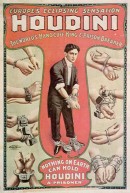 Harry
Houdini (b. 3/24/1874, Budapest, d. 10/31/1926, Detroit)
Harry
Houdini (b. 3/24/1874, Budapest, d. 10/31/1926, Detroit)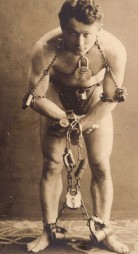 Harry
was the third of five children. When he was about four years old,
his father, Rabbi Dr. Mayer Samuel Weiss, who was a religious scholar
and teacher, moved the family to Appleton, Wisconsin where he became
the first rabbi of a new congregation. He told everyone for his entire
life that he was born in Appleton, so they would accept him as an
American. In later years, in a magazine interview, Houdini said about
Appleton, "the greatest escape I ever made was when I left Appleton,
Wisconsin." He was always concerned about physical fitness and
staying in shape. He won awards in
Harry
was the third of five children. When he was about four years old,
his father, Rabbi Dr. Mayer Samuel Weiss, who was a religious scholar
and teacher, moved the family to Appleton, Wisconsin where he became
the first rabbi of a new congregation. He told everyone for his entire
life that he was born in Appleton, so they would accept him as an
American. In later years, in a magazine interview, Houdini said about
Appleton, "the greatest escape I ever made was when I left Appleton,
Wisconsin." He was always concerned about physical fitness and
staying in shape. He won awards in 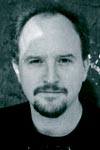
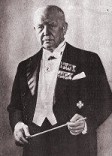 Lehár,
Franz (b. 4/30/1870 Komárom (now called Komarno in Slovakia
after annexation at
Lehár,
Franz (b. 4/30/1870 Komárom (now called Komarno in Slovakia
after annexation at  Walt
Disney eat your heart out. But there is no dispute that this Hungarian
born genius is the leader of the new
generation of animation. He received his animation
education at Hungary's famed Pannonia studio. In 1975 he fled Communist
Hungary by walking for 2.5 hours through a darkened railway tunnel
to Austria. Eventually in Stockholm, he helped produce Sweden's first
animated feature. While in Stockholm, he met graphic designer Arlene
Klasky. The couple relocated to Los Angeles, California and formed
Klasky Csupo, Inc. in late 1981 in the spare room of their apartment.
Klasky Csupo has won 5 EMMYS and 2 CABLE
ACE Awards plus a host of other top honors.
They produced Rugrats, the Simpsons, and even the opening to the hit
show "In Living Color."
Walt
Disney eat your heart out. But there is no dispute that this Hungarian
born genius is the leader of the new
generation of animation. He received his animation
education at Hungary's famed Pannonia studio. In 1975 he fled Communist
Hungary by walking for 2.5 hours through a darkened railway tunnel
to Austria. Eventually in Stockholm, he helped produce Sweden's first
animated feature. While in Stockholm, he met graphic designer Arlene
Klasky. The couple relocated to Los Angeles, California and formed
Klasky Csupo, Inc. in late 1981 in the spare room of their apartment.
Klasky Csupo has won 5 EMMYS and 2 CABLE
ACE Awards plus a host of other top honors.
They produced Rugrats, the Simpsons, and even the opening to the hit
show "In Living Color."
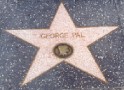 Since
the early history of animation, Hungarians have been involved in this
field (see Csupo above), and this history dates back to its earliest
in 1914, and then follows through to Paramount Studios in Hollywood
when in the 1940s Hungarian émigré George Pal developed methods
of integrating animated special effects with live action.
These methods were to become the accepted process for motion pictures
for decades thereafter. In the annals of Hollywood, George Pal will
always be remembered as a titan. A brilliant visionary who profoundly
shaped the art of motion pictures. As an animator, Pal was a pioneer
of stop-action animation and a peer of Walt Disney and Walter Lantz.
Since
the early history of animation, Hungarians have been involved in this
field (see Csupo above), and this history dates back to its earliest
in 1914, and then follows through to Paramount Studios in Hollywood
when in the 1940s Hungarian émigré George Pal developed methods
of integrating animated special effects with live action.
These methods were to become the accepted process for motion pictures
for decades thereafter. In the annals of Hollywood, George Pal will
always be remembered as a titan. A brilliant visionary who profoundly
shaped the art of motion pictures. As an animator, Pal was a pioneer
of stop-action animation and a peer of Walt Disney and Walter Lantz.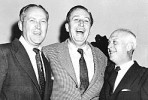 George
Pal was born into a Hungarian theatrical family. Both parents, Maria
and George Pal, Sr., were famous stage celebrities. George attended
the Budapest Academy to train as an architect, but a clerical error
put him in illustration classes... A medical school just down the
street offered classes in anatomy to its students. Pal found that
by simply slipping on a white smock, he could sneak into the classes
and learn anatomy. "The doctors," he says, "had
to learn how to draw muscles and bones -- no matter how badly -- so
that they knew them. I drew pretty good. So I reproduced my drawings
and sold them to the medical students. I had to make money somehow.
I think the medical professor got suspicious because so many students
turned in similar drawings. But he let it pass." ... as they
say, the rest is history. George graduated with an architectural degree
when Hungary was in no need of architects, but there were jobs for
animation illustrators at Hunnia films. Pal convinced his girlfriend
Zsoka to marry him, and only then found that his new job was un unpaid
apprenticeship. They migrated to Berlin (Zsoka's excellent idea),
where he found similar (but paid) work at the famous UFA studio.
Within sixty days, he was in charge of their cartoon production. The
rising tide of Nazi Germany pushed Pal to move to Holland. where he
created his revolutionary short, "Ship of the Ether." As
World War II loomed on the horizon, Pal realized an old dream and
headed to the U.S. for Hollywood.
George
Pal was born into a Hungarian theatrical family. Both parents, Maria
and George Pal, Sr., were famous stage celebrities. George attended
the Budapest Academy to train as an architect, but a clerical error
put him in illustration classes... A medical school just down the
street offered classes in anatomy to its students. Pal found that
by simply slipping on a white smock, he could sneak into the classes
and learn anatomy. "The doctors," he says, "had
to learn how to draw muscles and bones -- no matter how badly -- so
that they knew them. I drew pretty good. So I reproduced my drawings
and sold them to the medical students. I had to make money somehow.
I think the medical professor got suspicious because so many students
turned in similar drawings. But he let it pass." ... as they
say, the rest is history. George graduated with an architectural degree
when Hungary was in no need of architects, but there were jobs for
animation illustrators at Hunnia films. Pal convinced his girlfriend
Zsoka to marry him, and only then found that his new job was un unpaid
apprenticeship. They migrated to Berlin (Zsoka's excellent idea),
where he found similar (but paid) work at the famous UFA studio.
Within sixty days, he was in charge of their cartoon production. The
rising tide of Nazi Germany pushed Pal to move to Holland. where he
created his revolutionary short, "Ship of the Ether." As
World War II loomed on the horizon, Pal realized an old dream and
headed to the U.S. for Hollywood. 
 Born
of Hungarian parents, Claude-Michel began his career as a singer,
writer and producer of popular songs. Schonberg began his collaboration
with Alain Boublil in 1973 with the first-ever staged French rock
opera La Revolution Francaise, which played to capacity audiences
and sold over 350,000 double albums. A year later he sang his own
music and lyrics on an album which spawned the hit single "Le
Premier Pas'. In 1978, he and Boublil started work on the musical Les Misérables which was presented at the Palais des Sports
in Paris in September 1980. The concept album won two gold discs in
1981. When the show was produced on Broadway in 1987, Schönberg
won Tony Awards for best score and book, and a Grammy for Best Original
Cast recording.
Born
of Hungarian parents, Claude-Michel began his career as a singer,
writer and producer of popular songs. Schonberg began his collaboration
with Alain Boublil in 1973 with the first-ever staged French rock
opera La Revolution Francaise, which played to capacity audiences
and sold over 350,000 double albums. A year later he sang his own
music and lyrics on an album which spawned the hit single "Le
Premier Pas'. In 1978, he and Boublil started work on the musical Les Misérables which was presented at the Palais des Sports
in Paris in September 1980. The concept album won two gold discs in
1981. When the show was produced on Broadway in 1987, Schönberg
won Tony Awards for best score and book, and a Grammy for Best Original
Cast recording.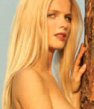 Ilona
Staller aka Cicciolina (Cuddles) (b. 11/26/1951, Budapest)
Ilona
Staller aka Cicciolina (Cuddles) (b. 11/26/1951, Budapest)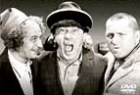 When you think of Columbia Pictures,
think of Jules White. White was born Juliusz Weisz and started out
as a child actor working for Pathe Studios during the 1910s. He came
to America with his family in 1904. Soon after founding Columbia Pictures
in 1924, Harry Cohn hired White to produce comedy short-subjects.
During his 25-year tenure at Columbia Pictures, he became the head
of Columbia's short film division in 1933 and directed 136 Three Stooges
shorts. He also produced or directed many other films with such stars
as Charley Chase, Andy Clyde, Harry Langdon and Buster Keaton.
When you think of Columbia Pictures,
think of Jules White. White was born Juliusz Weisz and started out
as a child actor working for Pathe Studios during the 1910s. He came
to America with his family in 1904. Soon after founding Columbia Pictures
in 1924, Harry Cohn hired White to produce comedy short-subjects.
During his 25-year tenure at Columbia Pictures, he became the head
of Columbia's short film division in 1933 and directed 136 Three Stooges
shorts. He also produced or directed many other films with such stars
as Charley Chase, Andy Clyde, Harry Langdon and Buster Keaton. White
also created the "Dogville Comedies," a popular series of
short subjects. In these one-reel shorts, trained dogs dressed as
people acted out the plots of popular movies of the day, sometimes
assisted directly by the movie they were spoofing, as in the case
of "The Dogway Melody," which borrowed the soundtrack recording
of "Singin' in the Rain" from The Broadway Melody (1929).
White
also created the "Dogville Comedies," a popular series of
short subjects. In these one-reel shorts, trained dogs dressed as
people acted out the plots of popular movies of the day, sometimes
assisted directly by the movie they were spoofing, as in the case
of "The Dogway Melody," which borrowed the soundtrack recording
of "Singin' in the Rain" from The Broadway Melody (1929).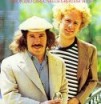 Simon
and Garfunkel was the name of the American team of singer/songwriter
Paul Simon and singer Art Garfunkel who recorded between 1964 and
1970. Their shimmering harmonies and acoustic concerts stood in stark
contrast to the rest of the spectacle that marked rock acts of the
'60s. They originally gained attention as a folk act (and some record
stores continue to file their records under 'folk'), but it was Simon's
songs, which frequently dealt with alienation and loneliness that
seemed to strike a chord with an entire generation. By the time of
the split, they were the most successful duo in pop music history.
Simon
and Garfunkel was the name of the American team of singer/songwriter
Paul Simon and singer Art Garfunkel who recorded between 1964 and
1970. Their shimmering harmonies and acoustic concerts stood in stark
contrast to the rest of the spectacle that marked rock acts of the
'60s. They originally gained attention as a folk act (and some record
stores continue to file their records under 'folk'), but it was Simon's
songs, which frequently dealt with alienation and loneliness that
seemed to strike a chord with an entire generation. By the time of
the split, they were the most successful duo in pop music history. Who's playing the music? Bob
was part of the legendary "Funk Brothers" who were the primary
studio musicians on almost all of the Motown hits that were recorded
and the ones who defined the music era of the 1960's. The Funk Brothers'
music is famous around the world, though their names are not. The
Funk Brothers put the backbeat - the soul - into the hits of Motown
Records creating music that helped to define the era of the 1960s
and has remained a vital influence to this day, these musicians played on more #1 records than the Beatles, the Beach
Boys, The Rolling Stones and Elvis Presley combined.
Who's playing the music? Bob
was part of the legendary "Funk Brothers" who were the primary
studio musicians on almost all of the Motown hits that were recorded
and the ones who defined the music era of the 1960's. The Funk Brothers'
music is famous around the world, though their names are not. The
Funk Brothers put the backbeat - the soul - into the hits of Motown
Records creating music that helped to define the era of the 1960s
and has remained a vital influence to this day, these musicians played on more #1 records than the Beatles, the Beach
Boys, The Rolling Stones and Elvis Presley combined. Bob's
long journey didn't start in New York, Detroit, Los Angeles, or any
other city with a rich studio tradition. It began in Pittsburgh, Pennsylvania,
a town renowned more for its steel-making than its hit-making. Born
Robert Kreiner to Hungarian parents, Bob received classical training
on upright bass, although he says the gypsy music to which his family
exposed him at a young age was far more influential. At 15, inspired
by early rhythm & blues, he began performing in local nightclubs.
Bob recalls his early days: "My parents sang with the Gypsies.
They were Hungarian, and they got me a job with a Gypsy band. I think
I made $15.00. It was in the late ’50s."
Bob's
long journey didn't start in New York, Detroit, Los Angeles, or any
other city with a rich studio tradition. It began in Pittsburgh, Pennsylvania,
a town renowned more for its steel-making than its hit-making. Born
Robert Kreiner to Hungarian parents, Bob received classical training
on upright bass, although he says the gypsy music to which his family
exposed him at a young age was far more influential. At 15, inspired
by early rhythm & blues, he began performing in local nightclubs.
Bob recalls his early days: "My parents sang with the Gypsies.
They were Hungarian, and they got me a job with a Gypsy band. I think
I made $15.00. It was in the late ’50s."  He did, however, have more than a touch of the roue about him, which
manifested itself in "Affairs of a Gentleman" (1934), "The
Three Musketeers" (1935) and in his splendid supporting performance
as one of the heroine's illicit romances in William Wyler's "Dodsworth"
(1936). Alfred Hitchcock's delightful thriller "The Lady Vanishes"
(1938) found Lukas playing an outright, though still sneaky, villain,
and he played a number of unsympathetic roles in wartime films, memorably
as Hedy Lamarr's dangerous husband in "Experiment Perilous"
(1944).
He did, however, have more than a touch of the roue about him, which
manifested itself in "Affairs of a Gentleman" (1934), "The
Three Musketeers" (1935) and in his splendid supporting performance
as one of the heroine's illicit romances in William Wyler's "Dodsworth"
(1936). Alfred Hitchcock's delightful thriller "The Lady Vanishes"
(1938) found Lukas playing an outright, though still sneaky, villain,
and he played a number of unsympathetic roles in wartime films, memorably
as Hedy Lamarr's dangerous husband in "Experiment Perilous"
(1944).  Zoltan
Kodály (b. 12/16/1882 Kecskemét, Hungary, d. 3/6/1967, Budapest)
Zoltan
Kodály (b. 12/16/1882 Kecskemét, Hungary, d. 3/6/1967, Budapest)  Olmos's
passion for education is a gift from his parents. He was born to Pedro
Olmos and Eleanor Huizar. His father had left Mexico City, Mexico,
at the age of twenty-one and settled in Los Angeles. Olmos claims
to be Chicano-American first, Asian second, and European third. Olmos
is a Hungarian name and his ancestry includes Moranos or Transversos,
Jews who converted to Catholicism during the Spanish Inquisition to
avoid religious persecution and torture. He also includes African
ancestry. It is this global heritage 'that made me brown," he
says with pride.
Olmos's
passion for education is a gift from his parents. He was born to Pedro
Olmos and Eleanor Huizar. His father had left Mexico City, Mexico,
at the age of twenty-one and settled in Los Angeles. Olmos claims
to be Chicano-American first, Asian second, and European third. Olmos
is a Hungarian name and his ancestry includes Moranos or Transversos,
Jews who converted to Catholicism during the Spanish Inquisition to
avoid religious persecution and torture. He also includes African
ancestry. It is this global heritage 'that made me brown," he
says with pride. feature
film directorial bow in 1992 with the powerful
feature
film directorial bow in 1992 with the powerful  Capa
left Hungary as a boy, lived in Paris in 1930's and covered many wars:
Spanish Civil war, China, WW II (north Africa, Italy, D-Day, Liberation
of Paris, Israeli War of Independence (1948), and the French Indo-China
war. He was killed after stepping on a landmine.
Capa
left Hungary as a boy, lived in Paris in 1930's and covered many wars:
Spanish Civil war, China, WW II (north Africa, Italy, D-Day, Liberation
of Paris, Israeli War of Independence (1948), and the French Indo-China
war. He was killed after stepping on a landmine.  Schorr
initially intended to become a lawyer. His father was an attorney,
but also a renowned Jewish cantor who had a first-class baritone voice
himself. His son Friedrich had a beautiful voice and studied singing
at Brno with Adolf Robinson, the teacher of Leo Slezak. Robinson recommended
the young bass-baritone to the management of the Chicago Opera and,
during his vacation, he had the opportunity to appear in small roles.
He made his debut at Graz as Wotan in Walküre! His success was great
and Schorr was immediately offered a four-year contract. He
remained there until 1916.
Schorr
initially intended to become a lawyer. His father was an attorney,
but also a renowned Jewish cantor who had a first-class baritone voice
himself. His son Friedrich had a beautiful voice and studied singing
at Brno with Adolf Robinson, the teacher of Leo Slezak. Robinson recommended
the young bass-baritone to the management of the Chicago Opera and,
during his vacation, he had the opportunity to appear in small roles.
He made his debut at Graz as Wotan in Walküre! His success was great
and Schorr was immediately offered a four-year contract. He
remained there until 1916.  He began as a medical
student in Budapest before studying art (1928-9) at the "Budapest
Bauhaus' (the Mühely Academy). He settled in Paris in 1930. He pioneered
the visually disturbing effects that were later called Op Art and
began experimenting with the use of optical illusion during the 1930s,
although the style of geometric abstraction for which he is best known
dates from the late 1940s. His paintings were characterized by their
repeated geometric forms and interacting vibrant colors which created
a visually disorientating effect of movement. He also experimented
with Kinetic Art.
He began as a medical
student in Budapest before studying art (1928-9) at the "Budapest
Bauhaus' (the Mühely Academy). He settled in Paris in 1930. He pioneered
the visually disturbing effects that were later called Op Art and
began experimenting with the use of optical illusion during the 1930s,
although the style of geometric abstraction for which he is best known
dates from the late 1940s. His paintings were characterized by their
repeated geometric forms and interacting vibrant colors which created
a visually disorientating effect of movement. He also experimented
with Kinetic Art.  Known
for his monumental scuplture in granite and marble. His work is present
on four continents and was considered to be a guiding force of his
generation. Pierre Szekely learned to sculpt stone on his own, before
attending art school. He came to Paris in 1946 where he formally studied
design, modeling and wood sculpture. He specialized in the creation
of monumental sculptures and worked in close collaboration with architects
on problems of architectonic integration and sculptural games for
children. His work employs the concept of
Known
for his monumental scuplture in granite and marble. His work is present
on four continents and was considered to be a guiding force of his
generation. Pierre Szekely learned to sculpt stone on his own, before
attending art school. He came to Paris in 1946 where he formally studied
design, modeling and wood sculpture. He specialized in the creation
of monumental sculptures and worked in close collaboration with architects
on problems of architectonic integration and sculptural games for
children. His work employs the concept of  Few literary figures have influenced
the course of modern history like Arthur Koestler. As a prominent
journalist, memoirist and popular science writer, Koestler chronicled
the dehumanizing brutality of totalitarianism. His publicized split
with the Communist International earned Koestler honorary standing
as a literary cold warrior. Darkness at Noon catapulted Koestler
to prominence as a somber critic of communist oppression. It ranks
consistently among the 20th century's most influential novels.
Few literary figures have influenced
the course of modern history like Arthur Koestler. As a prominent
journalist, memoirist and popular science writer, Koestler chronicled
the dehumanizing brutality of totalitarianism. His publicized split
with the Communist International earned Koestler honorary standing
as a literary cold warrior. Darkness at Noon catapulted Koestler
to prominence as a somber critic of communist oppression. It ranks
consistently among the 20th century's most influential novels. Csontváry
Kosztka Tivadar (b. 1853, Kisszeben, Hungary, d. 1919, Budapest)
Csontváry
Kosztka Tivadar (b. 1853, Kisszeben, Hungary, d. 1919, Budapest) In 1895 be travelled to Dalmatia and
Italy to paint landscape studies. His individual style - best illustrated
by "Trees in Electric Light a Jajce" and "Storm over
the Great Hortobágy" - was fully developed by 1903. In the beginning
of the same year, he travelled to he Near East in search of the "great
motif". The dramatic, expressive representation of "Great
Tarpatak" is a conclusion of this search. He worked on his other
monumental, singularly expressive painting. "The Ruins of the
Greek Theatre at Taormina" between 1904 and 1905. "Balbeck"
is the last piece of this period, which was characterized chiefly
by his pantheism and by his expressive use of colours.
In 1895 be travelled to Dalmatia and
Italy to paint landscape studies. His individual style - best illustrated
by "Trees in Electric Light a Jajce" and "Storm over
the Great Hortobágy" - was fully developed by 1903. In the beginning
of the same year, he travelled to he Near East in search of the "great
motif". The dramatic, expressive representation of "Great
Tarpatak" is a conclusion of this search. He worked on his other
monumental, singularly expressive painting. "The Ruins of the
Greek Theatre at Taormina" between 1904 and 1905. "Balbeck"
is the last piece of this period, which was characterized chiefly
by his pantheism and by his expressive use of colours.
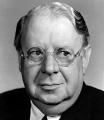 S.Z.
"Cuddles" Sakall (b. Budapest, 2/2/1884, d. Los
Angeles, 2/12/1955)
S.Z.
"Cuddles" Sakall (b. Budapest, 2/2/1884, d. Los
Angeles, 2/12/1955)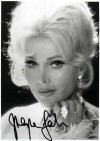 Zsa
Zsa Gábor - (b. 2/6/1918, Budapest)
Zsa
Zsa Gábor - (b. 2/6/1918, Budapest)  Less
known is that Zsa Zsa Gabor is the mother of actress
Less
known is that Zsa Zsa Gabor is the mother of actress  Eva
Gábor (b. 2/11/1920, Budapest, d. 7/4/1995)
Eva
Gábor (b. 2/11/1920, Budapest, d. 7/4/1995)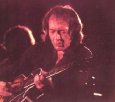 Gabor Szabo, (b.
in Budapest,1936 d: Budapest, 1982 )
Gabor Szabo, (b.
in Budapest,1936 d: Budapest, 1982 )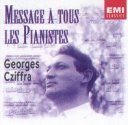 Georges (György) Cziffra (b. 11/05/1921,
Budapest, d. 01/15/1994 in Morsang-sur-Orge)
Georges (György) Cziffra (b. 11/05/1921,
Budapest, d. 01/15/1994 in Morsang-sur-Orge)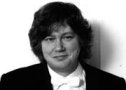 Zoltán Kocsis (b. 1952,
Budapest)
Zoltán Kocsis (b. 1952,
Budapest)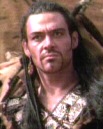 Marton’s performances on the stage include New Zealand’s productions
of "Arcadia," "Angels in America," "Julius
Caesar," "Glorius Ruins," "Amy’s View" and
"Closer." In Australia, Csokas has performed on the stage
in "A Clockwork Orange," "Twelfth Night," "The
Herbal Bed" and "Andromache" as well as an Australian
tour of "Ladies Night." Marton also co-founded the Stronghold
Theatre in Australasia, which has created such pieces as "Possibilities,"
"Meeting Place" and "Media Sluts," all of which
played to great acclaim. His talent for classical work was seen in
numerous productions of Shakespeare, Chekhov and Brecht, including
roles as Alstaff in The Merry Wives of Windsor, Brutus in Julius
Caesar and Orsino in Twelfth Night, as well as performing
in Three Sisters, The Cherry Orchard, and Happy End.
Marton’s performances on the stage include New Zealand’s productions
of "Arcadia," "Angels in America," "Julius
Caesar," "Glorius Ruins," "Amy’s View" and
"Closer." In Australia, Csokas has performed on the stage
in "A Clockwork Orange," "Twelfth Night," "The
Herbal Bed" and "Andromache" as well as an Australian
tour of "Ladies Night." Marton also co-founded the Stronghold
Theatre in Australasia, which has created such pieces as "Possibilities,"
"Meeting Place" and "Media Sluts," all of which
played to great acclaim. His talent for classical work was seen in
numerous productions of Shakespeare, Chekhov and Brecht, including
roles as Alstaff in The Merry Wives of Windsor, Brutus in Julius
Caesar and Orsino in Twelfth Night, as well as performing
in Three Sisters, The Cherry Orchard, and Happy End. Don became a commercial artist, but was not happy.
He began writing comedy material on the side and worked in small clubs.
"I'd always been able to do impressions and catch voices.
One day I tried to audition for the Arthur Godfrey's Talent
Scouts without an appointment. Don Married singer Adelaide
Adams and adopted her stage surname: "They asked me my name and
I said, 'Don Adams.' "They couldn't find it on the list, but I wrangled an audition,
anyway. A week later I was on the show and won the contest."
This led to appearances on other major television productions including
both Johnny Carson's and Steve Allen's Tonight shows, The
Perry Como Show, The Jimmy Dean Show, and The Bill Dana
Show. Of course he is best known for his starring role as
Maxwell Smart on the phenomenally successful TV show, Get Smart (NBC, 1965-69; CBS 1969-70) a James Bond spoof created by
Mel Brooks and Buck Henry. It was revived as Get Smart Again in 1989. Adams is best known to children of the 1980s as the voice
of cartoondom's bionic blockhead, Inspector Gadget, and as Tennessee
Tuxedo during the entire run of Underdog.
Don became a commercial artist, but was not happy.
He began writing comedy material on the side and worked in small clubs.
"I'd always been able to do impressions and catch voices.
One day I tried to audition for the Arthur Godfrey's Talent
Scouts without an appointment. Don Married singer Adelaide
Adams and adopted her stage surname: "They asked me my name and
I said, 'Don Adams.' "They couldn't find it on the list, but I wrangled an audition,
anyway. A week later I was on the show and won the contest."
This led to appearances on other major television productions including
both Johnny Carson's and Steve Allen's Tonight shows, The
Perry Como Show, The Jimmy Dean Show, and The Bill Dana
Show. Of course he is best known for his starring role as
Maxwell Smart on the phenomenally successful TV show, Get Smart (NBC, 1965-69; CBS 1969-70) a James Bond spoof created by
Mel Brooks and Buck Henry. It was revived as Get Smart Again in 1989. Adams is best known to children of the 1980s as the voice
of cartoondom's bionic blockhead, Inspector Gadget, and as Tennessee
Tuxedo during the entire run of Underdog. 
 Robert
Hegyes's (sometimes Bob or Bobby) father, ex-Marine and Hungarian
Stephen, and his Italian mother, Marie Cocozza, had three other children
besides Bob. Bob's father was a chief engineer estimator, and his
mother a housewife who got Robert interested in theatre. Bob was active
in high school dramatics. He majored in speech and theater at Glassboro
State College in New Jersey. When he received his B.A. degree, he
lost no time crossing the river from New Jersey to New York City to
have a go at professional acting. He got a job acting with the children's
theater company called "Theater in a Trunk." This was a
troupe of professional actors who performed plays in schools and playgrounds
all around New York City. Robert Hegyes landed a role in an off-
Robert
Hegyes's (sometimes Bob or Bobby) father, ex-Marine and Hungarian
Stephen, and his Italian mother, Marie Cocozza, had three other children
besides Bob. Bob's father was a chief engineer estimator, and his
mother a housewife who got Robert interested in theatre. Bob was active
in high school dramatics. He majored in speech and theater at Glassboro
State College in New Jersey. When he received his B.A. degree, he
lost no time crossing the river from New Jersey to New York City to
have a go at professional acting. He got a job acting with the children's
theater company called "Theater in a Trunk." This was a
troupe of professional actors who performed plays in schools and playgrounds
all around New York City. Robert Hegyes landed a role in an off- Dezo
Hoffman was born in
Dezo
Hoffman was born in  J.
Edward Bromberg, AKA Joe Bromberg
J.
Edward Bromberg, AKA Joe Bromberg  Bromberg
moved with his family to the US while still an infant. Bromberg was
certain from an early age that he would pursue an acting career, taking
several odd jobs (silk salesman, candy maker, laundry worker) to finance
his training. He studied with the Moscow Art Theatre, then made his
American stage bow at age 23 at the Greenwich Village Playhouse. He
worked extensively with the Theatre Guild, coming to Hollywood's attention
for his work in the 1934 Pulitzer Prize winning play Men in White.
With 1936's Under Two Flags, Bromberg began his long association with
20th Century-Fox, playing a vast array of foreign villains, blustering
buffoons and the occasional gentle philosopher. Short, dark, and stocky,
he played father figures, villains, and ethnic types and though he
wasn't cut out for romantic leads, he did star in 1937's Fair Warning
as a mild-mannered detective. The corpulent Bromberg conveyed a perpetual
air of ulcerated, middle-aged tension, allowing him to play characters
much older than himself. His other Hollywood films include "Jesse
James," "The Return of Frank James," "Phantom
of the Opera," "Cloak and Dagger," "Son of Dracula,"
and "Mark of Zorro." He gained critical acclaim on Broadway
in 1948 as a Louis Mayer-like movie mogul in Clifford Odets' The Big
Knife, but the euphoria would not last.
Bromberg
moved with his family to the US while still an infant. Bromberg was
certain from an early age that he would pursue an acting career, taking
several odd jobs (silk salesman, candy maker, laundry worker) to finance
his training. He studied with the Moscow Art Theatre, then made his
American stage bow at age 23 at the Greenwich Village Playhouse. He
worked extensively with the Theatre Guild, coming to Hollywood's attention
for his work in the 1934 Pulitzer Prize winning play Men in White.
With 1936's Under Two Flags, Bromberg began his long association with
20th Century-Fox, playing a vast array of foreign villains, blustering
buffoons and the occasional gentle philosopher. Short, dark, and stocky,
he played father figures, villains, and ethnic types and though he
wasn't cut out for romantic leads, he did star in 1937's Fair Warning
as a mild-mannered detective. The corpulent Bromberg conveyed a perpetual
air of ulcerated, middle-aged tension, allowing him to play characters
much older than himself. His other Hollywood films include "Jesse
James," "The Return of Frank James," "Phantom
of the Opera," "Cloak and Dagger," "Son of Dracula,"
and "Mark of Zorro." He gained critical acclaim on Broadway
in 1948 as a Louis Mayer-like movie mogul in Clifford Odets' The Big
Knife, but the euphoria would not last.  Though
some, like the "
Though
some, like the "


