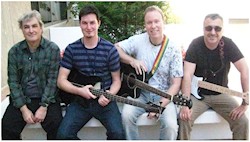
The Diplomats’ original members were all employees at the Embassy of Hungary. Today, the rock’n’roll and blues band’s members don’t all work at the Hungarian Embassy, but they do have diplomatic and/or Hungarian ties. (From left to right: drummer “Ringo Jancsi,” bassist Akos Veisz, singer Bryan Dawson, and guitarist David Rakviashvili)
10/5/2012 – “‘The Diplomats’ Pursue Rock-And-Roll Outreach.” NPR’s Metro Connection, hosted by Rebecca Sheir, featured the Hungarian Embassy’s rock band, “The Diplomats.” Rebecca and her popular NPR program that airs on WAMU has recently been exploring unique ways diplomacy works.
“The Diplomats” were originally formed exclusively with musicians from the Embassy of Hungary. It now also includes others, including Bryan Dawson, AHF’s Executive Chairman, who sings for the group. The Diplomats perform American and Hungarian rock songs. The radio personality came to interview the group during a rehearsal at the Hungarian Embassy in Washington, DC, as they were preparing for a concert at the 6th Annual Hungarian Festival in Sarasota, FL. In this segment, the band members shared their experiences with communism and the suppression of creative freedom.
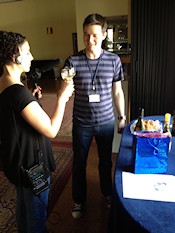

The peoples of the captive nations had to find unique ways to express their discontent while staying under the radar of communist authorities to avoid sometimes harsh punishment. One of the songs the Diplomats perform is by a Hungarian group formed in 1982 called Bikini. Akos Veisz, the band’s saxophonist and bass player explained, “The Hungarian title is “Adj helyet magad mellett,” which is, like, “Give Me a Place Right Next To You.” So they were trying to write songs, which had thesedouble meanings.So this one is about love, one meaning, the other is the love for freedom.” Akos is also a diplomat at the Hungarian Embassy in Washington. [Visit NPR and Listen to the Radio Program]
TRANSCRIPT (Courtesy of NPR / WAMU and Rebecca Sheir, producer and host of “Metro Connection.”)
‘The Diplomats’ Pursue Rock-And-Roll Outreach
MS. REBECCA SHEIR
00:00:09
Welcome back to “Metro Connection.” I’m Rebecca Sheir and today we’re talking Diplomacy. So far in the show we’ve covered international diplomacy, political diplomacy and in just a few minutes, we’ll engage in a bit of plant diplomacy. Yes, plant diplomacy. But first, we’ll meet some folks who are immersed in what I guess you could call musical diplomacy.
MS. REBECCA SHEIR
00:00:34
We’re in Northwest Washington at the Embassy of Hungary, where a four-member band is rehearsing for an upcoming gig.
MS. REBECCA SHEIR 00:00:51
The band is called The Diplomats and initially it consisted solely of Hungarian embassy staffers.
MR. AKOS VEISZ 00:00:56
But that’s the nature of diplomacy, it’s about change. People come and go and most of the band members left and are now back in Hungary.
SHEIR 00:01:08
Except for this guy.
VEISZ 00:01:09
I’m Akos Veisz and I’m a diplomat at the Hungarian Embassy dealing with political and economic issues.
SHEIR 00:01:16
Veisz started The Diplomats last year when the long-time saxophonist came to the U.S. and realized so many of his new colleagues dabbled in music too.
VEISZ 00:01:24
We had a drum, we had a guitar player, we had a piano player, we had singers, but no bass player so I’ve decided to learn the bass.
SHEIR 00:01:34
Nowadays, not all members of The Diplomats work in the Hungarian Embassy, but they do have diplomatic and/or Hungarian ties. First up, on vocals Bryan Dawson.
MR. BRYAN DAWSON 00:01:43
I’m executive chairman of the American-Hungarian Federation.
SHEIR 00:01:46
And on guitar, David Rakviashvili.
MR. DAVID RAKVIASHVILI 00:01:52
My name is very complicated to pronounce, a family name, Rakviashvili. I’m diplomat the Embassy of Georgia.
SHEIR 00:02:00
And on drums, The Diplomats newest member…
MR. RINGO JANCSI 00:02:02
Ringo Ashkosh (sp?)
SHEIR 00:02:05
Did we just make this name?
JANCSI 00:02:07
Given name, given diplomatic name. It’s a rock name.
DAWSON 00:02:12
Ringo Jancsi.
JANCSI 00:02:13
Try again, all right. Ringo Jancsi.
SHEIR 00:02:18
Ringo Jancsi (Reengo Yunchie), as he requested we call him, as only been with The Diplomats a couple of weeks. The Diplomats just lost a drummer, at the Hungarian embassy and with less than a month before their first gig outside Washington, a Hungarian Festival in Sarasota, Fla., Veisz says they scrambled to find a replacement.
VEISZ 00:02:35
We had Craig’s List, we had the same emails that we have sent when we found our singers and that’s how we found Ringo Jancsi, his Hungarian name.
SHEIR 00:02:49
Okay, so Ringo Jancsi may not have actual Hungarian roots, but he says he loves rehearsing here at the embassy.
JANCSI 00:02:56
Even, like, the ambassador came by. I mean, the ambassador’s working and we’re bashing away, playing rock and roll covers.
VEISZ 00:03:02
We have a cool ambassador, Ambassador Gyorgy Szapáry. He’s going to be there in Sarasota, Fla. with us.
SHEIR 00:03:09
So like a roadie.
DAWSON 00:03:10
Yes, the manager. Let’s give him — we’ll give him a little.
SHEIR 00:03:14
The Diplomats perform American and Hungarian songs like this one by Bikini, a Hungarian band which formed in 1982 when the Communist regime was suppressing freedom of speech.
VEISZ 00:03:25
The Hungarian title is “Adj helyet magad mellett,” which is, like, “Give Me a Place Right Next To You.” So they were trying to write songs, which had these double meanings. So this one is about love, one meaning, the other is the love for freedom.
SHEIR 00:03:51
Singer Bryan Dawson says he’s spent years trying to reconnect with his Hungarian roots and so this music means a lot to him.
DAWSON 00:03:59
My mother was very affected by all that happened. The multiple wars, the revolution, she was kicked out of school because of her family name. And so she largely wanted to forget when she came here and never really instilled anything in me. But my grandparents, whom I spent a lot of time with, from that, the love of my heritage really grew and I really tried to do what I can to give back what this country gave to me and my family.
SHEIR 00:04:23
That’s why he joined up with the American Hungarian Federation, an interest group representing the Hungarian-American community. It’s also why he joined The Diplomats.
DAWSON 00:04:32
A lot of folks have seen movies about the importance of music to the folks stuck behind the Iron Curtain. David talks about how he was not allowed to listen to rock and roll and so he would practice in secret. When I was in Hungary in ’89, I was amazed by all the little clubs that were popping up, the little jazz clubs and salsa clubs and young people coming in just hitting the piano. And so it’s an amazing experience to sit here in freedom and play rock and roll.
SHEIR 00:04:58
Not that The Diplomats just play rock and roll. They do blues too, including a tune inspired by Bryan Dawson’s father. It’s called “Baby Blues.”
SHEIR 00:05:31
The band hasn’t recorded an album, though it hopes to eventually. It also hopes to expand its Washington venues beyond the embassy.
SHEIR 00:05:38
So you do think maybe you’ll like play gigs around town?
DAWSON 00:05:41
We’re looking for a manager. Rebecca? 10 percent in for you, just for you.
SHEIR 00:05:47
Yes?
VEISZ 00:05:49
We are looking for an audience, guys, out there.
SHEIR 00:05:52
Yes, there is that.
SHEIR 00:05:54
And part of the reason they want an audience so badly, says Akos Veisz, is to lift that shroud of mystery that’s surrounded diplomacy through the years.
VEISZ 00:06:02
There is a part which has that secrecy and intimacy. But on the other hand, you have something else as well, which is the people-to-people diplomacy or public diplomacy. To understand the civilization of two countries, you know, to have a better understanding at the end of the day. And part of this effort is the rock and roll, what we are having here with The Diplomats.
SHEIR 00:06:27
Because ideally, Veisz says, this public diplomacy will bring the world together so it can sing as the old tune, “in perfect harmony.” The Diplomats will be performing in Sarasota, Fla. at the 6th Annual Hungarian Festival this weekend.
Related
Selected Articles on Democracy Issues
8/21/2012 – AHF sends letter to Romanian Ambassador and Chairmen of the US Helsinki Commission regarding the Szekely-Miko Case: AHF is “deeply concerned that the prosecution of former state secretary Attila Marko, Silviu Vlim and Tamas Marosan in connection with the restitution to the Reformed Diocese of Transylvania of the Szekely Miko Evangelical Reformed College (“MEC”) in Sfantu-Gheorghe, Romania was not justified. It only serves to further stall, and in this instance reverse, the lawful restitution of church properties and discriminate against Romania’s Hungarian minority… [read more]

7/17/2012 – AHF releases statement, “Romania: Reversing Lawful Church Property Restitution,
Through Criminal Prosecution.” AHF is deeply concerned that the prosecution of former state secretary Attila Marko, Silviu Vlim and Tamas Marosan in connection with the restitution to the Reformed Diocese of Transylvania of the Szekely Miko Evangelical Reformed College (“MEC”) is a baseless and blatant attempt by the authorities to further stall and reverse the lawful restitution of church properties seized by the communists.
[read more]

1/24/2012 – AHF reacts to what it sees as politically motivated, unfair, unmerited, biased criticism of Hungary. “While democratic institution building should be encouraged and debated, it should be done based on facts, and in a fair, unbiased and evenhanded manner [it must be] bereft of partisanship (or even the appearance of partisanship) and undertaken solely in furtherance of promoting Western values, not political expediency.”
[read more]
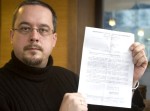
12/02/2011 – Slovakia strips citizenship to ethnic Hungarian minorties who assert their right to dual citizenship in violation of their own Constitution. AHF submits a statement to the US Congress Helsinki Commission: “Intolerance and discrimination targeting any group based on ethnicity, nationality or religion is not acceptable… The most recent anti-Hungarian incident involves Slovakia stripping Oliver Boldoghy of his Slovak citizenship after becoming a dual citizen. This decision is not only contrary to American and European practices, it violates the Slovak constitution, which provides that “no one must be deprived of the citizenship of the Slovak Republic against his will.” [read more]

9/29/2011 – Federation again raises minority rights. In a letter to Knut Vollebaek, OSCE High Commissioner on National Minorities, the Federation again raises anti-Hungarian measures in Slovakia and Serbia and requests the High Commissioner’s clarification of reports in the electronic media asserting that he had labeled Hungary’s support for Slovakia’s Hungarian minority “malicious and foolish.”
[read more]
4/27/2010 – AHF remains concerned that authorities continue to raise barriers to divide residents of Szelmenc, the Village Cut in Two “A kettévágott falu.” In 2004, AHF, working closely with member the Center for Hungarian American Congressional Relations (CHACR), worked to publicize the fate of villagers of Szelmenc, the “Village Cut in Two” / “A Kettévágott Falu.” But the very same Schengen guidelines used to open the border seem to have raised new barriers. [read more]

3/25/2011 – The Hungarian American Coalition and the Common Sense Society co-sponsored a seminar entitled, “Hungary’s New Constitution: Prospects for the Rule of Law & Liberty in New Europe.” The Federation urges cooperation among Hungarian American organizations to facilitate an educated debate of the provisions of Hungary’s draft constitution and the context of the proposed changes. AHF feels we must make every effort to correct the record and educate the public on the long history of Hungarian democracy. [read more]
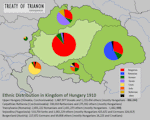

3/20/2011 – AHF Supports Voting Rights for all Hungarian Citizens… In a Heti Válasz article, AHF President Frank Koszorus, who, later this week, will be representing AHF at the Hungarian Permanent (Standing) Conference Diaspora Subcommittee (MÁERT) in Budapest, expressed AHF’s support for a citizen’s right to vote regardless of geographic location. “Enabling Hungarian citizens to vote [is a] democratic means of uniting a divided nation without endangering anyone and a practice that is consistent with the practices of other states in Central and Eastern Europe and elsewhere. [read more]

01/04/11 – Hungarian Media Law: In view of all the critical media play, moderate weekly Heti Válasz broadens discussion on Hungarian media law by adding another perspective. The Hungarian National Media and Infocommunications Authority releases English version of Media Law. It is available for download. [read more].
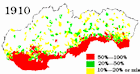
3/22/2010 – AHF President discusses Slovak Language Law with OSCE High Commissioner on National Minorities, Knut Vollebaek and submits follow up letter: “…[Slovakia’s] actions include the gerrymandering of the administrative division of Slovakia so that Hungarians are in the minority; adopting a resolution proposed by extremist Jan Slota ratifying and confirming the Benes decrees; and refusing to rehabilitate Janos Esterhazy, who as leader of the Hungarian Party in Tiso’s Fascist Slovakia was the only Member of Parliament to vote against the deportation of Jews in 1942, yet who died in a Czechoslovak prison after the war.” [read more]
2/16/2009 — AHF urges OSCE High Commissioner on National Minorities to increase pressure on Slovakia to repeal oppressive language law. “The language law is the latest manifestation of the Slovak government’s intolerance toward its Hungarian minority. Not surprisingly, the Slovak National Party (“SNS”) is a member of the ruling coalition. Its chairman Jan Slota is known for his xenophobia: “Hungarians are the cancer of the Slovak nation, without delay we need to remove them from the body of the nation.” [read more]

2/3/2009 — AHF urges Secretary of State Hillary Clinton to “publicly and unambiguously express [her] concern relative to the Slovak language law. By curtailing or eliminating the use of minority languages from the public sphere, that discriminatory law threatens the Hungarian minority’s culture and infringes on fundamental freedoms.” [read more]

11/23/08 – AHF Submits Letter Regarding Intolerance in Slovakia — On November 21, 2008, the American Hungarian Federation submitted a letter to Slovak Foreign Minister Jan Kubis who was visiting Washington, D.C. The Federation’s letter raised concern over the intolerant and discriminatory policies and practices aimed at Slovakia’s Hungarian minority. [read more]
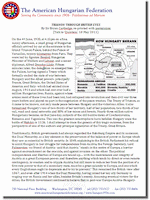
6/4/2011 – On the 91st Anniversary of the Treaty of Trianon, AHF remembers the ill-advised treaty and publishes essay by Sir Bryan Cartledge who calls the treaty “the greatest catastrophe to have befallen Hungary since the battle of Mohacs in 1526.” Over the course of its more than 100-year history, the American Hungarian Federation has commemorated the Treaty of Trianon, highlighting the gross injustices wrought by that treaty (better described as a diktat) and the entire Versailles so-called peacemaking. Trianon continues to plaque the region. [read more]
[Click] to see the video

12/18/2006 – The American Hungarian Federation Condemns Latest Minority Rights Violations By Romania: Sanctions Against Hungarian Professors At Babes-Bolyai University For Promoting Bilingualism. “Although Romania joined NATO and will be accepted into the EU, the irrefutable record demonstrates that its laws and practices fail to conform to European and Western standards relating to human and minority rights. A few examples of Romania’s less than exemplary record will suffice…” [read more][tovább magyarul]
Links on NATO
Links on Louis Kossuth, the
“Father of Hungarian Democracy”
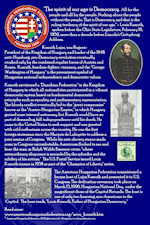
AHF and Kossuth in the US Capitol [read more]
[ < Go to AHF 1848 Hungarian War of Liberation Commemorations]
- Downloads AHF Speeches and Articles
- AHF 2012 Commemoration
- AHF 2011 Commemoration
- AHF 2010 Commemoration
- AHF 2009 Commemoration
- AHF 2007 Commemoration
- AHF 2006 Commemoration
- AHF 2004 Commemoration
- 2002 Louisiana
- 2001 Minnesota Hungarians
- 1961 Bela Bacskai
- Famous Kossuth Quotations
- About Louis Kossuth
 Hear Louis Kossuth Speak! Audio Recording and text of 1890 Louis Kossuth
speech
- Audio and text of the Kossuth Anthem, “Kossuth Lajos azt Uzente”
- Links
Today, there are many reminders of Kossuth’s impact on America and the world. In North America, there is a Kossuth County in the state of Iowa, a town with his name in Indiana, Ohio and Mississippi, a settlement with a Kossuth Post Office is in Pennsylvania. In addition, there are Kossuth statues and plaques in New York, Cleveland, Akron, New Orleans, Washington, and Ontario, Canada. The Hungarian Reformed Federation‘s building on Dupont Circle, in Washington, DC is called Kossuth House with a memorial plaque commemorating his speech on democracy. See the picture gallery and memorials on Louis Kossuth in North America.