| INVITATION / MEGHIVÓ
You are hereby cordially invited to a commemoration ceremony of Ferenc
Nagy, a peasant, journalist, civil rights leader, and former prime minister
of Hungary. The event is sponsored by the American Hungarian Federation,
the Hungarian Reformed Federation of America (Branch 300) and the Nagy
Ferenc Foundation.
Where: Chestnut Grove Cemetery, 831 Dranesville, Rd., Herndon, VA
When: Noon, October 8, 2007
Program:
- Welcome by Sandor A. Nagy, president of Nagy Ferenc Foundation, HRFA
Branch 300
- Presentation of the flags by the Arlington ROTC Honor Guard, led
by Lt. Col. Randy Royce
- Remarks by Stephen DeBenedittis, Mayor of Herndon, VA
- Remarks by H.E. Ferenc Somogyi, Ambassador of Hungary
- Remarks by Frank Kapitan, Branch Manager, HRFA
- Remarks by Frank Koszorus, Jr. of American Hungarian Federation
- Laying of the wreaths, end of ceremony.
[back to all AHF news]
 Sign
up for the AHF mailing list. Sign
up for the AHF mailing list.
Your information is not shared!
Contribute or
join online!
[<< back to all AHF news]
|
About
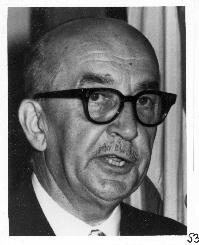
Prime Minister Ferenc Nagy
(b. Bisse, October 8, 1903, d. Herndon, June 12, 1979)
 A
member of a Protestant peasant family and a farmer by profession, Nagy
began his public career as a local agrarian politician in the Baranya
province of Hungary. Ferenc Nagy fought to establish a parliamentary democracy
in the Kingdom of Hungary, and improve the living conditions of the Hungarian
peasantry. A
member of a Protestant peasant family and a farmer by profession, Nagy
began his public career as a local agrarian politician in the Baranya
province of Hungary. Ferenc Nagy fought to establish a parliamentary democracy
in the Kingdom of Hungary, and improve the living conditions of the Hungarian
peasantry.
He served in Parliament from 1939 to 1942, and
was jailed by the German Gestapo in 1944. After the war, his party won
a landslide victory in the first free and
democratic elections with 57% of the vote. Ferenc Nagy served as Prime
Minister of Hungary from 1946 to 1947.
As Prime Minister, he resisted attempts by the
Hungarian communist party to gain complete control of the government.
He refused attempts by the communists to become a puppet of a Soviet Union,
and to turn the Hungarian democracy into a police state. He resigned under
duress when the intelligence services kidnapped his five-year old son.
He was not allowed to return to Hungary, he was stripped of his Hungarian
citizenship, and he found refuge in the United States. He spent the rest
of his life in Herndon, VA, where he purchased a farm from the proceeds
of his best seller memoirs, "The
Struggle Behind the Iron Curtain." In 1961-62 he served as Chairman
of the Assembly of Captive European Nations. He died in Herndon, VA on
June 12, 1979.
|